www.highered.nysed.gov/bpss

Introduction

- Director's Note
- The New York Botanical Garden
- The School of Professional Horticulture
- The Goal
- Program Overview

Director's Note

Professional horticulture is about utilizing science and art to beautify our surroundings so that others may enjoy and live a better life. The work itself allows us to nurture, create, build, and sculpt—everything that an artist does in his studio. The work also asks us to measure, research, and diagnose—everything that a scientist does in his/her fieldwork. The end result can be as spectacular as The New York Botanical Garden grounds or as subtle as a single well-grown orchid.

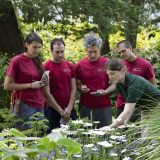
At The School of Professional Horticulture, one of only two horticulture schools in the country, art and science form the very core of the program. The classes are kept small to ensure that each student receives the appropriate amount of attention from staff and that teamwork is fostered. Students from diverse backgrounds come together to study, create, and refine their skills and knowledge. Within these two years, students will come to know the cultural needs of more than 1,000 plants and some of the common pests and diseases that accompany them. They install a show garden, attend numerous field trips, and lectures, and work with people of exceptional talent. Upon graduation, they leave knowing that they are horticulturists of the highest caliber who will move on to leadership positions in public, private, and other horticultural venues.

Charles M. Yurgalevitch, Ph.D., Director
The School of Professional Horticulture
For more information, call 718.817.8797

The New York Botanical Garden

In 1891, an eminent Columbia University botanist, Nathaniel Lord Britton, and his wife, Elizabeth, also a botanist, inspired by their visit to the Royal Botanic Gardens, Kew, determined that New York should possess a great botanical garden. The site was selected in the northern section of the Bronx, part of which had belonged to the estate of Pierre Lorillard, a leading tobacco merchant. The land was set aside by the State Legislature for the creation of “a public botanic garden of the highest class” for the City of New York. Prominent civic leaders and financiers, including Andrew Carnegie, Cornelius Vanderbilt, and J. Pierpont Morgan, agreed to match the City’s commitment to finance the buildings and improvements—initiating a public/private partnership that continues today.

The 250-acre grounds of The New York Botanical Garden include dramatic rock outcroppings, wetlands, ponds, a cascading waterfall, and a 50-acre tract of original forest that once covered New York City. Among the horticultural attractions are 48 gardens and plant collections including the newly renovated Benenson Ornamental Conifer Collection, the Peggy Rockefeller Rose Garden, the Rock Garden, the Enid A. Haupt Conservatory, and the Jane Watson Irwin Perennial Garden, as well as outstanding collections of daylilies, orchids, hardy ferns, flowering trees, and conifers.

The School of Professional Horticulture

Begun in 1919 as a horticulture vocational training program for returning war veterans at The New York Botanical Garden, the School was expanded into a professional gardener-training program in 1932 by distinguished horticulturist Thomas H. Everett. An alumnus Royal Botanic Gardens, Kew, Everett modeled the horticulture school after the programs at British botanical gardens such as Kew and Edinburgh, which combined practical and academic work in horticulture.

The School has trained hundreds of skilled horticulturists, a majority of whom go on to work in key positions in the horticulture field in the capacity of estate managers, nursery and landscape business owners and managers, greenhouse growers, garden authors and photographers, designers, and gardeners. Alumni remain an integral part of the School and students have numerous opportunities
to network with them.

The Goal

The School trains motivated individuals to become horticulturists of the highest caliber who will take on leadership positions in public, private, and other horticulture venues. The School combines academic studies with hands-on practical training in a two-year, full-time program. Students learn the science of horticulture in the classroom and practice what they learn on the Garden grounds. After successfully completing the program, students receive The New York Botanical Garden’s Diploma in Horticulture.


The School of Professional Horticulture is a key component of the Education Division at The New York Botanical Garden. Since its founding more than a century ago, education at the Garden has maintained a strong commitment to public education, offering a full spectrum of education programs focused onthe science, function, and beauty of plants, and the relationship between plants and people.

Program Overview

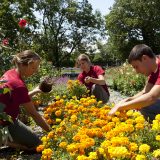
Classes, work rotation, group projects, plant walks, fieldtrips, and lectures expose the student to a myriad of concepts, practices, and philosophies. The two-year program is designed to best develop the student’s mastery of this field. The program begins in February. Students tackle core courses in botany, math, and soil sciences. As the growing season approaches, the program shifts from the classroom to horticulture work rotations (page 11). Students participate in installing shows at the Enid A. Haupt Conservatory, growing display crops in the new Nolen Greenhouses, scouting pests in the different plant collections, and planting displays in the Everett Children’s Adventure Garden. At the same time, students will tackle the planting of the Student Garden, and participate in weekly plant walks and monthly fieldtrips to horticulture destinations.

As fall approaches, students return to the classroom to commence studies in landscape design and plant propagation. The work rotation segment is reduced and concentrated in indoor venues such as Plant Records and Greenhouse production. In addition to the coursework, the students design next year’s Student Garden, and explore their second-year internship options.

back to the top