|
|
|
|
|
|
|
|
|
|
|
|
|
|
Habitats Palustrine System Open Mineral Soil Wetlands-- Deep emergent marsh
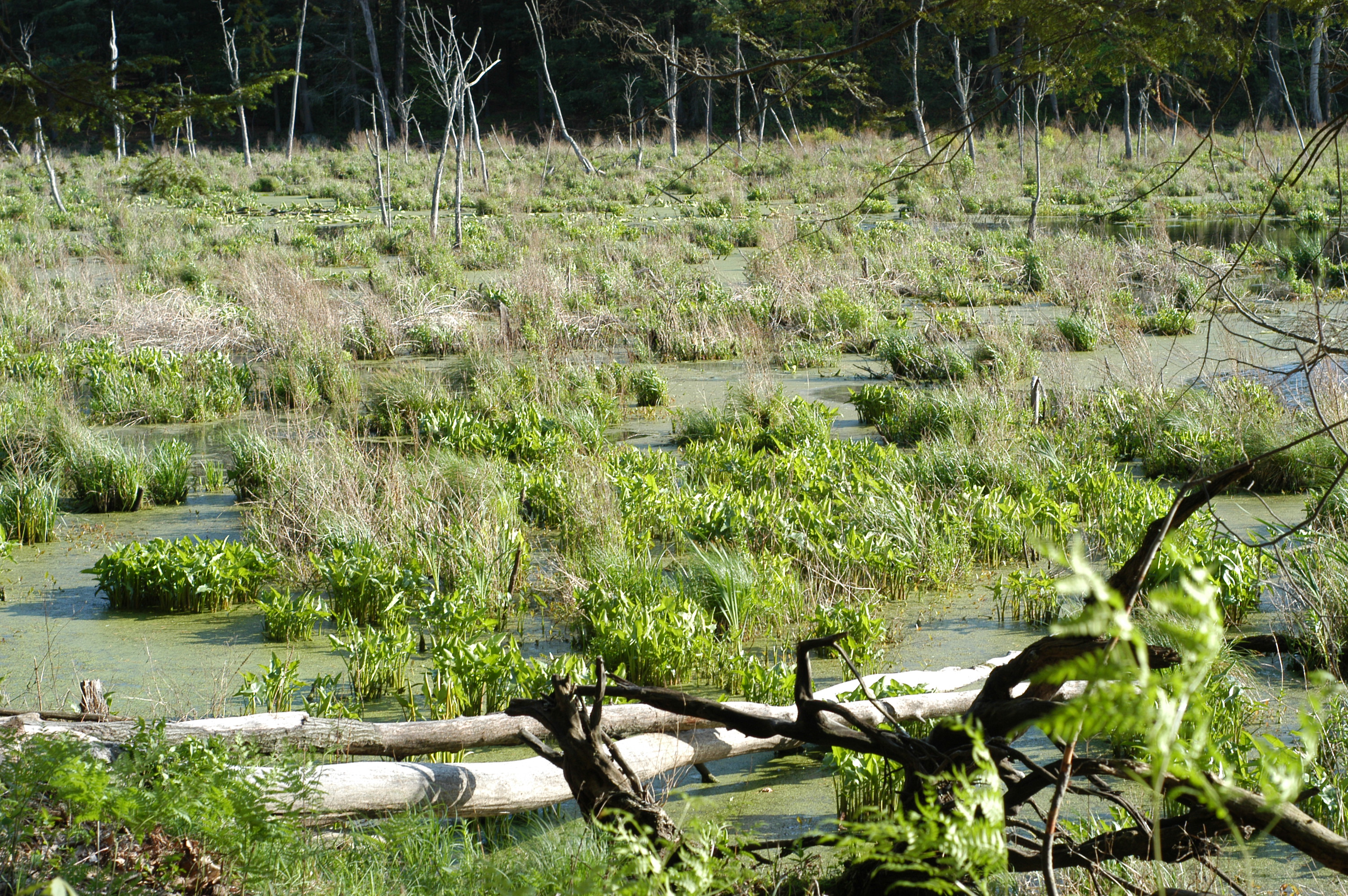
Substrate and Hydrology: The substrate is composed of deep, well-decomposed muck and mineral soil. The water depth is about 1 meter throughout the year with minimal wave action. It receives perennial water recharge from a stream running east to west under Putnam County Road 62 (Farm to Market Road) and eventually drains into the Ice Pond through a two-meter pipe under the eastern branch of the Metro North Railroad tracks. Biota: This marsh has no woody vegetation (except dead Acer rubrum L., and Fraxinus pennsylvanica Marshall var. pennsylvanica stems) and is dominated by herbaceous plants including: Pontederia cordata L., Persicaria robustior (Small) E. P. Bicknell, Typha latifolia L., Lythrum salicaria L., Rumex altissimus Alph.Wood. Several non-aquatic herbs grow on tussocks formed around dead trees. Cultural: Stone walls border most edges of the marsh, following the current high-water line, but do not cross through the marsh, suggesting that this area was segregated from the adjacent uplands and perhaps was not drained. According to one local resident, beavers occasionally block the outflow pipe causing the water level to rise significantly until adjacent homeowners and Railroad personnel clear the pipe and evict the beavers (Anthony Russo, pers. comm). |
Copyright © The New York Botanical Garden