
Rubiaceae of the New World
By Piero Delprete and
Rocio Cortés
CATESBAEA Linnaeus
Rubiaceae of the New World
By Piero Delprete and
Rocio Cortés
CATESBAEA Linnaeus
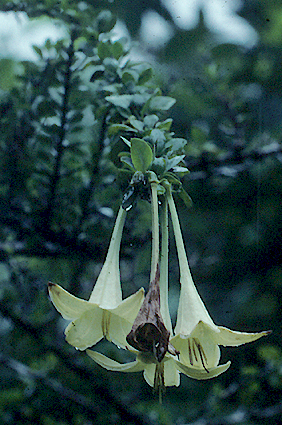
Catesbaea spinosa Photo P. Delprete Fairchild Gardens, Miami, Florida, USA |
Synonyms: Catesbya Cothenius (orth. var.); Echinodendron A. Richard in Sagra.
Subshrubs, erect or scandent shrubs or small trees; raphides absent; axillary thorns straight, needle-shaped, straight, stout modified lateral branches, with vestigial nodes, sometimes with reduced leaves. Stipules interpetiolar, free at base or interpetiolar, connate at base or sheathing (not plitting on one side), low ridge or narrowly triangular, subcaducous. Leaves opposite, short-petiolate, subsessil or sessil; blades extremely reduced, scale-like, often absent, narrowly ovate, narrowly elliptic, elliptic, obovate, oblong, oblanceolate or lanceolate; chartaceous, stiffly chartaceous, papyraceous or thinly coriaceous; foliar pellucid glands absent; domatia absent. Inflorescence axillary, sometimes present on the axillary thorns, cymose, pauciflorous or uniflorous. Flowers bisexual, protandrous. Calyx tube absent, lobes connate at base, or tube extremely reduced, with large lobes, persistent or caducous; lobes 4 or 5, narrowly triangular, lanceolate, basally triangular and distally linear, or linear thorughout, minute, small or long. Calycophylls absent. Corolla campanulate or broadly infundibuliform, actinomorphic, white to cream-white, yellow to yellowish-white; tube externally glabrous, internally glabrous or puberulent, without a pubescent ring inside; orifice annular thickening absent; lobes 4 or 5, imbricate (tube reduplicate), broadly triangular, ovate or broadly ovate, margin entire, rounded at apex. Stamens alternate to the corolla lobes, partially exserted (only tips exserted); anthers elongate or linear, round at base, round at apex, dehiscing by longitudinal slits, basifixed; filaments attached at base of the corolla tube, free at base, slender, long, shorter than corolla tube, equal, glabrous or puberulent at basal portion (glabrous above). Pollen colpate, apertures 3, exine surface echinate-perforate, released as monads. Style exserted just beyond the corolla, terete throughout, not fleshy, glabrous; lobes absent, stigmatic surface linear along style. Ovary inferior, 2-locular, obconical, ovoid or obovoid; placentation axile, placenta peltate to the entire lenght of the septum, ovules few to many per locule. Fruit a berry, leathery. Seeds horizontal, medium-sized or large, dorsoventrally compressed or ovate to obovate in outline; wings absent.
Geographic distribution: West Indies and extra-tropical North America. Sometimes cultivated in the Caribbean islands for its ornamental value; Catebaea spinosa is sometimes cultivated in the Caribbean islands for its edible fruits.
Number of species: 16.
References: A. H. Liogier, Catesbaea. Fl. Cuba 5: 68–70.
1963; A. H. Liogier, Catesbaea. Fl. Espanola 7: 225–230. 1995.