Inside The New York Botanical Garden
Doug Daly
Posted in Garden News on November 2 2018, by Plant Talk
Stephan Chenault is The New York Botanical Garden’s Director of Science Development.
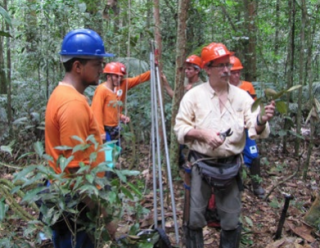 Douglas Daly, Ph.D., B. A. Krukoff Curator of Amazonian Botany and Director of the Institute of Systematic Botany at NYBG, has spent several years working in collaboration with the Brazilian Forest Service to conduct extensive training and certification programs in the Amazon for traditional forestry personnel, called mateiros, forest-born but town-educated. His efforts have promoted conservation of Amazonian rain forests by ensuring far more accurate representation of tree diversity in forest inventories, and by assisting timber operations certified for sustainability. More than 100 mateiros who work in national forest concessions, universities, nongovernmental organizations, and Brazilian government environmental agencies have been trained thus far.
Recently Dr. Daly was awarded a generous grant of $200,000 over two years from the Tinker Foundation for a new but related project, Equipping Community Participation in Management and Monitoring of Amazon Forests. This initiative will build on past capacity-building accomplishments of the NYBG project team, by taking a novel approach of training community members in tree identification, forest inventory, and monitoring in protected areas. The project is a collaboration of NYBG with the Chico Mendes Biodiversity Institute (ICMBio), the Rio de Janeiro Botanical Garden, and the Forest Products Laboratory of the Brazilian Forest Service. These efforts aim to conserve Amazonian biodiversity and establish community members as stakeholders in protected forest areas by ensuring that local communities benefit from this initiative in terms of both livelihoods and the local economy.
This article originally appeared as part of a series on responsible citizenry in the 2018–2019 issue of Garden News, NYBG’s seasonal newsletter. For further reading, view the issue online and discover a sampling of stories about our current efforts and activities that promote, engage, and support active and responsible citizenry on local, regional, and global levels.
Posted in Science on May 18 2010, by Plant Talk
Garden Scientists Explore Biodiversity in Australia, Brazil, and Colombia
As environmental pressures increasingly put biodiversity at risk, one of the Garden’s most important goals is to lead in the effort to document every plant and fungal species on Earth. Garden scientists conduct research around the globe. Here are three recent reports from the field.
Roy Halling Returns to Fraser Island, Australia
In late March, Roy Halling, Ph.D., a specialist in mushrooms, continued his survey of macrofungi on Fraser Island, the largest of the world’s sand islands and a World Heritage Site off the east coast of Queensland, Australia. There he  and Nigel Fechner, a Senior Botanist at the Queensland Herbarium in Brisbane, found an undescribed genus of “false-truffle,” previously known only from Cape York, the northernmost part of Queensland. They discovered the fungus (pictured), about the size of a golf ball, protruding from a sand bank near Lake McKenzie. Scratching with a truffle rake in the sand and litter under a gum tree (Eucalyptus signata), they unearthed more of the bright red fungus. Like the truffle of commerce, this fungus has a strong penetrating odor, one of the key factors in attracting marsupials, which eat the fungus and disperse the spores in their scat.
The real gems for Halling on this trip were finding an exquisite species of Strobilomyces and a first report from Australia of a Heimioporus japonicus. This is the second known instance of a species in that genus in Australia.
Wayt Thomas Joins Partners in Brazil
Wayt Thomas, Ph.D., studies tropical American forests, especially the Atlantic forests of Brazil, one of the world’s biodiversity “hotspots.” He spent February in Brazil, working with colleagues from the Federal University of Paraiba and four other Brazilian universities studying the plants found in one of the most critically endangered rain forests in the world.
Two of the reserves Thomas visited on this trip protect submontane forests—moist forests at elevations of 1,300–2,600 feet. These two reserves are home to some of the world’s rarest birds, including the Alagoas Antwren, the Alagoas Foliage-gleaner, the Alagoas Tyrannulet, and the Orange-bellied Antwren. By comparing submontane forests with similar avifauna, he hopes to predict the occurrence of these rare birds in other areas.
Douglas Daly Travels to Colombia
Douglas Daly, Ph.D., returned to Colombia in January for the first time in 20 years to pursue his studies of the tropical tree family Burseraceae. He consulted eight herbaria in three cities and identified and annotated some 4,000 Burseraceae specimens in order to complete his treatment of the family for Colombia’s national flora checklist. Daly was able to secure permission to work in two localities on the western side of the Andes where small areas of primary forest remain. Although Colombia was in the grip of a severe drought, he collected more than 16 distinct species of Burseraceae, two of which he had never seen before, a tribute to the dizzying plant diversity of Colombia.