Jonathan W. Toll is a Project Manager for The William and Lynda Steere Herbarium. He is currently involved with the Great Lakes Invasives project, a multi-institutional effort that focuses on digitizing non-indigenous and related species of vascular plants, green algae, fish, and mollusks in the Great Lakes Basin.
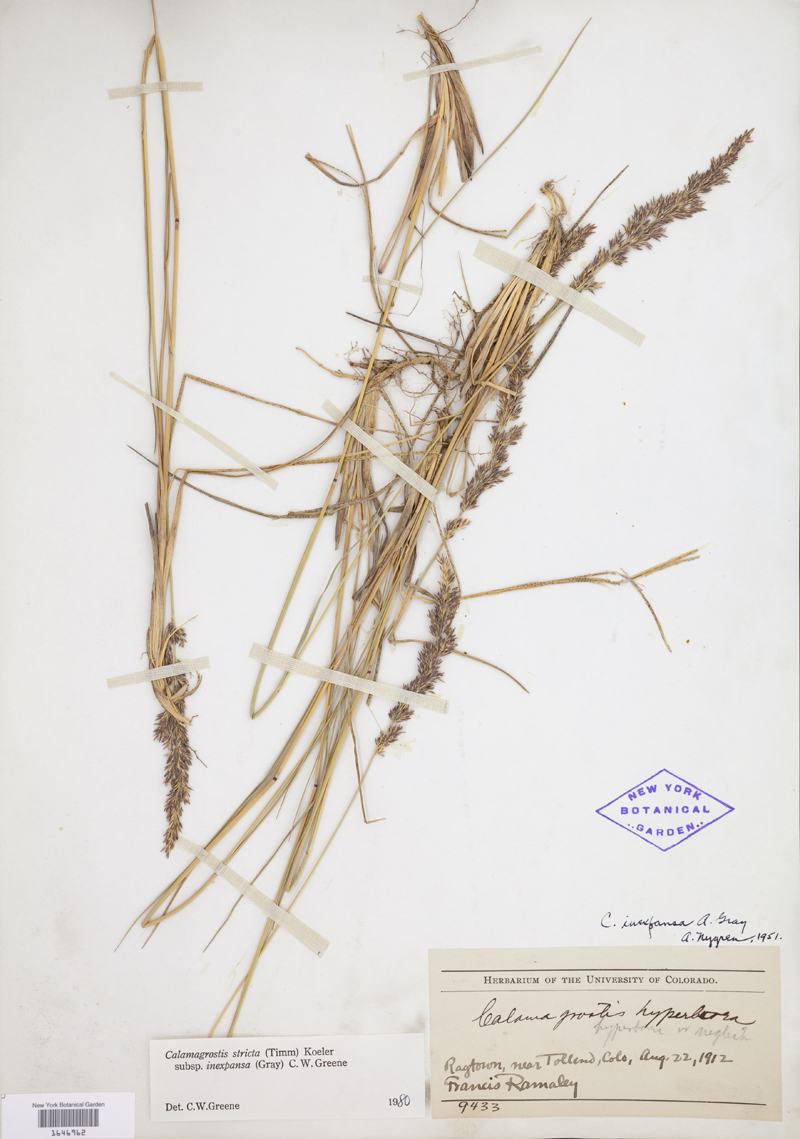
Calmagrostis neglecta specimen collected in 1912
While cataloguing herbarium specimens for a large, multi-institutional project last year, I came across a particular specimen, Calmagrostis neglecta, that caught my eye. This species is a perennial grass that ranges throughout the northern United States; it is usually found in wetlands but can also occur in non-wetland areas. What stood out for me was a phrase on the specimen label: “Ragtown, near Tolland, Colo. Aug. 22, 1912. Francis Ramaley.”
I briefly visited Tolland in 2009, and when I came across the specimen, I was planning on going there again. My dad had been there countless weekends, so I emailed him to tell him about the specimen label. He replied with another fascinating nugget of information. “I wonder if Margaret Ramaley is somehow related to Francis Ramaley,” he wrote. “She is still in Tolland last time I heard”. With that as background, I flew into Denver’s airport at the end of last July and drove into the Rockies.
A curious specimen surfaces in the Herbarium’s archives
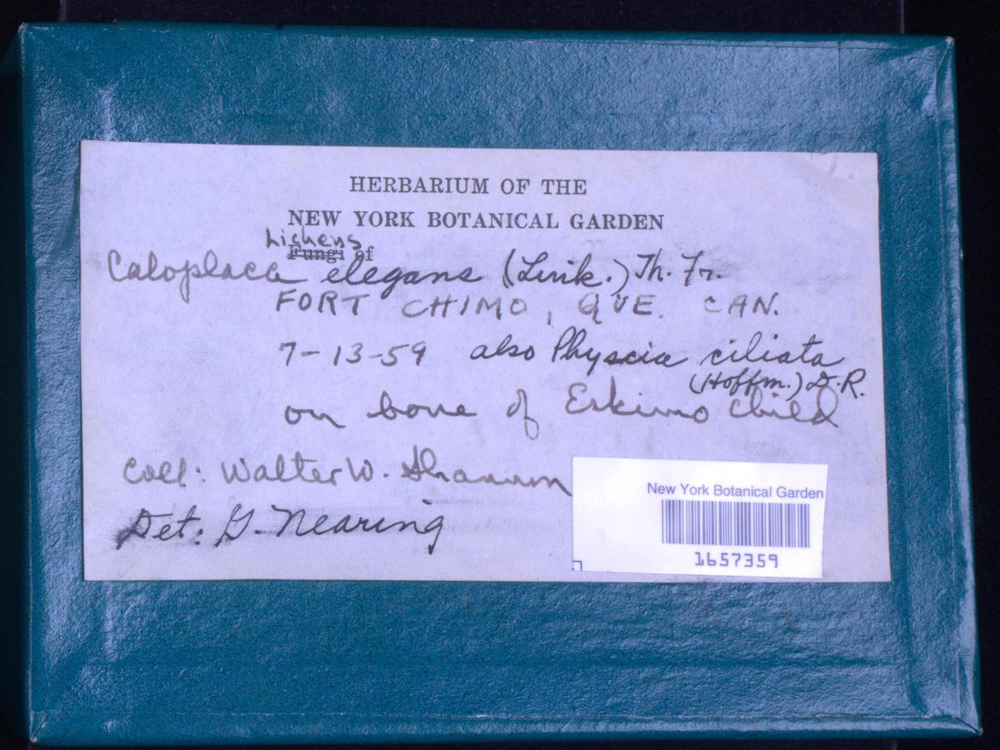
While making high-resolution digital images of lichen-covered rocks that are part of the collection in the William and Lynda Steere Herbarium, I came across a specimen not long ago with an unusual and rather alarming label. Plainly written as part of the collection data on this otherwise inconspicuous box was the statement that the specimen was “on bone of Eskimo child.” I opened the box to find, indeed, a bone of some kind with bright orange and yellow lichen growing on it.
I happen to have studied anthropology in college. One of the most important things you learn in a modern anthropology class is that many of the interactions between researchers and indigenous peoples during the long history of the discipline were downright exploitative and unethical by today’s standards. For example, archaeologists and anthropologists have had an unfortunate history of taking artifacts and even human remains from groups of people without consent from the members of that community—and sometimes even when they were explicitly asked not to. Today, many indigenous peoples are working to repatriate these artifacts and human remains back to their original communities. This possible human bone in the Steere Herbarium immediately concerned me, and I wondered whether the NYBG should attempt to return it to the people it came from. Dr. Barbara Thiers, the Garden’s Vice President for Science Adminstration, agreed that we should look into it, and we began to investigate the history of the specimen.
Amy Weiss is a curatorial assistant in The New York Botanical Garden’s William and Lynda Steere Herbarium, where she catalogues and preserves plant specimens from around the world.
Mary Katharine Brandegee
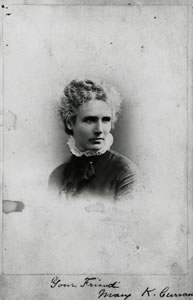
Novels are full of unconventional women, from Jane Austen’s spunky Elizabeth Bennet to the brilliant botanist Alma Whittaker in Elizabeth Gilbert’s recent novel The Signature of All Things. But Mary Katharine Layne Curran Brandegee (1844-1920), a real-life botanist, could certainly have taught these fictional women a thing or two about forging your own path.
Born Mary Katharine Layne in 1844 to a Tennessee farmer, she was a young girl when the Laynes moved west to California during the 1849 gold rush, eventually settling in Folsom, California. She married Hugh Curran, a constable, in 1866, but he died of alcoholism in 1874. Often described as strong-willed, Mrs. Curran moved to San Francisco the following year and enrolled at the University of California’s medical school. She was only the third woman to do so.
At that time, botany was an essential component of medical science education, and after receiving her degree, Curran followed the advice of an instructor and pursued botany rather than practice medicine. She became a member of the California Academy of Sciences in San Francisco in 1879, continuing her botanical training by collecting plants throughout California and working in the Academy’s herbarium. In 1883, Curran was appointed a curator of botany, one of the first women to hold such a position at a major museum, and in 1891 she became the sole botanical curator.
Ellen Diane Bloch is the collections manager of the William and Lynda Steere Herbarium‘s Cryptogamic Herbarium, which includes the fungi collection.
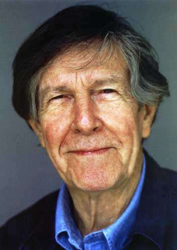
Many people know John Cage (1912-1992) as one of the foremost experimental composers and musicians of the 20th century, but he was also a dedicated amateur in the field of mycology, the study of mushrooms and other fungi. When he was asked to teach a music course at the New School in New York City in the late 1950s, he said yes, but only if he could also teach a class in mushroom identification. He taught the class for three years.
A letter from Cage, now kept in The New York Botanical Garden’s archives in the LuEsther T. Mertz Library, shows how committed he and his New School students were to their mycological studies. Dated November 6, 1961, the letter was addressed to Dr. Clark Rogerson, the Garden’s mycologist at the time.
Cage announced that after three years, the people involved in the New School classes wanted to form a society to “continue the field trips in suitable weather but which would add winter study periods with emphasis on the literature and work with microscope (sic). In addition we want to have a series of lectures given by authorities in the field. We would like to diminish the gap between ourselves as amateurs and the professional mycologists, knowing full well that we have much to gain, and hoping that our activities in the field can become more useful to the science itself … We would call ourselves the New York Mycological Society … We would have a Secretary and Treasurer but no other officers. We would not employ parliamentary law. Our wish is that the Society would function without dependence on leadership, focusing its attention directly on fungi.”