Inside The New York Botanical Garden
Posted in Exhibitions, Moore in America, Programs and Events on March 13 2009, by Plant Talk
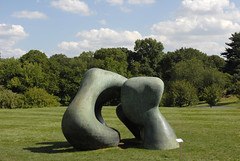
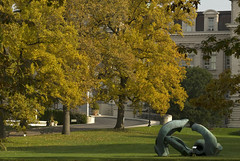
This weekend marks the end of the nearly 10-month run of Moore in America, the largest outdoor exhibition of the famed sculptor’s work in a single venue in the United States. Visitors to the Botanical Garden were able to view his magnificent work across this historic landscape in four seasons (as seen here); the show opened May 24, 2008.
Art in Nature walking tours of the show will be held both Saturday and Sunday so you can get one more look at these monumental pieces in this wonderful setting.
Check out all of Saturday’s programming.
Check out all of Sunday’s programming.
Posted in Learning Experiences, Programs and Events on March 12 2009, by Plant Talk
 Carol Capobianco is Editorial Content Manager at The New York Botanical Garden.
I recently completed a New York Botanical Garden Continuing Education course, Soil Science for Gardeners, with instructor David Bulpitt.
While that’s not remarkable in itself, it’s noteworthy because I had first become acquainted with David Bulpitt and his passion for soils at a Continuing Education Open House and promised myself that one day I would take his course. That was nine years ago!
It was the spring of 2000 when I attended the Open House to learn about taking classes so that I could finally gain some theory for the seat-of-the-pants home gardening I’d been doing and to investigate the various certificate programs offered at The New York Botanical Garden—the definitive source of everything related to plants.
At the free Open Houses, which are held twice a year, on a single day you can wander in and out of ongoing mini-classes on subjects related to seven main disciplines, some of which can lead to a career change such as Landscape Design or Horticultural Therapy, as well as hear about the School of Professional Horticulture. The setting is informal, you meet some of the instructors and program coordinators, and you feel a kindred spiritedness with the other searching, prospective students.
That day I was determined to at least poke my head into each of the rooms hosting the different topics so I could sample all the possibilities. I hesitated, however, when I came to the Horticulture presentation titled “Soil Science.” Oooh. That sounded boring. But, the curious sort that I am, I took a deep breath and walked in. Arrayed on tables were several samples of soils and testing paraphernalia. David, who led the session, was talking animatedly about soil texture and structure and permeability. I sat there fascinated. It was an hour later when I finally dislodged myself, knowing that I wanted to make my way to other classrooms and subjects.
After that Open House I registered for several classes, mostly in gardening and botany, all of which I completed with high marks. At the time, David Bulpitt was teaching Soil Science only as a two-course offering in the Horticulture program, which was too intensive for my needs. And so, I put the encounter in my memory bank. However, when I perused the Continuing Education Fall 2008–Winter 2009 Catalog and realized that he now teaches a more condensed, less-extensive class for the Gardening discipline as well, I immediately registered for the course.
Four weeks and lots of weighty information later, I’m feeling a great sense of fulfillment, and I’m armed with important new knowledge to take into my home garden this spring. The experience has renewed my excitement to learn, and I’ve begun skimming the newly released Spring–Summer Catalog and even the online version to find new courses to take. I invite you to attend this weekend’s Open House and begin your own journey.
Posted in People on March 11 2009, by Plant Talk
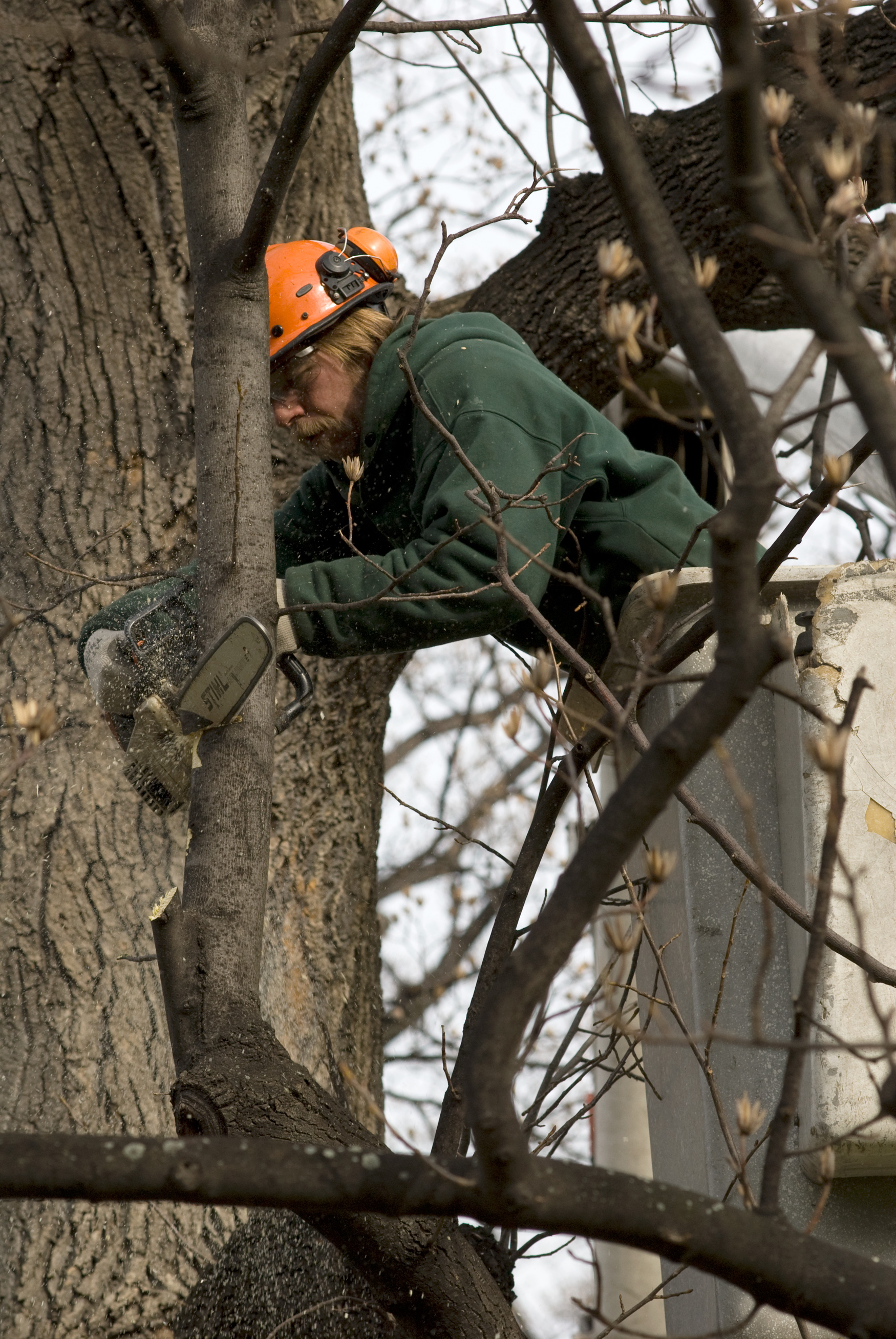 Late winter and early spring are great times to take a good look at trees and shrubs and see what pruning needs to be done. New York Botanical Garden Arborist Andrew Baird gets up close to one of the venerable tulip trees in front of the Mertz Library building, pruning out dead wood and checking for other problems.
Photo by Ivo M. Vermeulen
Posted in Exhibitions, Learning Experiences, The Orchid Show on March 10 2009, by Plant Talk
 |
Jane Dorfman is Reference Librarian/Exhibitions Coordinator in the LuEsther T. Mertz Library. |
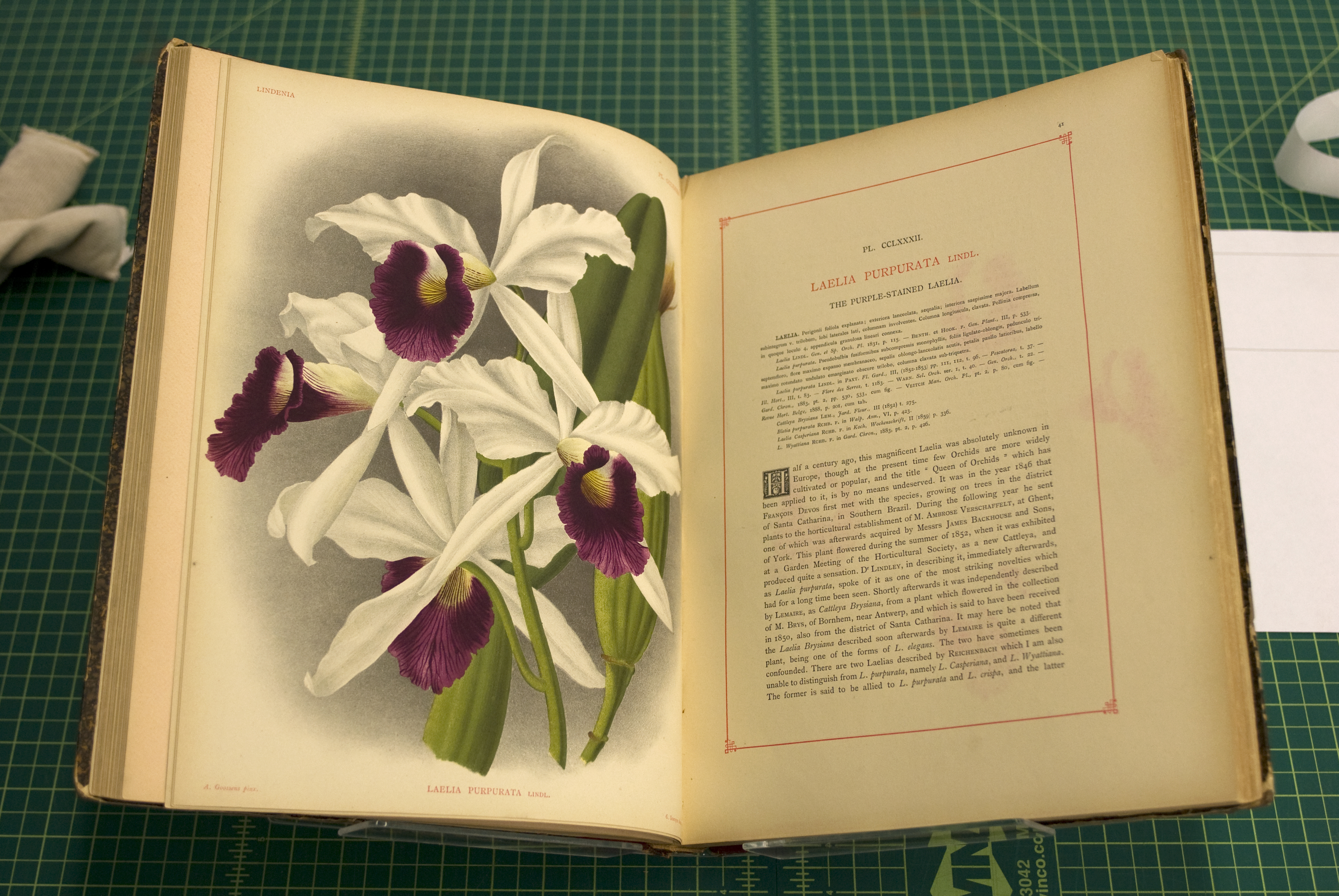 In conjunction with The Orchid Show, a small, but delightful array of orchid images is on view in the Rare Book and Folio Room and in the Reading Room of the LuEsther T. Mertz Library. The images were selected because they depict Brazilian orchids that are known to have been grown at the estate of Brazilian artist, architect, and landscape designer Roberto Burle Marx (1909–1994) and in the gardens that he created for others. The orchids highlighted include: Sobralia sessilis, Sophronitis grandiflora, Grammatophyllum speciosum, and Laelia purpurata Lindl., the national flower of Brazil.
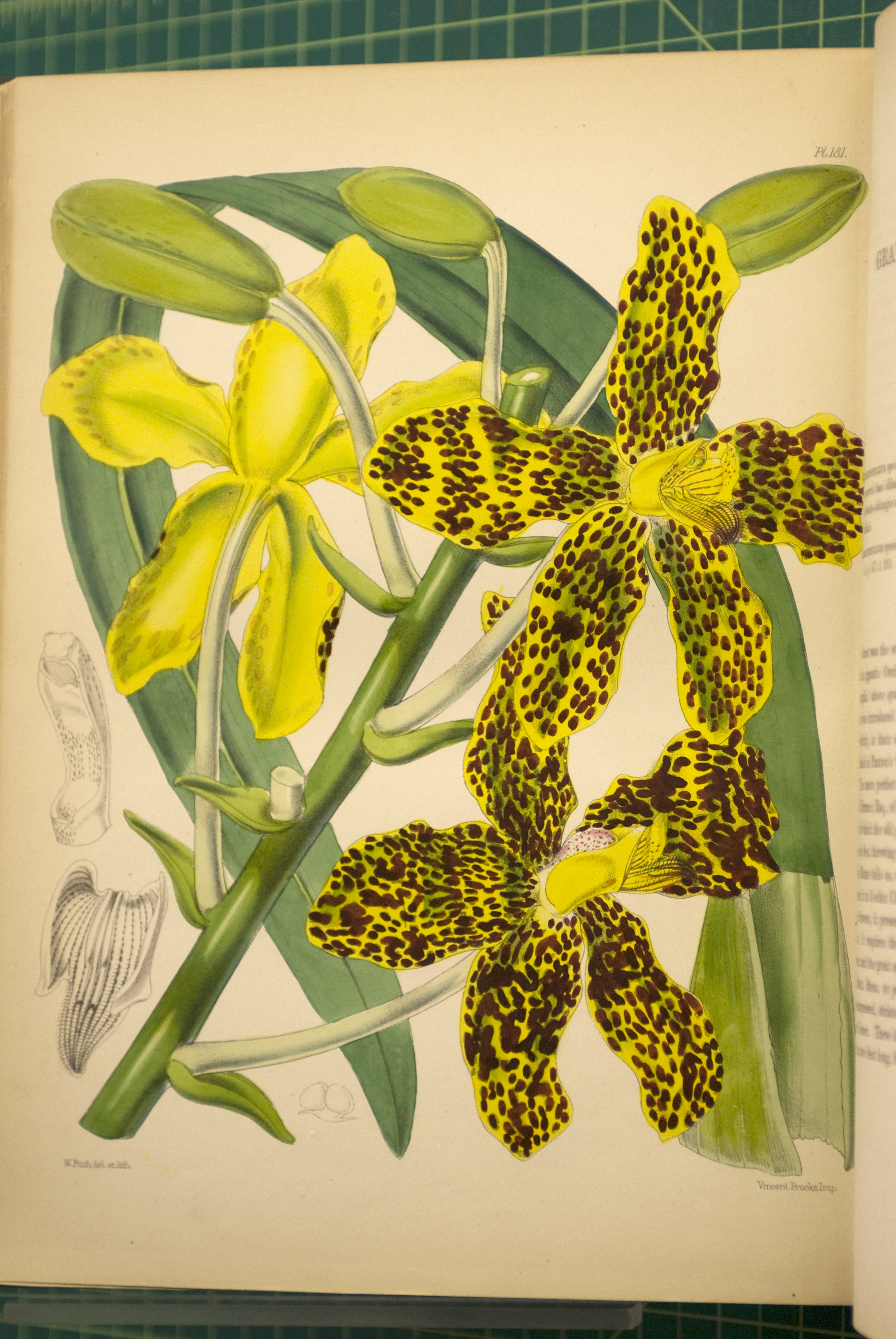 Walter Hood Fitch (1817–1892) one of the most celebrated lithographers of the 19th century, Mary Eaton (1873–1961), and Sarah Drake ((1803–1857) are some of the artists represented in the display.
Several images of Burle Marx and his home near Rio de Janeiro are also included.
To conserve the rare books on display, they will be replaced with other books midway through the exhibition.
The display is on view through April 10 during library hours: Tuesday–Thursday, noon to 6 p.m., and Friday and Saturday, noon to 5 p.m.
Posted in Gardening Tips on March 9 2009, by Sonia Uyterhoeven
Sowing Seeds Indoors
 Sonia Uyterhoeven is Gardener for Public Education at The New York Botanical Garden.
There are a number of advantages to starting your seeds indoors, among which is getting a jump on the growing season weeks before the last frost date (May 15 in New York City). Some vegetables take a long time to mature, and early sowing assures a good crop.
Starting from seed offers you a much wider selection than what you would find in already grown plants in a gardening center. Often, the more unusual and cherished varieties are only available in seed, and over the past decade, many more interesting ones, especially heirlooms, have become available.
I have many friends who like to trial heirloom tomatoes. Starting them from seed is easy and gives you more choices than you can possibly make in one season. Thumbing through the Seed Savers Exchange catalog is a great way to kindle your enthusiasm. I am personally interested in starting a basil trial and have been perusing Seeds of Change and Johnny’s Selected Seeds catalogs for inspiration.
These days, many seed companies are catering to our desire to “try a little bit of everything.” Besides the popular mesclun mix, companies now offer a variety of seed mixes such as “gourmet beet blend” and “gaggle of gourds,” which include a tasty and colorful assortment of heirlooms. Botanical Interests, Inc. is one such company that has a delightful selection of seeds.
Starting from seed is an incredibly cost efficient way to grow a large variety of herbs, flowers, and vegetables. The price of a seed packet is just a fraction of the cost of store-bought plants. Finally, it is simply rewarding to plant seeds and to watch them grow. Passionate gardeners and good cooks wait with anticipation as their summer harvest begins its seasonal cycle.
Sonia tells how to best sow seeds indoors, after the jump.
Read More
Posted in Gardening Tips on March 6 2009, by Plant Talk
Help for the Home Gardener
Carol Capobianco is Editorial Content Manager at The New York Botanical Garden.
Spring is just around the corner. Will you be ready when it arrives? Are your gardening plans taking shape? There’s no need to face the daunting task alone: Take advantage of the Garden’s expert resources for plant information and gardening advice.
- Spend tomorrow, March 7, learning about spring preparation—fine-tuning your soil, starting plants from seed, pruning, and more—during an all-day immersion, Spring Fever Saturday. This is just one of the many fabulous Continuing Education classes and workshops offered throughout the year.
- Attend one or all of the onsite demonstrations (free with Garden admission) offered each week in the Home Gardening Center.
- Explore the wealth of ideas, recommendations, and guidance offered on our Home Gardening Online Web pages.
- Refer to our Monthly Gardening Calendar to learn which garden chores to tend to each month.
- Search through the top seasonal plant picks in our Recommended Plants database.
- E-mail the Garden’s Plant Information Specialists with specific gardening questions such as when to prune your trees and shrubs, and which species to choose for a hedge.
- Read the many tips and how-to information presented such as how to keep deer away, downsize your lawn, or attract butterflies.
- Stroll the grounds and soak up inspiration from the 50 gardens and living collections. Or, if you’re looking for historical information and a warm place on a cold day to read about gardens and dream, peruse the infinite collection of botanical books in the unrivaled LuEsther T. Mertz Library.
- Beef up your own home gardening library with a visit to Shop in the Garden, in person or online, which recently was called “the most intelligently run shop for garden books in America,” by the Financial Times of London.
- Include the kids. The Ruth Rea Howell Family Garden opens for spring in a few weeks with new display gardens, plant varieties, programs and more.
- And don’t forget. You can always chat with other gardeners right here on Plant Talk and on our companion blog, Green Perspectives: Tom Christopher on Sustainable Gardening.
Check out all of Saturday’s programming.
Check out all of Sunday’s programming.
Posted in Exhibitions, Programs and Events, The Orchid Show on March 5 2009, by Plant Talk
 |
Amanda Gordon writes about the New York City social scene. |
The New York Botanical Garden is not only skilled at cultivating orchids, it also knows how to keep its annual Orchid Dinner fundraiser blooming.
“In this difficult time, we’ve raised almost $600,000,” announced gala chair and Botanical Garden board member Mary Davidson at the February 24 event at the Rainbow Room in Manhattan.
The steadiness of support is owed to the loyalty the Botanical Garden inspires. “The finest in the USA, The New York Botanical Garden deserves support in the best of times and the worst of times and at all times,” Fernanda Kellogg, president of The Tiffany & Co. Foundation, said. Orchids are of particular interest to the Foundation because in 1900 Tiffany & Co. won its first international award at the World Exposition in Paris with a collection of jeweled orchids.
Guests also enjoy buying tickets to this event because it offers such a beautiful spectacle of orchids, as featured in 28 centerpieces—one for each dinner table—created by top designers at the invitation of Veranda magazine editor-at-large and design maven Carolyn Englefield.
“My favorite part of the evening is walking into the dining room for the first time and seeing the incredibly creative centerpieces. They are amazing!” said gala chair Gillian Miniter, who in keeping with the theme wore an Angel Sanchez gold cocktail dress with flowers on the torso.
Gala chair Deborah Royce formally thanked the designers at the podium for their extraordinary effort. Among their feats: Alan Tanksley designed a cornucopia of purple orchids in a handcrafted black-and-white vase. Elise Cullman and Lee Cavanaugh wrapped orange orchids around a gold wireframe. Barclay Butera used white orchids and driftwood to transport guests to a beach setting, complete with sand dollars at each place setting. Darren Henault placed a disco-sized ball of white orchids atop a Chinese vase and made it glow by placing battery-operated lights inside.
Guests also had the opportunity to purchase orchids to take home. Many noted that the orchids were of the highest quality. In fact, they were hand-picked by The New York Botanical Garden’s Manager of the Nolen Greenhouses for Living Collections and Curator of The Orchid Show, Marc Hachadourian, who was on hand to answer questions about their care.
The dinner was a brief break from his busy schedule working on the Garden’s 7th annual Orchid Show, which opened on Saturday. A dramatic mosaic by the late Brazilian landscape architect and artist Roberto Burle Marx takes center stage in the Palms of the Americas Gallery in the landmark Enid A. Haupt Conservatory.
“It will be like nothing you’ve ever seen,” the president of the Garden, Gregory Long, told guests at the dinner, describing the design for the show by landscape architect Raymond Jungles as “architectonic.”
As for tending orchids at home, that’s another story. Fernanda Kellogg leaves the orchid care to her husband. “Kirk has the orchid green thumb,” she said. “He lived in Florida and learned to grow and nurture these quirky plants, so we always have orchid plants blooming at home. The orchids are off-limits to the housekeeper and the same goes for me!”
“I have tried to resuscitate orchids many times,” said Jane Pauley, the former Today Show co-anchor, as she walked across the dance floor in the Rainbow Room with Alan Tanksley. She got better results with less effort. “After sheer neglect, one plant gave us six more flowers,” she said.
Elise Cullman said orchid care is worth learning, especially in a recession. “Orchids are good value; they last much longer than fresh-cut flowers,” she explained. And she shared an orchid tip from a friend, author Patrizia Chen: “She sings to her orchids.”
For tips from Botanical Garden experts on caring for your orchids, check The Orchid Show blog regularly, visit the Home Gardening Online Web pages, or come to the many on-site demonstrations, Q&A sessions, and classes at the Garden.
Posted in People, Science on March 4 2009, by Plant Talk
Batty for Brazil Nuts
During The Orchid Show: Brazilian Modern, Plant Talk takes a look at some of the research and conservation efforts of The New York Botanical scientists whose work is focused in Brazil. This interview was conducted by Jessica Blohm, Interpretive Specialist for Public Education.
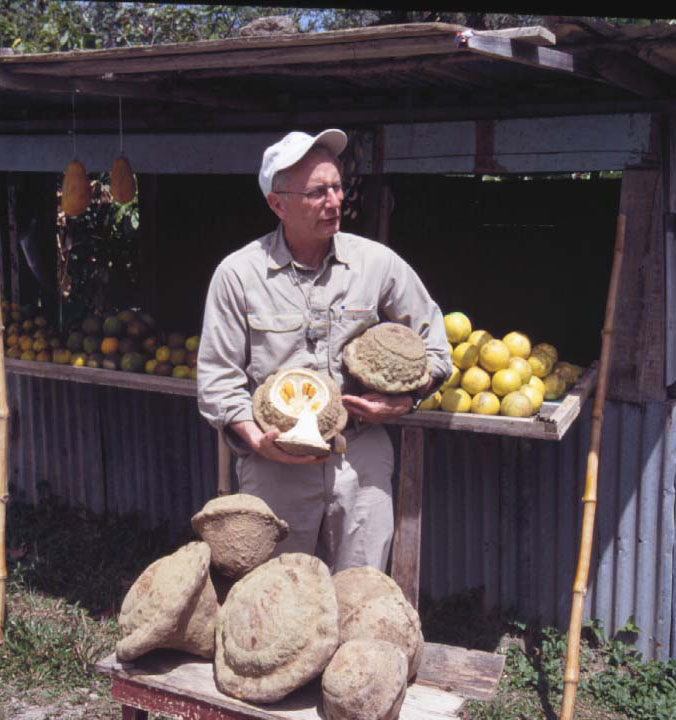 Dr. Scott Mori holds the giant, woody fruits of the
 sapucaia,
a species belonging to the Brazil nut family.
Photo by Carol Gracie“The diversity of Brazil is amazing,” Botanical Garden scientist Dr. Scott Mori says. “I grew up in Wisconsin, where there are 74 different species of trees in the entire state. In Brazil, there can be 300 different species of trees in the area the size of two American football fields. That means that every second tree that you look at is something different.”
Scott, who once met Roberto Burle Marx, the inspiration for this year’s Orchid Show, at a party in Brazil, is helping to preserve the Brazil nut family (Lecythidaceae), which includes the Brazil nut we eat and several hundred other species of magnificent, towering trees. Brazil nut seeds are easy to harvest because they are trapped inside woody, cannonball-like fruits that fall from the tree at maturity. These “packages of seeds” are simply picked from the ground and broken open to yield a harvest of 20 to 30 Brazil nuts per fruit. Brazil nuts are an economically important, non-timber forest product in the Brazilian Amazon.
Over the course of 40 years studying New World rain forests, Scott, the Nathaniel Lord Britton Curator of Botany, has described 51 new species of the Brazil nut family. His research has demonstrated many co-evolutionary relationships among species of the Brazil nut family and different animals, including bats and bees. Understanding these plant-animal interactions is an important part of understanding the plant’s biology and how best to conserve these plants. Scott co-authored Seed Dispersal by Bats in the Neotropics, which will be released in late April by NYBG Press.
“I am a hard-core scientist,” says Scott. “I go out into the field, collect plants, bring the specimens back here, and study the specimens.” This increased understanding of tropical plants, how they function and what they need to survive, often leads to efforts to conserve the rain forest habitats in which they are found.
Scott has shared his expertise on the Brazilian Amazon with Botanical Garden supporters on dozens of ecotours, combining informal natural history instruction with a myriad of other activities such as swimming in the tea-colored waters of the Rio Negro, hiking in the rain forest, fishing for piranha, early morning birding by canoe, and nocturnal trips for alligator spotting. He will lead his next ecotour, Ten Days in Brazil, October 10–21 with Botanical Garden President Gregory Long and James Miller, Ph.D., Dean and Vice President for Science. For additional information contact Brian Boom, Ph.D., Special Assistant to the President, at bboom@nybg.org or 718.817.8708.
Posted in Learning Experiences on March 3 2009, by Plant Talk
 |
Charles M. Yurgalevitch, Ph.D., is the Director of the School of Professional Horticulture. |
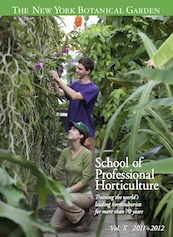 This Friday (March 6), the School of Professional Horticulture will graduate 10 students who have successfully completed the intense, two-year horticulture training program. The program involves academic coursework, hands-on practical training, field trips, group projects, plant identification walks, a six-month internship and other activities.
Students enter the program with diverse backgrounds—such as Myung-Woo Yu from Korea, who graces the cover of the newest course catalog—yet with shared interests and goals to become professional horticulturists.
Within two years, they come to know the cultural needs of more than 1,000 plants and the common pests and diseases that accompany them. They leave the program with a strong and solid foundation in horticulture, confident that they are well prepared to succeed in a wide variety of horticultural venues.
The 10 students in the Class of 2009 have worked very hard to reach this moment, and I want to congratulate each and every one of them as we recognize their achievements.
Posted in Gardening Tips on March 2 2009, by Sonia Uyterhoeven
Steaming Things Up: Growing Orchids in the Home
Sonia Uyterhoeven is Gardener for Public Education at The New York Botanical Garden.
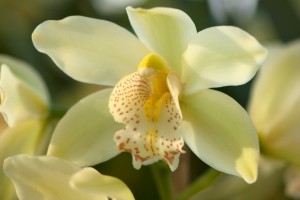 One of the challenges of growing orchids in the home is maintaining reasonably high humidity levels.
A drywell, while not the most effective antidote, is a common solution and one of the easiest for many houseplants. Creating one is as simple as filling a tray with a layer of pebbles and water and placing the orchid on top, making sure that the pot rests above the surface of the water. The water from the drywell will evaporate around the plants. Placing an oscillating fan so that it gently blows are over the surface will increase the evaporation.
Better yet is investing in a humidifier. The humidity levels in your home will drop down to 15–25 percent in winter; a good humidifier can raise that back up to 40 percent. This higher humidity level is good not only for orchids, but probably for your wintertime dry skin and the furniture as well. Of the many wonderful books on orchids, one of my personal favorites is William Cullina’s Understanding Orchids, which has an informative chapter on different types of humidifiers.
Some orchids, however, are more demanding and require levels of humidity that are unrealistic for most homeowners. Occasionally, I hear of people who successfully grow epiphytic orchids in slatted cedar baskets that dangle beneath a skylight in their bathroom. If you have the room and the inclination to shower with your orchids, then this is fine; but for most of us, that is not a viable option.
One solution is to begin collecting miniature orchids and grow them in an old aquarium. A friend of mine grows orchids this way and fits about four or five miniature orchids in a 15-gallon tank. Fill the aquarium with 2 inches of clean pebbles and add water to just beneath the top layer of pebbles. You are essentially creating an enclosed drywell for the plants.
Circulation is an important consideration for healthy orchids, so it is best to leave the top of the aquarium open. While this growing system increases the humidity, the enclosed case can overheat in the sun, so it is important to monitor the growing conditions.
Once all the variables are in place, you have an opportunity to experiment with growing a delightful array of miniature orchids. To create a display of different heights, turn over an empty terra-cotta pot and use it as a stand for your orchids. To learn more about this setup and for an accessible, no nonsense approach to growing orchids, refer to Ellen Zachos’ book Orchid Growing for Wimps.