Xavier Cornejo, a former Research Assistant at NYBG, is a curator of the GUAY Herbarium at the University of Guayaquil, Ecuador. His main research interests are the taxonomy of Neotropical Capparaceae and the conservation of mangroves and terra firme forests in western Ecuador.
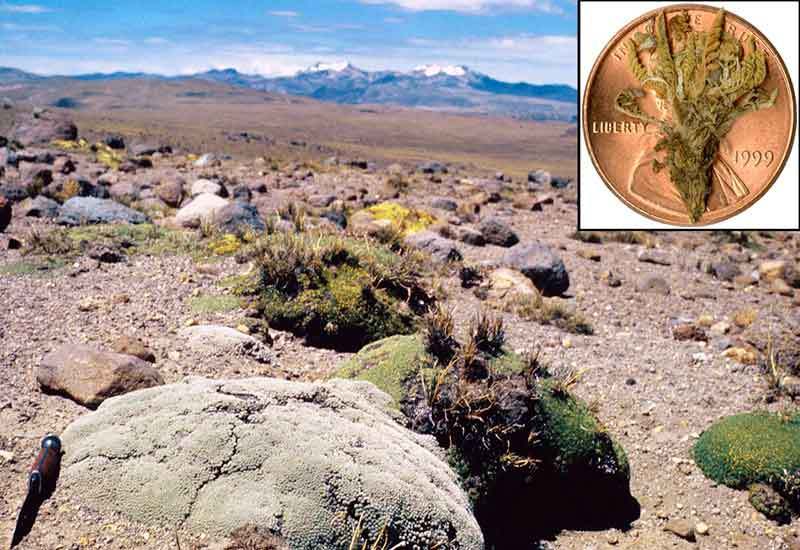
Viola liliputana is as small as a penny. Photo of violet on penny by H. Ballard.
Each year the Institute for Species Exploration of Arizona State University selects 10 species from among the estimated 18,000 new species of plants, animals, or fungi as the most interesting published in the previous year. In 2012, 140 species were nominated and only two of those selected were flowering plants—a miniature violet named Viola liliputana from the Peruvian Andes, and a species of the Myrtle family, Eugenia petrikensis from Madagascar.
We are especially pleased to see the violet selected because we know both of the authors: Harvey Ballard, now an Associate Professor at Ohio University, and Hugh H. Iltis, former Director of the Herbarium of the University of Wisconsin and research mentor to our research and Ballard’s alike. Hugh collected this spectacular violet nearly 50 years ago and was so impressed by the miniature high Andean plant that he took copious notes about the species, which was published in Brittonia by Springer for The New York Botanical Garden. We take this opportunity to recognize the accomplishments of Hugh Iltis in conservation and botanical science, and to thank him for the role that he has played in our careers.
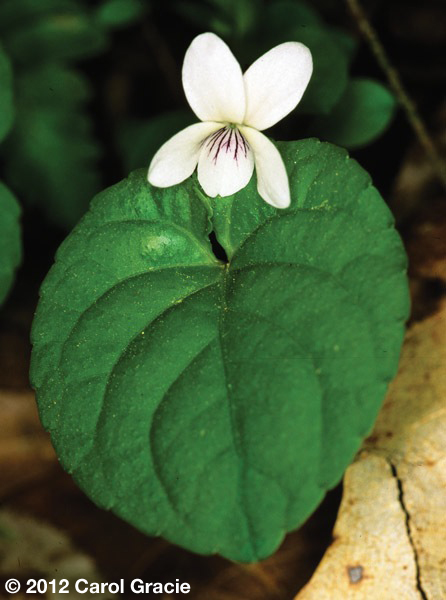
The sweet white violet (Viola blanda) is tiny, but often grows in masses.
Although many of our northeastern violets are lovely to look at, there is only one that is intensely fragrant—the tiny, white-flowered Viola blanda, commonly called sweet white violet. The delicate little flowers are well worth kneeling down and placing your nose right next to them to inhale their sweet scent.
While there, take the time to observe the structure of the flower. Like other members of its genus, the flowers have five petals, the lowest of which is modified into an extended spur to hold the flower’s nectar. Rather than aroma, most of our violet species attract pollinators with their pleasing colors of purple, white, or yellow. To reach the nectar in the deep spur requires a long proboscis such as that of butterflies. By patiently observing a patch of violets, you may be lucky enough to witness one of these pollinators visiting the flowers. In the case of the accompanying photograph, a West Virginia White butterfly visited several species of violets, among them this long-spurred violet, Viola rostrata. The same species of butterfly may also be seen depositing its eggs on nearby toothwort plants (Cardamine spp.), which serve as food plants for its larvae.
Sweet-scented violets have played a notable role in history. The favorite flower of Napoleon and his first wife, the Empress Josephine, was a European violet, Viola odora, which was especially prized for its lovely, sweet scent. Each year Napoleon would present Josephine with a bouquet of sweet violets on the anniversary of their wedding day. Violets, in fact, became a symbol of the Napoleonic reign. Despite Napoleon and Josephine’s great love, when Josephine failed to produce an heir after 13 years of marriage, Napoleon divorced her and married the young Marie Louise, who quickly bore him a son. However years later, when Napoleon died, his locket was found to contain a lock of Josephine’s hair and some pressed violets—a token of his lasting love for his first wife.