Saying Hello to New Arrivals and Goodbye to a Friend
Debbie Becker leads a free bird walk at the Garden every Saturday from 11 a.m. to 12:30 p.m., beginning at the Reflecting Pool in the Leon Levy Visitor Center.
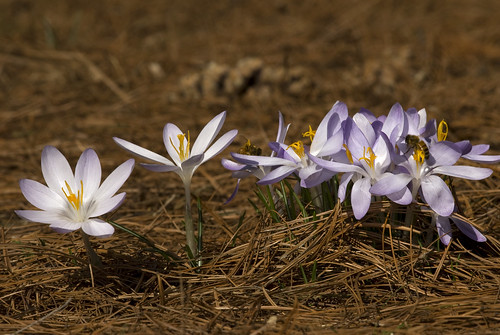
Spring has sprung at NYBG. The phoebe, spring’s harbinger, has arrived. A beautiful phoebe was spotted down by Twin Lakes bobbing its tail and calling. Ruby-crowned kinglets, brown creepers, and a juvenile eastern kingbird were also spotted on last Saturday’s walk.
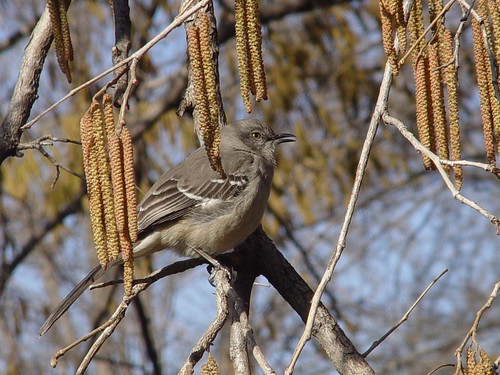
Perhaps the best indication of spring is seeing the mating rituals that some of the birds perform. The male mockingbird does a dance on the lawn by extending his wings and flashing his white stripes. The female, who looks exactly like the male, is an onlooker who watches from afar. She may judge him on his display or wait further to hear the kaleidoscope of songs that emanate from his vocal cords when he is high atop a tree. Many mockingbirds mock sounds they hear in their vicinity. NYBG mockers often imitate the other birds at NYBG along with alarm systems from cars and sometimes screeching—like the sounds a child might make. The female only mocks in the fall, leaving the spring air open for her suitor’s song.
Read more about birds at the Garden and check out all of this weekend’s programming after the jump.
Brad Roeller is a research horticulturalist at the Cary Institute of Ecosystem Studies, formerly the Mary Flagler Cary Arboretum of The New York Botanical Garden. He has been an instructor at the Botanical Garden for over 25 years.
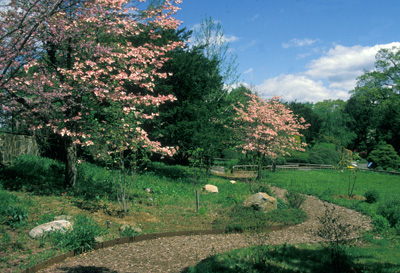
Over my three decades of gardening in the public arena, I’ve seen numerous landscaping trends come and go. However, landscaping with natives has always been popular, with current interest in this genre at an all-time high—and with good reason! A designer with a strong native plant background can meet virtually any design need by using native plants. Further, these days there seems to be something of a clarion call in the green industry to landscape with natives. I’m witnessing private, commercial, and even municipal planting specifications that are mandating, or at least strongly encouraging, using native plants in landscape designs.
While this trend is sweeping the country, landscaping with natives is often done without much thought. Typically the designer is just substituting native counterparts of exotic plants using conventional design criteria. As with the increased interest in natives, another “in” industry phenomena is the concept of creating “sustainable” gardens and landscapes. My definition of a sustainable landscape is one where, once the plants are established (typically a one- to two-year process) the need for additional irrigation, fertilization, or pesticides should be nil. Sounds nice, but I have seen very few examples of sustainable landscapes.
Many “sustainable” landscape designers are using the “natural” model, going “wild” by using native plants in a more naturalistic design. While these intentions are laudable, unless one thoroughly analyzes the growing characteristics of the property and makes wise plant selections based on their investigations, their plantings are destined to need continued sustenance. Even if the necessary site investigations are made and plants are selected based upon growing constraints, unless accepted planting and post-planting care guidelines are used, even the best natives for your site will perform poorly.
One popular application associated with landscaping with natives involves restoration projects in woodlands, meadows, wetlands or other riparian areas where the goal is to introduce indigenous native species back into their representative habitats. This approach is also finding some popularity in residential and even commercial landscapes. While it is typically used for large areas that have varying degrees of functioning native plant communities present, it does have a place in “small” landscapes. The time has come for ecologically designed landscape, and there is no reason that even the smallest of landscapes can’t duplicate a particular and appropriate habitat and landscape with plants obligate to that ecological niche.
This approach is not for the faint of heart and does require something of a learning curve. A working knowledge of the natives of your region coupled with an understanding of some important ecological principles is essential in establishing sustainable native plant communities.
Brad Roeller will be teaching three classes March 28 during Native Plants Saturday, an all-day Continuing Education program in the Watson Education Building at The New York Botanical Garden.
During The Orchid Show: Brazilian Modern, Plant Talk takes a look at some of the research and conservation efforts of The New York Botanical scientists whose work is focused in Brazil. This interview was conducted by Jessica Blohm, Interpretive Specialist for Public Education.
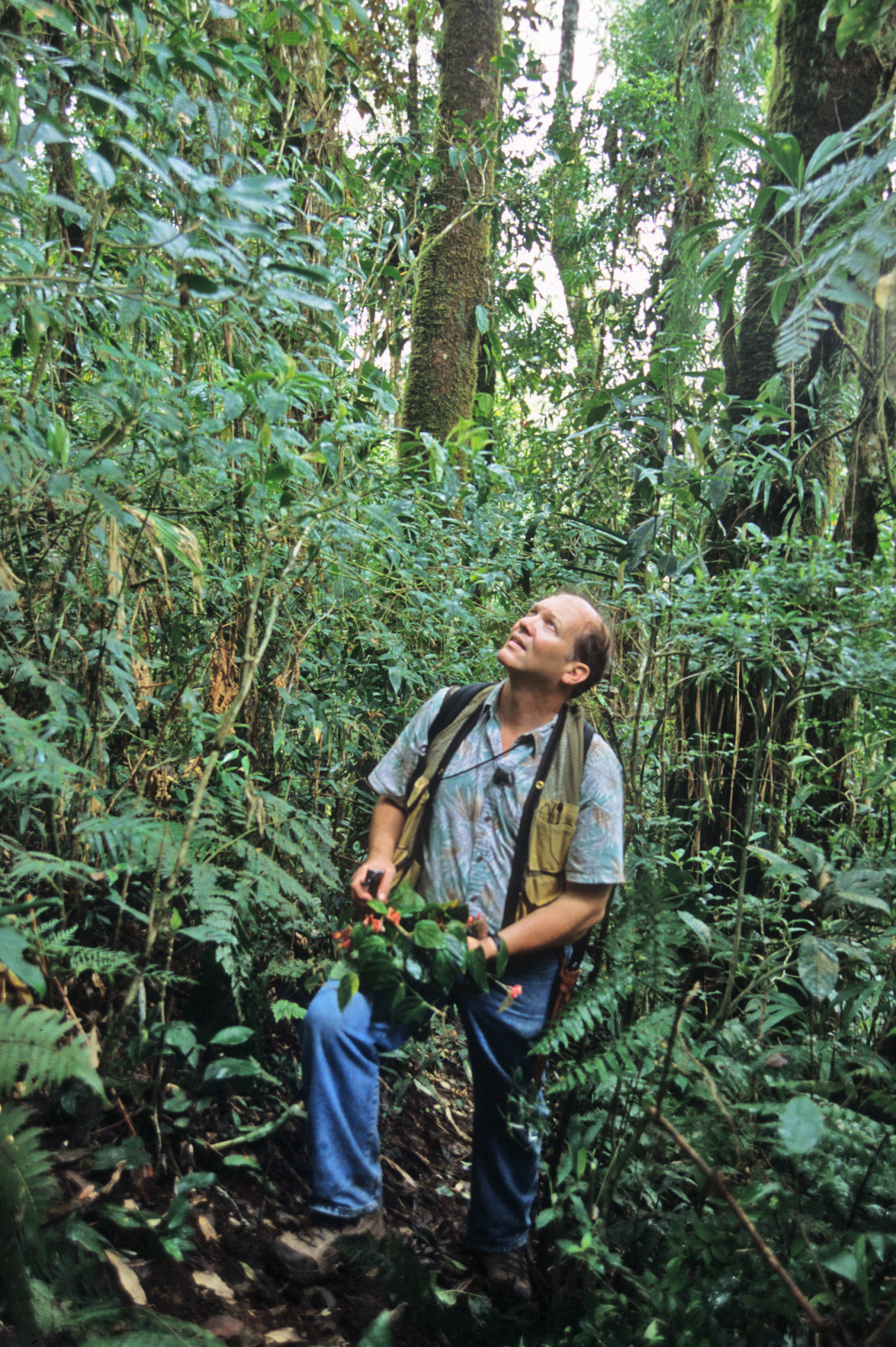
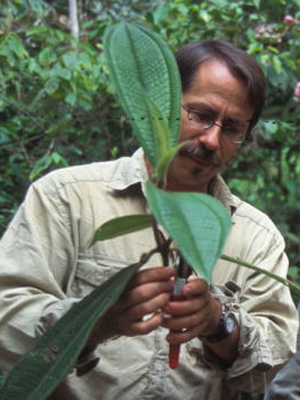
Dr. Doug Daly examines the ant domatia (chambers) of a Tococa (Melastomataceae) in Acre, Brazil. Ants live and reproduce in the swollen leaf petioles, and in return they protect the plant from herbivores. Photo by Rogerio Reis/Black Star
“For me, the pure enjoyment of botany is in exploration, discovery, and especially solving puzzles,” says Dr. Douglas Daly, the B.A. Krukoff Curator of Amazonian Botany. A 30-year veteran of the Garden, he focuses on three avenues of research: flora and conservation of the Southwestern Amazon region, applications of plant taxonomy and systematics in ecology and public policy, and systematics of the Burseraceae, a diverse family of tropical trees and shrubs best known as a source of frankincense and myrrh.
Some of the mysteries he unravels help to conserve biodiversity in Brazil. For instance, his new book, Manual of Leaf Architecture, which he co-wrote with six other botanists, provides a detailed framework for describing leaves that is enabling loggers and conservationists to distinguish rare and endangered tree species in the field and the herbarium. At the same time, he has been the catalyst for bringing together the World Wildlife Fund-Brasil, the Forest Stewardship Council, the Tropical Forest Institute, the Brazilian Forest Service, and Amazonian state agencies to work together on overhauling the biodiversity aspects of the standards and procedures for managing certified forest operations as well as operations in national forests in Brazil.
His wide-ranging research in the southwestern Amazon, especially in Acre, Brazil, not only helps regional governments designate conservation areas, but it also produces vital information about useful plants that aids forest dwellers to better manage their resources for a more sustainable living from the forest. The book he published with his colleague Marcos Silveira in 2008, First Catalogue of the Flora of Acre, Brazil, is the first of its kind for any major part of the Brazilian Amazon.
A sample of his publications illustrates the scope of his work:
The local branch: Toward better management of production forests in Amazonia.
“Lost” plant collections from the Amazon 1. The 1899 expedition of Dr. Luigi Buscalioni. (w/ A. Miloza)
Cacao and its relatives in South America: An overview of taxonomy, ecology, biogeography, chemistry, and ethnobotany. (w/ N. Bletter)
A digital base map for studying the Neotropical flora. (w/ N. Bletter)
Floristic aspects of the Rio Juruá basin: Botanical history, peculiarities, similarities, and importance for conservation. (w/ M. Silveira)
Forests of the Rio Negro. (book edited w/ A. Oliveira)
Lowland vegetation of tropical South America—an overview. (w/ J. Mitchell)
The “black holes” of diversity—Studies in Acre reveal the precariousness of our knowledge of the Amazonian flora. (w/ M. Silveira)
The role of the physician in medicinal plant research. (w/ Dr. C. Limbach)
The National Cancer Institute Plant Collections Program: Update and implications for tropical forests.
“When you work with biodiversity, resource management, and conservation in Brazil, the scale is daunting and the stakes are very high,” says Doug. “But my Brazilian colleagues and the students we are training are so talented, dedicated, and resilient that I really believe we can make a difference in the future of the Amazon region.”
Wayt Thomas is the Elizabeth G. Britton Curator of Botany in the Institute of Systematic Botany. Stella Sylva is Administrative Curator in the William and Lynda Steere Herbarium.
Photo by Tony Kirchgessner
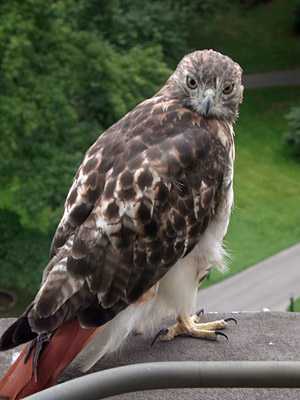
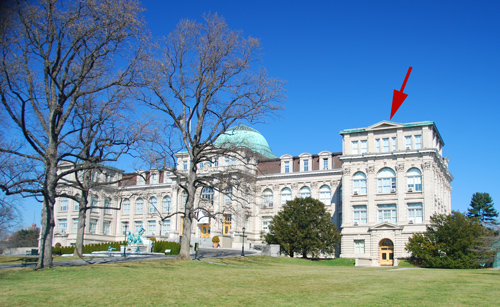
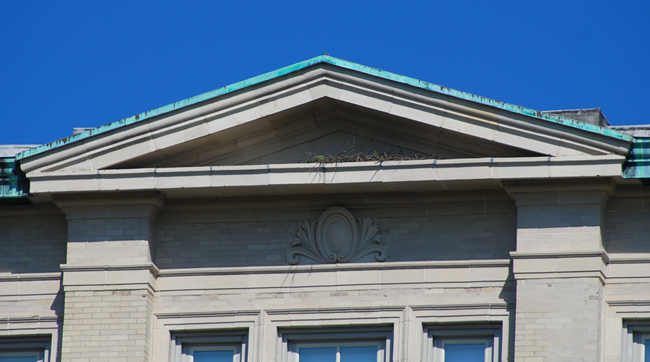
For the past several weeks a pair of red-tailed hawks (Buteo jamaicensis) has been building a nest on the Library building. Their nest is in a small triangular alcove near the top of the front face of the building on the east side (see photos)—they swoop by our office windows on their way to and from the nest.
Last year they started building a nest here but changed their mind and went elsewhere—Fordham University, according to Debbie Becker, who leads the Saturday morning bird walks at the Botanical Garden. This year the hawks seem to be serious. Two weeks ago they were engaged in a very active courtship display and mated several times a day.
Photo by Wayt Thomas
Red-tailed hawk pairs are monogamous, with females (2–4.5 lbs.) larger than males (1.5–3 lbs). The adults have a dark brown back with a pale underbelly and a darker band across the belly; the tail is brick-red above and pinkish below. Our pair is unusual in that they are accompanied by a third hawk—rarely, a second female may help tend the nest and feed the young. This immature bird is an offspring of the pair’s from last year. If everything proceeds according to what we know about these hawks, 1 to 3 eggs will be laid in late March or April—we’ll keep you posted.
Photo by Wayt Thomas
Red-tailed hawks usually feed on small mammals or birds and their preferred habitat is a mix of forest and open areas, such as we have here on the Garden grounds. Their diet consists primarily of squirrels, pigeons, small birds, and rabbits. We don’t know if they are part of the Garden’s Integrated Pest Management plan, but there are fewer squirrels than usual in front of the Library building.
Larger than Life Space Savers: Growing Miniature Orchids in the Home
Sonia Uyterhoeven is Gardener for Public Education at The New York Botanical Garden.
If you have been visiting the Garden over the past few weeks and enjoying The Orchid Show, once you get into Shop in the Garden to “do some damage” you will be surrounded by many sweet smelling and wonderful hybrids that stretch upward to 4 feet and beyond with wonderful exotic sprays of flowers (Brassia, Oncidium, Ondontoglossum, and more).
If you don’t have space in your home for these gorgeous giants, there are many attractive miniature alternatives that are ideal for orchid growers of different experience levels, from beginner to advance.
We always think that bigger is better, but often in the confined quarters of our homes this is not the case. When you are thinking of growing plants on a windowsill or table, a diminutive-size plant not only does a better job of fitting the space but ends up creating a greater impact. Here are a few suggestions.
For several years now, the clone or cultivar Oncidium ‘Twinkle’ has been all the rage. To tell you that it is fragrant is an understatement. It exudes a strong, spicy vanilla fragrance that fills the air. This small orchid grows to about 12 inches tall with a full spray of white flowers. It is a cross between Oncidium cheirophorum and Oncidium ornithorynchum. There are a number of clones on the market, Oncidium ‘Twinkle Sharry Baby’ looks and smells like its larger parent (a scent of chocolate) but only reaches 6 inches tall.
Like other “dancing ladies,” these little orchids do well in medium to high levels of light. They will thrive in a southern or western exposure as long as the temperatures do not get too warm or the air too dry. One common mistake that people make with these orchids is overwatering. Miniature orchids grow in smaller pots that dry out faster and often need more frequent watering than orchids in larger pots. Remember, however, that many of the same rules apply. Oncidium like to approach dryness between watering; ‘Twinkle’, with its tiny roots, is no exception.
Encyclia have big, round pseudobulbs (swollen stems that hold water), which tells you right away that this orchid likes to get dry in between watering. This is an ideal orchid for the beginner who has bright light. Encyclia like intermediate to warm temperatures (average household temperatures) and are more forgiving of low humidity levels in the home.
Dendrochilum is a cool-looking orchid—the tiny flowers run down the spike to form a chain. This attribute is augmented by a sweet fragrance. They do well in a 3- to 6-inch pot with a fine fir bark mix or sphagnum moss. Water when the mix starts to dry and fertilize lightly on a regular basis. This orchid is happy with household temperatures and moderately bright light.
Cochleanthes and Masdevallia are good small choices for the more experienced orchid grower. Cochleanthes amazonica thrive in low levels of light (eastern or bright northern exposure) and intermediate temperatures. This orchid likes high levels of humidity (up to 70 percent), so it might be a good candidate for the aquarium or an enclosed case. The reward is a big flower on a small plant.
Masdevallia is known for its intoxicating, colorful blooms. It demands a relatively cool and humid environment to survive. These orchids do not posses a storage system, so they should not dry out. New Zealand sphagnum moss makes an excellent choice for potting media. A regular feed of a diluted fertilizer will keep this orchid healthy and flowering.
Gregory Long is President and CEO of The New York Botanical Garden.
You owe it to yourself to join the plant, nature, and orchid enthusiasts arriving in record numbers to see the Garden’s absolutely world-class Orchid Show: Brazilian Modern.
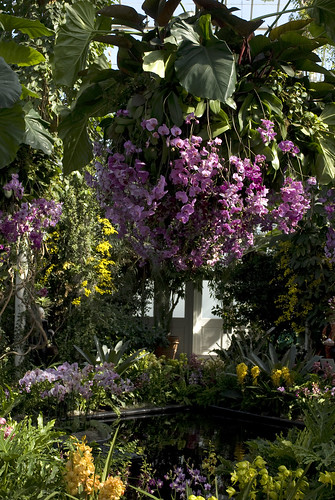
The combination of creative talents Raymond Jungles, the designer, and Fran Coelho, who creates all of our Conservatory exhibitions, is mind boggling. This is something you could see nowhere else in the world—the design and execution are tropical horticulture at its most perfect. Notice in the photograph the huge hanging basket of tropical aroids and descending orchids—there is a matched set of four of these huge hanging baskets created by Fran Coelho. These baskets alone are worth the trip to the Garden, and they are only part of the fun.
Everyone who knows and loves plants must come to see this marvelous masterpiece. The exhibition runs through April 12, and come soon, because I suspect if you see it once, you will want to see it again.
I am usually measured in my praise for NYBG exhibitions, but this orchid show is spectacular—a gift to New York. Come enjoy an exhilarating experience.
Dr. Wayt Thomas holds a begonia he’s just collected in the montane tropical forest of the Serra Bonita Private Reserve in Bahia, Brazil.
Photo by Rogerio Reis/Black Star
During The Orchid Show: Brazilian Modern, Plant Talk takes a look at some of the research and conservation efforts of The New York Botanical scientists whose work is focused in Brazil. This interview was conducted by Jessica Blohm, Interpretive Specialist for Public Education.
Botanical Garden scientist Dr. Wayt Thomas knows first-hand the importance of his research in Brazil. A planned highway that would have cut through the sensitive Serra Grande Forest in coastal Bahia was diverted thanks, in part, to the identification by him and his Brazilian collaborators of 458 species in an inventory of 2,500 trees—one of the highest forest diversity levels ever recorded.
“Our data about the high diversity of this forest came out while [local officials] were in the planning stage for this highway/road project. The local NGO [non-governmental organization] got our data, and they ran with it,” Wayt says.
The impressive data led officials to change the path of the road from a straight shot through the forest to a park-like road following the contours of the land and avoiding big patches of forest. In addition, a state park was created to protect that section of the forest, one of the world’s most critically endangered rain forests. Less than 5 percent of the original forests in the region remain.
“I can do my science and really have an impact on local conservation,” Wayt says.
He frequently finds species that no one has ever studied before: In Bahia, 7 percent of the tree species his team has found were unnamed. Wayt suspects that the area supports such diversity because three or four different kinds of forest intersect there. “Seeds are going to go where they want to. So you have plants that are from one forest that end up in another type of forest. The populations mix,” he says.
Wayt specializes in research of the sedge family, especially the beaked rushes, and the Tree-of-Heaven family. “In this research, I define species concepts, describe species and genera new to science, and use molecular techniques to understand the evolution of each group,” he says.
He also heads the international Organization for Flora Neotropica, which promotes the preparation of systematic monographs of plants and fungi in the American tropics.
“I have been working in this region for at least 17 years. There is no end to stuff to do here,” Wayt says.
Sonia Uyterhoeven is Gardener for Public Education at The New York Botanical Garden.
While good husbandry is an essential quality for any man, it is equally important for your plants. Now, what exactly is good husbandry some of you may be asking? For the former, I will wisely defer. As far as your plants are concerned, however, good husbandry essentially means good breeding practices. It is about selecting desirable qualities.
While I was in England last summer visiting the legendary garden Great Dixter, plantsman and designer Fergus Garrett spoke a great deal about good husbandry. It is important to do a little bit of research before you purchase a plant. Fergus pointed out that in some cases when you are choosing certain cultivars (cultivated varieties) you are making the choice between plants that will flower for 4 months versus 3 weeks.
Geranium ‘Johnson’s Blue’ is a good geranium and a former award winner, but it has now been superseded by the long-flowering Geranium ‘Rozanne’. In England a popular geranium is the longstanding Geranium ‘Ann Folkard’. A new addition to the market these days is Geranium ‘Ann Thompson’, whose magenta flowers last longer and are equally glorious.
It is not only about finding plants that flower well. There are other attributes to consider when choosing cultivars such as growth habit, the ability to form good seed heads and berries.
In terms of his selection of dahlias, Fergus looks for cultivars with a good, strong branch structure. He likes dahlias where he can simply stake the main stem and then secure strong lateral branches to the framework. Some of the favorite dahlias at Great Dixter are Dahlia ‘David Howard’, D. ‘Wittemans Superba’, and D. ‘Hillcrest Royal’.
If you are at a loss for choosing good cultivars for your garden and are searching for perennials that will not only perform well throughout the summer with their flowers but will also fade with dignity, form good seed heads, and maintain an attractive appearance, then come visit the Botanical Garden’s Seasonal Walk.
This year we had the famous Dutch designer Piet Oudolf team up with the Dutch bulb designer Jacqueline van der Kloet to create our seasonal display. This border will be full of many of Oudolf’s own introductions from his nursery in Hummelo, the Netherlands. It will include Echinacea ‘Fatal Attraction’, E. ‘Green Jewel’, and E. ‘Vintage Wine’ as well as Salvia ‘Eveline’.
Along with these Dutch introductions are stalwarts in our own nursery trade such as Astilbe ‘Visions in Pink’, Actaea ‘Brunette’, Helenium ‘Moerheim Beauty’, and many more. Bring your notepad and pencil and enjoy a stroll down Seasonal Walk for a wonderful educational experience. The bulbs will start the show early in the season and the perennials and ornamental grasses will take over during the course of the summer and close out the show in the fall.
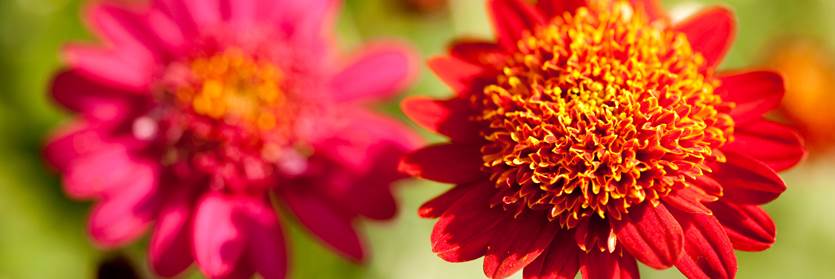

 Spring has sprung at NYBG. The phoebe, spring’s harbinger, has arrived. A beautiful phoebe was spotted down by Twin Lakes bobbing its tail and calling. Ruby-crowned kinglets, brown creepers, and a juvenile eastern kingbird were also spotted on last Saturday’s walk.
 Over my three decades of gardening in the public arena, I’ve seen numerous landscaping trends come and go. However, landscaping with natives has always been popular, with current interest in this genre at an all-time high—and with good reason! A designer with a strong native plant background can meet virtually any design need by using native plants. Further, these days there seems to be something of a clarion call in the green industry to landscape with natives. I’m witnessing private, commercial, and even municipal planting specifications that are mandating, or at least strongly encouraging, using native plants in landscape designs.
 Dr. Doug Daly examines the ant domatia (chambers) of a Tococa (Melastomataceae) in Acre, Brazil. Ants live and reproduce in the swollen leaf petioles, and in return they protect the plant from herbivores. Photo by Rogerio Reis/Black Star