Jessica Blohm is Interpretive Specialist for Public Education.
Clearly the theme of the week is color!
Obviously there are tons of flowers in bloom at the Garden with magnificent color!
Look for red roses, orange zinnias, yellow daylilies, green ferns, blue hydrangeas, and purple salvia.
OMG, you have got to get down to the garden to see all this beautifulness.
Really, you wrote an acrostic about color?
Not only are there plenty of colors to see at the Garden, but there are also exhibitions and workshops involving color. For instance, this weekend Sonia Uyterhoeven will explore the color wheel during her Home Gardening Demonstration, Celebrating Color and Form in the Garden, which will help gardeners find effective color combinations for their own gardens. Also, the exhibit Shapes of Nature in the Summer Garden, in the Enid A. Haupt Conservatory, features many varieties and colors of coleus and caladium, providing inspiration to gardeners looking to add color to those shady garden spots.
And clearly, the many fabulous Henry Moore programs that are going on at the Garden should not be forgotten; as Kate Murphy, our Communications intern says, “There is always more Moore.”
For a full schedule of this weekend’s programming, click on the links below. And for a totally fun look at color in a different way, see Disney cartoon character Ludwig Von Drake talk about the topic these YouTube videos: “The Wonderful World Of Color” and “The Spectrum Song.”
Written by Kate Murphy, a junior at Fordham University, with additional reporting by Genna Federico, a senior at St. John’s University; both are interns working in the Communications Department this summer.
The 2008 Olympic Games open tomorrow in Beijing. And though China’s capital and second largest city seems a world away, you might be surprised to learn you can find a little bit of China right here at The New York Botanical Garden.
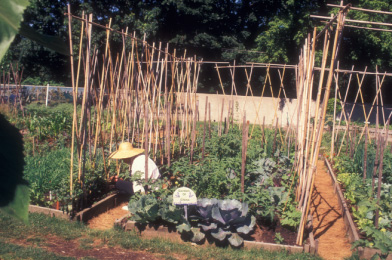
The Ruth Rea Howell Family Garden features a collection of Global Gardens—gardens planted and tended by volunteers in the spirit of different cultures and countries. Shirley Cheung, along with her husband, Frank, and her mother, Mrs. Miu, has maintained the Chinese Garden for over 15 years. As a schoolteacher, Shirley gets the summers off and likes to tend the Chinese Garden every day. She and her husband try to come in the early morning, usually before seven, to beat the heat.
The Chinese Garden contains plants both for show and for cooking, but Shirley prefers the latter, using almost everything she grows in her own kitchen. She likes to grow new things every year: This year they’re harvesting kohlrabi, a cultivar of cabbage, which she explains is popular in China and grows easily here. The leaves of kohlrabi, which cannot be found in food markets because they are discarded before being sold, are good for digestion. She suggests growing your own kohlrabi and steeping the leaves to make a tea for this purpose.
Another plant you’ll have to grow at home if you want to enjoy Shirley’s recommendation is garlic. While most everyone can find garlic at a local supermarket, the green tops are harder to find. Shirley insists that this is the best part and tastes great on chicken or fish.
The Chinese Garden also contains three different kinds of beans, tomatoes weighing in at over two pounds, and bitter melon, a fruit that in China is said to “cure 100 diseases.” Another highlight is the pumpkin flower, which can be picked, dipped in egg batter, fried, and enjoyed as a delicious treat.
Shirley calls the Chinese Garden her “paradise,” and her doctor told her to continue, because it’s keeping her young.
“It’s a lot of work, but a lot of fun,” Shirley says. “It’s the best life you can have!”
Genna Federico, a senior at St. John’s University, is an intern working in the Communications Department this summer.
It’s hard to avoid social networking sites on the Internet lately. These sites are ways to rekindle old friendships, consider new ones, find people with common interests, or even discover new business opportunities.
Now you can also add The New York Botanical Garden to the online discussion.
We recently expanded our profiles on Facebook and MySpace to let a broader public stay informed of what’s happening at the Garden. Check out the pages, watch the videos, share your thoughts, spread the word, and maybe decide to become our new BFF!
And for those of you who want to share your photos, don’t forget our Flickr group. It’s already jam-packed with some really stunning shots; will your masterpiece be the next addition?
Jessica Blohm is Interpretive Specialist for Public Education.
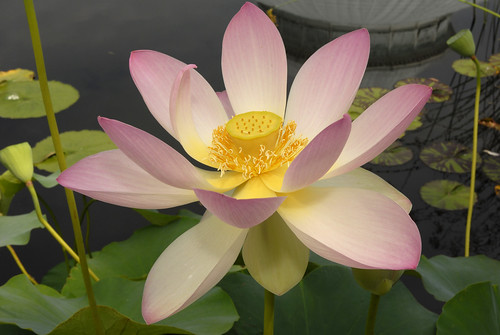
This week, while planning the upcoming fall Kiku (Japanese chrysanthemum) exhibit, I came across the lotus flowers that are blooming in the aquatic gardens of the Enid A. Haupt Conservatory Courtyard pools. Thinking about the role that kiku plays in Japanese culture got me thinking about the meaning of the lotus in other cultures.
After doing a bit of research I discovered that throughout history people all over the world have valued the lotus for a variety of reasons. For instance, the lotus flower signifies purity and peace to the people of India, who consider the lotus to be sacred. In China the lotus flower represents a kind person who keeps pure and clean. To Buddhists the lotus flower symbolizes enlightenment, and in Egypt the seeds of the lotus flower are used to make bread.
I am fascinated by the techniques used to care for and maintain lotus plants. If you want to learn to grow and nurture these and other aquatic plants, you should attend this weekend’s Home Gardening Demonstration, “The Incomparable Lotus and Waterlily,” presented by Sonia Uyterhoeven, Gardener for Public Education. Who knows? You, too, may discover the meaning of the lotus!
There are lots of other activities taking place at the Garden this weekend as well: a plethora of popular Henry Moore activities such as walking tours, film screenings, and children’s tours (P.S. It was Henry Moore’s 110th birthday this past Wednesday.) If you are looking for an event that will entertain the entire family, visit the Global Gardens in the Ruth Rea Howell Family Garden, where you can participate in cultural crafts and activities and sample special regional foods—homegrown produce and native recipes.
Genna Federico, a senior at St. John’s University, is an intern working in the Communications Department this summer.
Before the Waterlilies and Lotus Aquatic Exhibitionin the Enid A. Haupt Conservatory Courtyard pools opened, I wanted to find out how these flowers floating in water are kept bright and perky. To get to the bottom of this, so to speak, I watched one day as Foreman of Gardeners Gary Bendykowski gave the tropical pool (one of two pools in the courtyard) a cleaning. It was quite a sight to see. Donning brown waders Gary entered the pool with great enthusiasm, saying “It’s the best; you get to be in the water and away from the crowd.”
The weekly cleaning is generally done for aesthetic purposes, to remove leaves that are discolored or have been torn. It also serves to get rid of the abundance of elodea, aquatic weeds that are not needed in these hot summer months, although in colder months they help provide oxygen.
See the video below and read about the rest of Genna’s day at the pool after the jump.
Dachell McSween, Publicity Coordinator, spent a morning with School of Professional Horticulture student Songsuk Kim to find out what it’s like to attend “plant school” at NYBG.
Songsuk Kim took a break from grooming, watering, and inventorying plants to talk about her experience as a student at the Botanical Garden and now as an intern in the Garden’s Enid A. Haupt Conservatory. She assists staff with maintaining a variety of plant displays and preparing major blockbuster exhibits such as The Orchid Show and Caribbean Gardens.
“It makes me feel good to see the public enjoying our exhibits. As a student, it is a great accomplishment.”
Two years ago, Songsuk Kim (pictured at left), then 26, was working at a teacher in Korean but wanted to enhance her horticulture skills, so she enrolled in NYBG’s School of Professional Horticulture (SOPH). Although Songsuk, who has a Bachelor of Science degree in landscape architecture from her native country, South Korea, she wanted to increase her knowledge about botany and soil sciences. She felt that SOPH was the best place to study because she would be able to use NYBG’s 250-acre landmark site as a classroom and be trained by leading experts in the horticultural field, including SOPH alumni.
“As a student in the program, I have learned so much about horticulture. I enjoy all of the hands-on experience that I receive at NYBG,” she says.
Each day brings a new set of opportunities to learn from Garden staff. Recently, she began working with NYBG Gardener Yukie Kurashina on Kiku: The Art of the Japanese Chrysanthemum exhibit, which entails painstaking propagation techniques. During lunch hour you’ll find Songsuk viewing the “colorful plant combinations” in the Jane Watson Irwin Perennial Garden. She loves native plants as well and enjoys perusing the Native Plant Garden.
When Songsuk graduates from the School of Professional Horticulture next year she plans to use her new skills to design public gardens. But she says she will miss NYBG staff, fellow classmates (who “feel like a family”), and wandering around the Garden.
“The School of Professional Horticulture has an international reputation, known throughout the horticultural community, and this, together with my hard work, will help me to continue to develop my horticultural skills.”
SOPH is now accepting applications (due August 15) for the class of 2011.
Nick Leshi is Associate Director of Public Relations and Electronic Media.
The video review of Moore in America by Time magazine’s art critic Richard Lacayo is now on YouTube. It is a wonderful analysis of Henry Moore’s sculpture and the 20 monumental works on display at The New York Botanical Garden.
Since its creation in 2005, YouTube has revolutionized the distribution of user-generated video content. YouTube accurately describes itself as “the leader in online video and the premier destination to watch and share original videos worldwide.”
If you come across any videos about the Botanical Garden, let us know. One of my favorites is this charming clip created by “megruth” who visited with her mom a couple of years ago during our popular Chihuly exhibition.
You can also browse through the videos in The New York Botanical Garden’s own channel on YouTube. The videos from our Kiku exhibit, for example (below), have generated hundreds of hits and have been linked to a number of social networking sites.
Nick Leshi is Associate Director of Public Relations and Electronic Media.
With Olafur Eliasson’s ambitious New York City Waterfalls project receiving so much attention, it’s worth mentioning our own cascading waterfalls that visitors can see at The New York Botanical Garden. Not to detract from the multi-million dollar display along the East River presented by the Public Art Fund in collaboration with the City of New York, the four waterfalls here at the Botanical Garden are just as captivating and mesmerizing in their beautiful settings.
Glenn Collins wrote in The New York Times about the many other aquatic falls located throughout the city, including the ones here at NYBG. In his follow-up the next day on the “City Room” blog, readers also identified the Garden’s falls as sites to see.
Read about what you’re seeing below in the video after the jump, in Nick’s rundown of the four falls that flow at the Botanical Garden:
John Suskewich is Book Manager for Shop in the Garden.
It happens every year. It happened again this year. In June everything looks fresh and vibrant; the parade of tulips has ended in a triumph of roses, and you are smug. Even the delphiniums look as if they might flower a two-foot-long tower, like you are Lawrence Johnston and this is Hidcote or something, and you are smug.
And then by mid-July the garden starts to sag; the color looks washed out, leaves are wilting and turning brown, stems start to tilt, and so you pray for rain. And then it rains. Torrentially. It rains and rains. The Amazon doesn’t see such downpours. And then it stops and you go out on the deck and survey the damage. And you are no longer smug. The garden looks flattened; the plants lean against each other, like partygoers after their seventh mojito, and too late you begin to stake.
But there is a book, The Well-Tended Perennial Garden: Planting and Pruning Techniques, by Tracy DiSabato-Aust, that has the cure for this perennial problem, and it is easier than a 12-step. The simple insight that she presents so elegantly is to prune plants for better maintenance. Genus by genus she tells you when and how and she tells you with such clarity and such conviction that your garden will almost immediately look a thousand times better. You must overcome your initial hesitation caused by the thought “but I will be cutting off all the flowers!” What will result is a better behaved and much more floriferous garden.
To see the benefits of this technique walk through the Jane Watson Irwin Perennial Garden here at The New York Botanical Garden. Designed by Lynden B. Miller and curated by Bruce Dryden, this is a classic example of the mixed herbaceous border, with each element showing its uniqueness but each playing its role in the overall arrangement. Following the tactics of DiSabato-Aust, every plant has been pruned and deadheaded and divided with an almost annoying exactness—I should be so focused!—and the end result is a work of art right here in the heart of the Bronx.
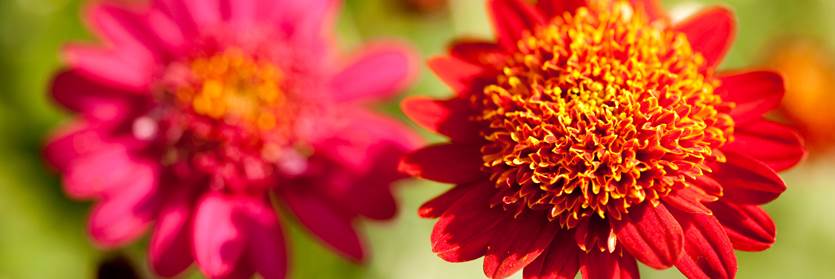

 Not only are there plenty of colors to see at the Garden, but there are also exhibitions and workshops involving color. For instance, this weekend Sonia Uyterhoeven will explore the color wheel during her Home Gardening Demonstration, Celebrating Color and Form in the Garden, which will help gardeners find effective color combinations for their own gardens. Also, the exhibit Shapes of Nature in the Summer Garden, in the Enid A. Haupt Conservatory, features many varieties and colors of coleus and caladium, providing inspiration to gardeners looking to add color to those shady garden spots.