Last week, I discussed the various taros or elephant’s ears (Colocasia esculenta) that we had on display in the Home Gardening Center. What I didn’t mention was that these robust tropical plants with their gigantic floppy leaves and their large round corms can be edible when properly prepared. Taro—or Cocoyam, or Yu Yu Tou—is a popular staple for many cultures.
It is believed that taro is indigenous to India. In Southeast Asia, it was grown near or in rice fields. In ancient times the Greeks and the Romans brought taro to Egypt and the Mediterranean. Spanish and Portuguese explorers then transported it to the New World. It is revered in Hawaii through prayers and takes on many forms in the cuisine. It goes without saying that taro is a globally important food source.
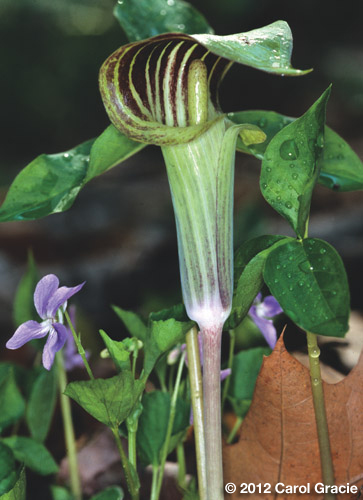
An inflorescence of Jack-in-the-pulpit showing the long spadix appendage protruding from the striped spathe.
One of our easiest to recognize wildflowers is Jack-in-the-pulpit (Arisaema triphyllum). Named for its fancied resemblance to a preacher (“Jack”) in his over-hanging pulpit, the name captures the imagination and makes the plant easy to remember. Like other members of the aroid family (Araceae) the inflorescence is comprised of two parts: a spadix that bears numerous small flowers and a modified leaf called a spathe that surrounds and partially encloses the spadix. In the case of Jack-in-the-pulpit, each plant bears either male or female flowers; the plants are dioecious.
Other aroids can have different arrangements of their flowers; for example the flowers of skunk cabbage (Symplocarpus foetidus) are perfect, meaning that every flower has both male and female parts, while those of the European wildflower known as lords and ladies (Arum maculatum), are arranged with separate male flowers on the upper part of the spadix and female flowers on the lower part.