Benjamin M. Torke, Ph.D., is an Assistant Curator at the Garden’s Institute of Systematic Botany. His specialty is legumes, a large plant family that includes not only beans and peanuts but also hundreds of rain forest tree species.
Rare. Restricted. Remote. Those are three characteristics, or “flavors,” of the new species that plant scientists discover and describe every year. Breaking our pattern, the fourth and final flavor in this series does not begin with an “r.” Some new species are cryptic.
The most recent comprehensive taxonomic treatment of Swartzia was written by the late Dr. Richard Cowan, curator of legumes at The New York Botanical Garden during the 1950s. In that seminal work, Cowan brought order to chaos. Previous authors had given numerous scientific names to the same species. Cowan recognized one name for each species and classified the other names as synonyms. In at least one case, however, it appears that he may have gone a bit too far.
Benjamin M. Torke, Ph.D., is an Assistant Curator at the Garden’s Institute of Systematic Botany. His specialty is legumes, a large plant family that includes not only beans and peanuts but also hundreds of rain forest tree species.
Every year, scientists in the Institute of Systematic Botany here at The New York Botanical Garden describe dozens of species of plants and fungi that are new to science. Recent examples come from Cuba, Venezuela, Ecuador, Peru, Bolivia, Brazil, Thailand, Vietnam, New Guinea, Australia, and the United States. These new species range from nearly microscopic lichens to huge forest canopy trees and were discovered in an equally broad range of habitats, ranging from rock outcrops in the Smoky Mountains to tropical rainforests in the Amazon Basin.
Despite the seeming randomness of discovery, most new species display at least one of four characteristics, or what might be called “flavors.” In my own research on the taxonomy of the tropical tree genus Swartzia, I have come across examples of each flavor. I’ll describe them in this series of posts, starting with new species that are rare.
In 2012, a Costa Rican colleague, Dr. Nelson Zamora, and I described a striking new species of Swartzia from the Pacific coast of Costa Rica. Several years before that, I had traveled to that small Central American country, partly to collect more specimens of this mysterious plant, which at the time was known from only a few fragmentary collections gathered primarily at two sites separated by about 100 miles. During the course of that trip, we discovered additional populations that bridged the geographical gap, and we concluded that the species ranges throughout the southern two-thirds of the Pacific lowlands of the country. It even occurs in popular tourist destinations such as La Cangreja and Corcovado National Parks. The fact that it had remained hidden for so long from botanists who have spent quite a lot of time in these areas is remarkable.
Benjamin M. Torke, Ph.D., is an Assistant Curator at the Garden’s Institute of Systematic Botany. His specialty is legumes, a large plant family that includes not only beans and peanuts but also hundreds of rain forest tree species.
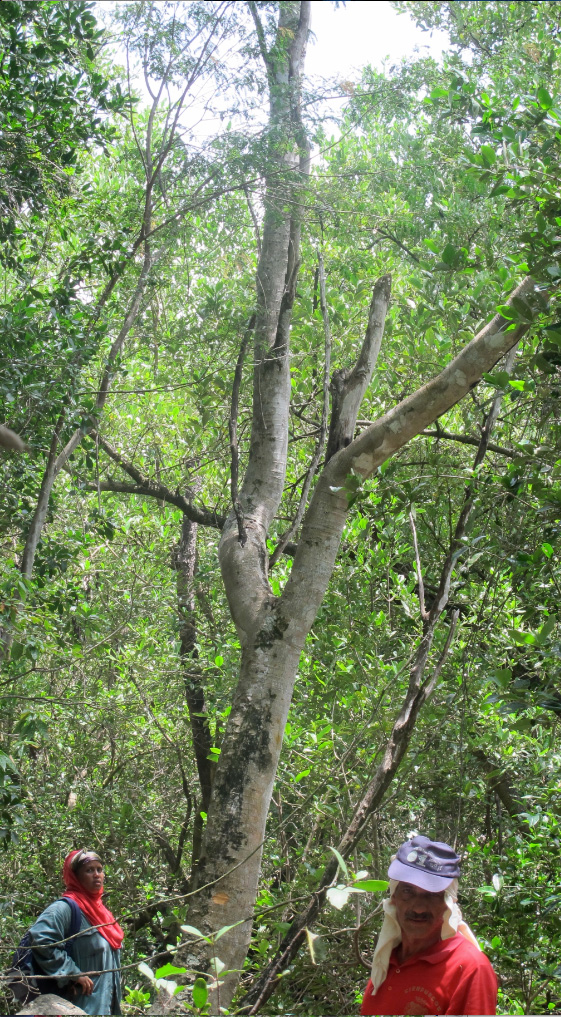
Julio León and Yoira Rivera Queralta encounter a single individual of the exceptionally rare Cuban endemic tree, Behaimia cubensis
Editor’s Note: President Obama’s recent announcement that the U.S. will normalize its relationship with Cuba has focused attention once again on Cuba, an island nation where scientists from The New York Botanical Garden have conducted expeditions and scientific research for more than a century. In this two-part series, a Botanical Garden scientist describes his recent two-week field trip to Cuba, part of an ongoing effort to discover and document the island’s richly varied plant life.
For the next leg of my August field trip to central Cuba, my colleagues and I traveled to the city of Cienfuegos on the southern coast. In Cienfuegos, we were joined by Julio León of the Botanical Garden of Cienfuegos, an expert on the flora of Cienfuegos Province. Julio took us to several highly productive collecting sites.
One of the most interesting habitats was the transition zone between a karst slope and a coastal mangrove swamp. Here we encountered one of the best finds of the whole trip, an individual of Behaimia cubensis, a very rare Cuban tree which is the only species of its genus. The evolutionary affinities of Behaimia are currently unknown, so I was very excited to collect material that could be used for DNA analysis.
Benjamin M. Torke is an Assistant Curator at the Garden’s Institute of Systematic Botany. His specialty is legumes, a large plant family that includes not only beans and peanuts but also hundreds of rainforest tree species.
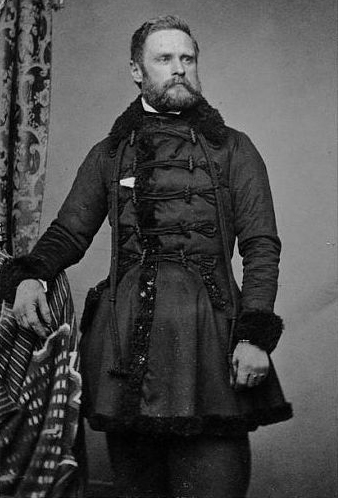
Arthur Carl Victor Schott
As an avid history buff, I get excited when my research on neotropical legumes turns up unexpected historical connections. In one recent example, the discovery of a new species of tree shed light on a mostly forgotten episode in the 19th-century international struggle to control shipping commerce.
From 1857 to 1860, Arthur Carl Victor Schott—a topographical engineer, cartographer, naturalist, and artist—was part of a U.S. Army-sponsored expedition to survey a route for a transoceanic canal from the Atlantic to the Pacific oceans, one that passed through nearly impenetrable tropical rainforests in the Darien region of northwestern Colombia. The expedition was destined to become a historical footnote—an alternative route through what is now Panama was ultimately chosen for the now-famous canal—but a small collection of dried plant specimens that Schott gathered during the expedition have ongoing importance.