Ellen Bruzelius is Director of Special Projects, Garden Retail and Business Development.
Shop in the Garden has been garnering attention lately in the blogosphere with a variety of garden-inspired goods that have struck the fancy of bloggers around the world. From a Chicago-based shopping blog that featured our green bicycle basket (also mentioned on Glamnest.com) all the way across the pond to Berlin where a New England-born journalist noted our Summer Pleasures melamine plates on her blog, Tidepooler.com, nybgshop.org has been piquing interest near and far.
Back on our own shores, in New York the Today show and Cookie magazine picked up on new NYBG products developed with licensing partner Lunt Silversmiths. Using glorious images from works in the Rare Book Collections of our LuEsther T. Mertz Library, Lunt has developed a tabletop collection that ranges from elegant silver tea sets inspired by 18th-century designs for Chinoiserie garden follies to garden plant trays and marvelous Mark Catesby-inspired glasses and barware and more.
The Peak of Chic (check out the July 15 and August 6 posts) loved the Lunt Silversmiths products as well as NYBG fine art prints sold through Artaissance.com. These archival quality reproduction prints also stem from historic botanical illustration in the Mertz Library collections. Some are presented in their original form, while others are given a modern sensibility with color and creative cropping.
This Old House featured one of our stainless steel birdfeeders, and Glamnest.com loved our array of colorful imported flower pots.
Not surprisingly, this interest in Shop in the Garden goods reflects the enormous effort put in by Shop staff to develop and find items that are design-driven and not ubiquitous. We’re adding new things all the time, so be sure to visit often.
Sonia Uyterhoeven is Gardener for Public Education at The New York Botanical Garden.
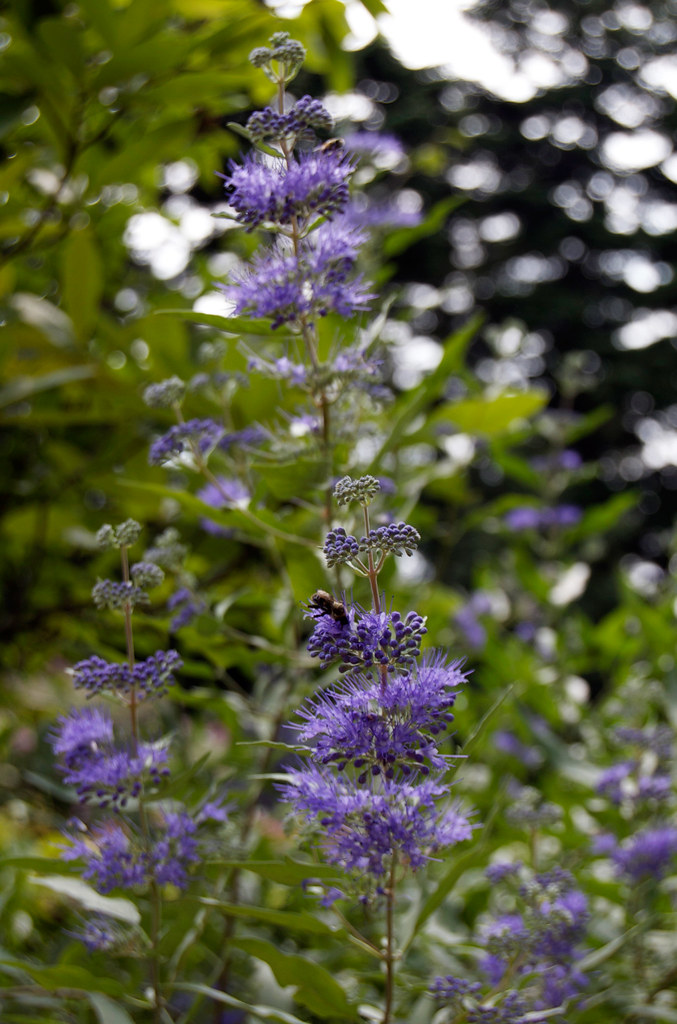
High on my agenda these days is using plants that benefit the environment while also doing the work I need a good plant to do, which is to create a beautiful garden. Caryopteris or blue beard fits this criterion.
It is not a particularly needy plant; it doesn’t require copious amounts of fertilizer or water—in fact it likes good drainage and moderate to lean soil.
Caryopteris is a magnet for wildlife: Bees and butterflies cover the flowers while deer show no interest and leave it intact.
Finally, a bonus for the shrub world—it flowers in August, long after most woody plants have finished flowering for the season.
It has a nice open structure that makes it an adaptable companion in any mixed border. In one location we have it snuggling up to a Daphne ‘Carol Mackie’. The graceful blue beard’s loose branches would also spill nicely into any small- to medium-size ornamental grass, making the two a lovely late-season pair.
I cut this shrub back to a one- to two-foot framework in mid-April to keep it flowering freely and to maintain a compact three-to-four-foot fountain of pale-blue to deep-purple flowers for a late season display.
Jessica Blohm is Interpretive Specialist for Public Education.
Jennifer Josef, Director of Public Education at the Garden, can’t wait for Wednesdays to roll around so that she can buy farm-fresh produce at the Garden’s Farmers Market.
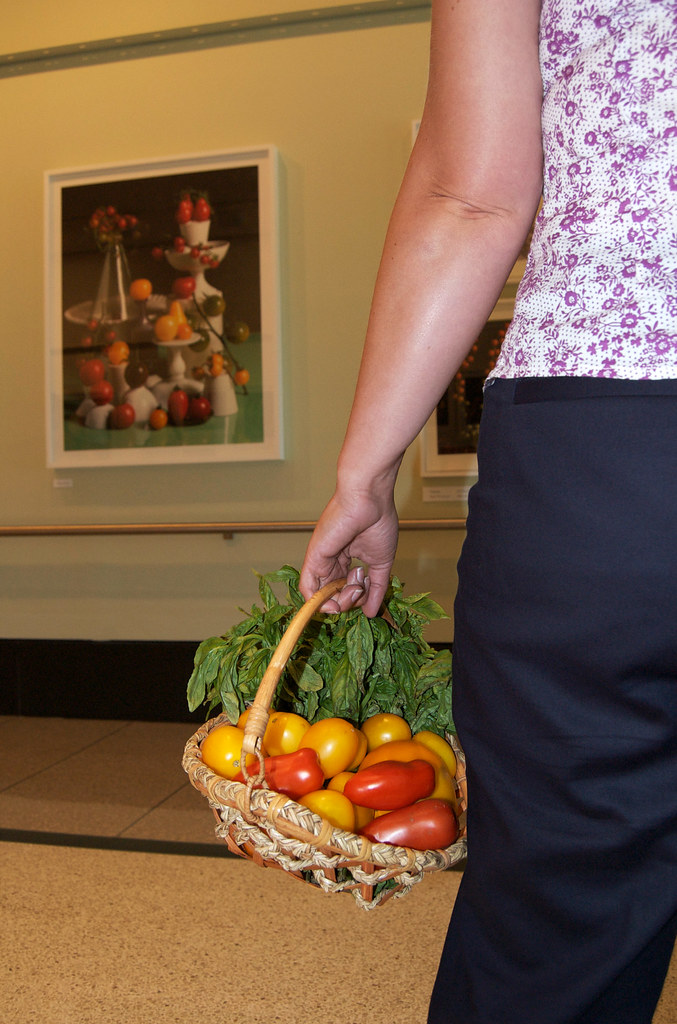
This week she bought several varieties of heirloom tomatoes and a big bunch of basil. The heirlooms seen at the market are similar to those depicted in Victor Schrager’s photographs in The Heirloom Tomato, the new exhibit in the Arthur and Janet Ross Gallery, which was also featured in the August 2008 issue of Martha Stewart Living.
The images highlight heirloom tomato varieties grown by Amy Goldman, a self-described “vegetable rights activist” who works to preserve the agricultural heritage and genetic diversity of the world’s vegetables. Jenn visited the gallery to view Victor Schrager’s divine photographs after buying her own fresh produce.
Jenn’s family, originally from Agrigento, Sicily, in Italy, loves to make traditional Italian delights with heirloom tomatoes. After the jump are three tomato recipes that Jenn makes with her mother. Check out these classic Mama Josef summertime treats yourself and let us know how you like them!
Kate Murphy, a junior at Fordham University, and Genna Federico, a senior at St. John’s University, interned in the Communications Department this summer.
The weekly Farmers Market not only features vendors with regionally grown produce and home-baked treats but also offers demonstrations on the first and last Wednesday of every month. We decided it would be fun to check out the demonstration on composting led by staff from our Bronx Green-Up program.
The New York City Composting Guide The NYC Composting Guide describes composting as “the process of creating the ideal conditions for the rapid decomposition of organic materials.” In other words, it’s what happens in your pile of vegetable and fruit peels, garden waste, and raked leaves after tending it in a particular way for a while.
Our first stop was the composting table at the Farmers Market, where we found lots of free information and learned that there was hands-on experience to be had if we visited the Home Gardening Center’s composting station, a short walk away. There we met a group of students from Adlai E Stevenson High School in the Bronx who are part of New York City’s GreenThumb-certified summer program.
The students were here to learn about composting so that they could use it when planting and maintaining the more than 20 vegetable beds at the Stevenson campus community garden, where the students also learn how to cook with what they grow. These students have also planted gardens at a local elementary school and have worked with a local homeowners’ organization in planting trees in nearby neighborhoods as part of the MillionTreesNYC initiative. (The Garden is involved in this initiative, too.)
Want to know more about composting for your own garden? See the tips after the jump.
Reading this article made me think of all the other amazing wildlife one can see here on a given day. Yes, the Botanical Garden prides itself as a museum of plants with extensive flora in its 50 gardens and plant collections. But visitors might be surprised at the diversity of fauna they could also stumble upon during a visit here. Our neighbor across Fordham Road may have lions and tigers and bears, but a stroll through NYBG reveals an unexpected variety of life from the animal kingdom.
Birds are abundant, from majestic hawks circling overhead to families of ducks ambling along a path. On the Garden’s popular guided Bird Walks, held Saturday mornings September through June, people seek out robins, blue jays, cardinals, sparrows, and even owls. I’ve been amazed to see wild turkeys, blue herons, plump pheasants, and even what looked like an ibis swooping to grab a koi from one of the pools in the Enid A. Haupt Conservatory Courtyards.
If you look closely enough, birds aren’t the only wildlife you’ll see. Chipmunks scurry in the Forest. Frogs belch their songs in the ponds of the Rock Garden, while Italian wall lizards dash across nearby stones. From rabbits and turtles to muskrats and squirrels, it’s incredible to realize how many species of life call our 250 acres “home.”
Sonia Uyterhoeven is Gardener for Public Education at The New York Botanical Garden.
Gardening is about observation. I have noticed over the past several years that my phlox and peonies that are out in full sun never suffer from powdery mildew while those that are in partial shade suffer miserably. What then are the lessons for the gardener?
Powdery mildew tends to create a problem for gardeners in middle to late summer. Unlike many fungal problems that need good moisture to take hold, powdery mildew thrives with warmth (temperatures around 70s-80s) and high humidity.
What can we do to alleviate the problem? Not surprisingly, good maintenance practices and smart gardening is the key to healthy plants.
Do not overcrowd your plants; this will lead to poor air circulation and will create problems with the humidity level around susceptible plants.
During the winter the fungus survives on plant debris, so it is important to clean up around infected plants.
Using high nitrogen fertilizers (the first number on fertilizers) promotes weak, leafy growth; try a balanced fertilizer with low numbers and apply only once in the spring to give perennials a boost for the season.
Choose disease-resistant cultivars whenever possible.
Follow the maximum “the right plant for the right place.” A healthy plant is always more resistant to disease problems.
If your favorite perennials do get attacked with powdery mildew, you have several options. When powdery mildew attacks my peonies late in the season, I just cut them back once the leaves get unsightly. If your bee balm has succumbed and is beyond repair, then cut the foliage back; you will get a new flush of foliage but no more flowers for the rest of the season. If it is a late-season bloomer that you’re set on keeping, then remove the worst stems and apply an environmentally friendly product to the rest of the plant as soon as you notice the powdery mildew. Some options include products that contain neem oil, sulfur, or potassium bicarbonate.
Written by Genna Federico, a senior at St. John’s University, with additional reporting by Kate Murphy, a junior at Fordham University; both are interns working in the Communications Department this summer.
A few years ago, NYBG made Frank Russo “an offer he couldn’t refuse.”
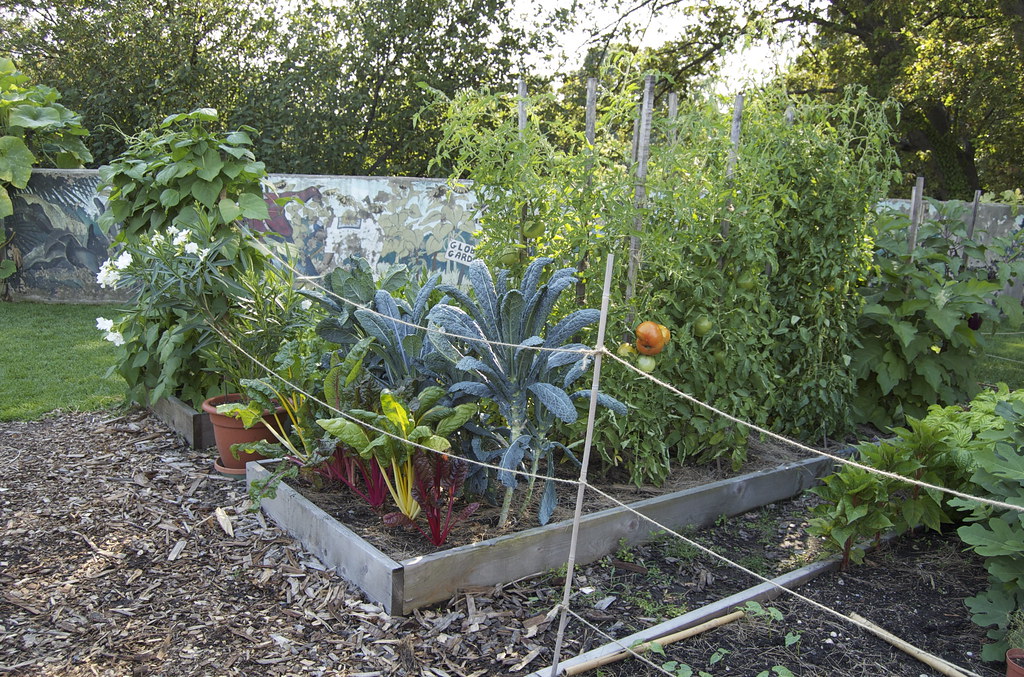
The Ruth Rea Howell Family Garden asked him to start an Italian Garden as part of its Global Gardens program. Russo had been volunteering in the Family Garden for about four years, so it was a natural fit.
The Global Gardens are planted and maintained by volunteers who take pride in the culture of the countries represented. Frank comes from an Italian background; his parents were born in Italy. But it was his grandparents who sparked his interest in gardening—growing up he liked to help them with their own garden.
At first Frank was hesitant to take on the job of the Italian Garden due to the maintenance required—indeed, during the summer months, he tends to the garden about four to five days a week. He knew it would mean a drastic change from the “come as you please” schedule he had enjoyed as a regular volunteer up until that point. But he soon accepted the challenge.
And he’s done a great job since. The garden is bountiful and full of fresh aromas. He tries to grow 100 percent of it from Italian seeds, most from Italy but also from Italian friends who have brought them over and passed them down to him.
Frank occasionally likes to change things up and try new varieties in the Italian Garden, now in its fourth season. This year he’s growing tomatoes, eggplants, escarole, arugula, string beans, chicory, garlic, basil, and even dandelions, the leaves of which can be used in salads, soups, or as a side dish.
The tomatoes are a sight to see! Colorful and juicy-looking, the seeds date back to 1910 and hold a special place in Frank’s heart. He has named them “Dominick” seeds after his grandson. Then there’s the basil; the leaves were immense and you could almost taste them from their intense aroma. We couldn’t leave without taking a sample of both of these delights home!
Frank makes sure his harvest never goes to waste and says he “absolutely” takes home the bounty to cook with. In fact, this weekend he will show off his culinary excellence at the Italian Garden celebration in the Family Garden, from 1 to 5:30 p.m.
Kate Murphy, a junior at Fordham University, is an intern working in the Communications Department this summer.
When I think of summer, I think of two things: heat and sun. And while I like a summer day just as much as the next person, I prefer summer nights. You get all of the beauty of summer without the humidity and sun in your eyes. So when I heard about the August concert series Evenings at the Garden, I knew I would have to check it out. The first concert, held August 7, featured classical guitarist Mattias Jacobsson and violinist Kristin Lee.
Mattias Jacobsson is classically trained. He studied at both the Malmö Academy of Music, in his home country of Sweden, and the Julliard School, here in New York City. His co-performer, Kristin Lee, also has Julliard experience: She has been there for over a decade, beginning with pre-college programs, and will continue studying the violin in its Masters program this fall. The two met at a birthday party where they both were performing; their concert at the Garden marked the first occasion in which they have performed together.
In addition to the concert, attendees were free to roam the Garden Grounds until 8 p.m.—a rare opportunity to experience everything the Garden has to offer, from the Enid A. Haupt Conservatory to Shop in the Garden, at night!
It’s not too late to experience Evenings at the Garden. There are two more concerts scheduled: The Trinity Singers led by Owen Burdick will perform this evening, August 14, and next week, August 21, jazz with the David Grossman Ensemble is featured. Both concerts begin at 7 p.m.