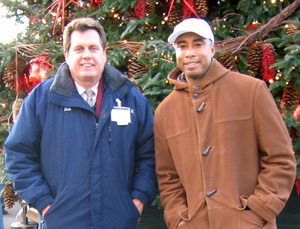
Over the years, The New York Botanical Garden has been visited by a few of the “boys of summer” who have worn those classic pinstripes and played in baseball’s historic cathedral. Former Yankees center fielder and All-Star Bernie Williams dropped by during the winter of 2004 (seen at right with Bob Heinisch, our VP for Site Operations). Joe Torre, who guided the Yankees through four World Series Championships and was an All-Star player himself during his career, toured the Holiday Train Show with his family a few years ago as well. Other Yankee heroes and All-Stars who have enjoyed a visit to the Botanical Garden included Joe Pepitone and Willie Randolph (seen below, again with VP Bob). Yankee broadcaster Michael Kay even served as Master of Ceremonies for the Garden’s Holiday Tree Lighting ceremony in 2007.
This is the last year people will be able to step foot inside the “House That Ruth Built”—the new stadium opens next year. But you can wax nostalgic and still see a replica of the original Yankee Stadium—made of plant parts—at the Garden’s Holiday Train Show, which opens November 23.
Sonia Uyterhoeven is Gardener for Public Education at The New York Botanical Garden.
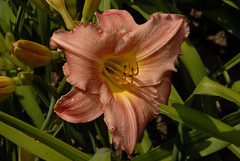
Daylilies are marvelous additions to the summer border. They are easy to grow and have large, trumpet-shaped blooms that scream out “Look at me!” Hybridizing daylilies is a passion of many, and the market is always flooded with a multitude of options. Some are short, some are tall, some have flowers the size of your hand. The latest trends are for re-blooming daylilies that flower from July into September. Rosy Returns is a popular performer, Apricot Sparkles is a peachy compact choice, the dark-eyed Moonlight Masquerade will woe you with the striking contrast of wine and cream, and Indian Giver will quickly find a way into your heart with its iridescent rose-pink flowers.
While longevity of bloom is always appealing, don’t overlook the fact that a number of daylilies have fragrance. My favorite is a pale lemon-yellow daylily named Hyperion. It has a happy home in the corner of my vegetable garden and is the main attraction in July. Often plants are described as being fragrant when they have a light scent—this one is truly fragrant. Other fragrant daylilies include Kathy Rood, Fragrant Light, Scape Stopper, and Vanilla Fluff.
Another week has come and gone at the Garden. Don’t fret though; there’s plenty of summer left to go around. The delicious weather in store for us seems like the perfect situation to see the monumental works of Henry Moore. There’s also Home Gardening demonstrations, guided tours, kids programming, and much more.
Educator Anabel Holland is giving guided tours of Moore in America at The New York Botanical Garden
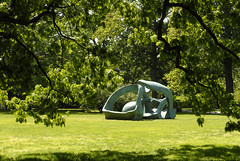
This summer’s Henry Moore exhibition at the Garden has me coming back again and again. The large sculptures hulk quietly throughout the grounds, not imposing themselves upon you but waiting to be discovered. Some hide behind trees or in enclosed gardens only to be revealed when you fully take in both the sculpture itself and the setting around it. For me the most breathtaking is Large Reclining Figure, 1984. As you follow the path up toward the Rose Garden, it slowly takes shape. The brilliant white of the fiberglass contrasting against the vivid green grass is a sight to be seen.
The most amazing aspect of Moore in America is its ability to transform. While walking around with tour groups, my view of each sculpture is constantly changing. In one group everyone sees elephant bones in many pieces, while in another the focus is on the texture and the way it affects the light that reflects off the surface. Not only do the subtle changes in landscape transform the pieces, as Moore would have wanted, but seeing them through someone else’s view is unbelievably eye opening. This exhibition is definitely a must see for the summer!
Kate Murphy, a junior at Fordham University, and Genna Federico, a senior at St. John’s University, are interns working in the Communications Department this summer.
Any time you visit the Farmers Market at NYBG, you’ll find seasonal recipes that incorporate the locally grown foods available. These recipes are provided by Community Markets, which co-organizes the Garden’s weekly event and is dedicated to “supporting local agriculture, strengthening local communities, and making fresh produce available to neighborhoods with limited access.”
We tried out the recipe for Blueberry Blast Smoothie this past weekend. It’s a great energizing start to the day or a cool treat on a warm summer night. A delicious alternative is adding in some blackberries and strawberries. It takes on a mix of sweet and tart and even gives the smoothie a new color. We also added bananas to kick up the fruity flavors. The recipe worked great with soy milk or almond milk, too. Try making the recipe when all the ingredients are nice and cold.
Check out some great recipes for yourself after the jump, and make your way to the Farmers Market to stock up on the delicious ingredients!
Sonia Uyterhoeven is Gardener for Public Education at The New York Botanical Garden.
The best advice that I have ever heard about staking plants in the garden is twofold: Stake early before the plants need it, and don’t put your plants in a straight jacket—the idea is to see the plant and not the staking.
The aim then is to hide the stakes in the plant; when using string or twine pass it underneath the foliage and work with the natural structure of the plant. There are many different staking techniques and products available to the gardener.
You can use store-bought products such as peony hoops that fit neatly over the plant and can be raised up as the perennial grows. A plethora of stakes are available in gardening centers and from catalog companies; find the ones that work for you and your perennials.
For some jobs you can take the bounty of your spring pruning and use the branches as stakes. I have done this in the vegetable garden in the Home Gardening Center using leftover butterfly bush (Buddleia) branches to hold up peas and climbing nasturtiums. The key here is to place the twigs close to each other and get them deep enough into the ground so that they can support the plant.
Most of the staking done in this garden is done the old-fashioned way, with bamboo stakes and string. The stake generally needs to support only the bottom half of the perennial; in this way it doesn’t obstruct the view of the flower spike and lets the plant move naturally in the wind.
If the plant can only be viewed from one direction, stake from behind. If the plant can be viewed from all four sides, place the cane in the center of the plant. Drive the cane deeply into the ground to give maximum support. When tying the stems, work the strings beneath the foliage. Make a figure eight around the stem with the string and tie to the stake. If the plant has multiple stems, loop the string around all the main stems and tie to the stake.
In the summer of 1977 the Bronx was literally burning. In the midst of a devastating blackout, New Yorkers were faced with looting, bankruptcy, municipal layoffs and the very real threat of the Son of Sam killer.
You’d have to be Rip Van Winkle to not notice that much has changed in the 31 years that have followed, but to some the rugged, urban stigma of the Bronx remains. No longer, says Associated Press Travel Editor Beth Harpaz. In her article, “The Bronx Is Blooming,” she celebrates the more than 7,000 acres of park land, and in particular, The New York Botanical Garden. As one of the many luscious “green spaces” in the borough, Harpaz credits the Garden and others as instrumental in revitalizing tourism in the Bronx.
The article is generating a lot of buzz and has been picked up by major outlets such as USAToday.com, CNN.com, AOL.com, NYPost.com, AMNY.com, Newsday.com, CBSNews.com, the Poughkeepsie Journal.com, and more.
The weather forecasters have good things in store for us this holiday weekend, so why not spend our nation’s birthday at one of the best getaways NYC has to offer? If you’re not scarfing down hot dogs and “ooh” and “ahh”-ing at the fireworks display, there’s plenty of stuff to keep you busy at the Garden all weekend long.
Guided tours, screenings of The Art of Henry Moore, edible herbs and flowers, and much more are on tap.
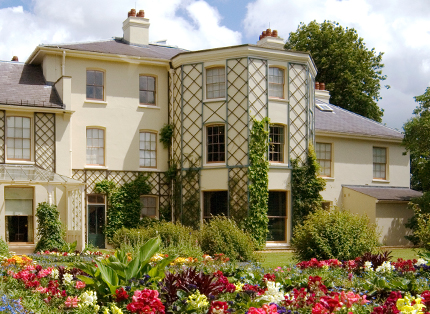
I just returned from a short visit to the United Kingdom where a colleague from the Royal Horticultural Society Lindley Library arranged for a private tour of Down House, the home of Charles Darwin. He lived there with his family for the last 40 years of his life, experimenting with plants.
The tour of the house and garden was led by author and conservationist Randal Keynes, a great, great grandson of Charles Darwin. Erudite and charming, Mr. Keynes offered insights and details about the life and work of his extraordinary relative that enlivened and inspired the experience.
Come and be inspired, as well, by the work of Charles Darwin in the Mertz Library’s Rondina Gallery exhibit, Darwin’s Garden: An Evolutionary Adventure, which continues until July 20.