Karen Daubmann is Director of Exhibitions and Seasonal Displays.
Planning for the holiday celebrations at the Garden starts long in advance. At this time last year the holiday display in the Reflecting Pool in the Leon Levy Visitor Center was evaluated and decisions were made concerning additions, deletions, and upgrades for this year’s display.
In August, our Director of Arboretum, Grounds, and Gardens, Kurt Morrell, traveled to the mountains of North Carolina to select the trees that would be used. Since big trees are hard to come by, the location of the farm must be kept a secret. We use a 28-foot tree in the center, surrounded by eight smaller trees. Always working well in advance of each project, Kurt has earmarked several trees that are being groomed for the years to come. Fraser fir, Abies fraseri, is his tree of choice. It lasts well from mid-November through mid-January, has nice structure and color, and the branches are stiff enough to support the weight of the large ornaments and the huge pine cones, which are from Pinus lambertiana, sugar pine, native to California.
To reduce energy use, we decided to change over to LED lights this year; the orders had to be placed earlier than usual, beginning in early summer. The lights arrived by early autumn and awaited installation—more than 19,000 bulbs just for the Reflecting Pool trees. Vendors were selected for the lighting and the decorating, and all waited for the November 10 arrival of the trees, ready to put the plan in motion.
The trees left North Carolina early Saturday morning, November 8, on a special, extra-long trailer. They arrived at the Garden two mornings later and were met by a crew from the outdoor gardens staff and a large crane. After the trees were placed in special steel tree stands, the crew from Frost Lighting leaped into action. It took three days to add the LED light strings to the trees. Meanwhile, the crew from Bowman Dahl Floral and Event Design arrived to clean and prep the ornaments, both those that were recycled from past shows and those that would be new additions.
Just five days after delivery, the vignette of trees was ready for its unveiling.
When I was a kid growing up in rural Newtown, Connecticut, my best friend, Cliff, and I climbed trees. We were good. We could shimmy, twist, and scamper our way to the highest branches that would support our meager weight. From there, we would survey the neighborhood like forest rangers as the treetop swayed. (We never understood why our moms cried in horror whenever they discovered us happily perched 30 feet above our roofs.) Those were the days.
If someone had told me then that you could actually make a career out of climbing trees, I would have said, “Where do I sign up?” And now, when I speak with passionate recreational gardeners about the frustrating shortage of skilled horticulturists, many respond with similar wide-eyed surprise: “You mean I could do this for a living?”
But the fact is that arborists and horticulturists of every description are truly in demand, and have been for some time. Botanical gardens, municipal parks departments, estate managers, and landscape design/building firms all lament the shortage of trained professionals, from entry level gardeners to horticulture directors and executives. And the best I can figure, it is largely for lack of public awareness that these career tracks actually exist!
The New York Botanical Garden’s Continuing Education program and School of Professional Horticulture have trained generations of the world’s finest horticulturists for over 80 years. Now, certificates are offered in seven disciplines, including horticulture, landscape design, floral design, and horticultural therapy.
But in this economy, will there be jobs? I can’t tell the future, but I know the history—too few trained professionals for too long. And I know the present—trees still need to be pruned, gardens still need love and care. Look up the New York City Parks Department’s Career Opportunities, for just one example. Then go to our Continuing Education Web page and register online for an introductory class (or call us at 1-800-322-NYBG for guidance). The Garden’s classes are like potato chips: I bet you can’t take just one.
Carol Capobianco is Editorial Content Manager at The New York Botanical Garden.
Each day in the media we are made aware of the harm being done to the environment due to climate change, invasive species, overuse of natural resources, and clear-cutting of forests. Gardeners can make a difference—in the way they design and manage the landscape.
Today, Plant Talk introduces a companion blog, Green Perspectives: Tom Christopher on Sustainable Gardening, to offer gardeners solutions and ideas on how to help the environment. Veteran garden writer Tom Christopher has been gardening and writing for more than 30 years and is a graduate of NYBG’s School of Professional Horticulture. He will take you along with him as he explores, investigates, and tests different ways and methods of restoring Earth through our passion for earth.
The New York Botanical Garden, as a premier plant research and cultural institution, is working to address conservation concerns both here at the Garden and around the world. The Garden’s sustainability and climate change initiatives include improving operational efficiencies and energy use, reviewing horticultural practices, presenting educational programs and symposia, conducting biodiversity research, and providing scientific advice to conservation organizations.
To find Tom Christopher’s blog posts, click on the “Green Perspectives” tab above. Be sure to visit often and to share your comments. Let us know what has worked for you. Together we can make a difference.
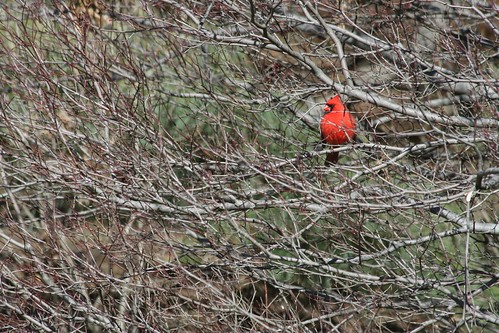
Debbie Becker leads a free bird walk at the Garden every Saturday from 11 a.m. to 12:30 p.m., beginning at the Reflecting Pool in the Leon Levy Visitor Center. Join her tomorrow, December 13, for the 2008 New York Botanical Garden Bird Count.
Every year at this time, birders flock to the parks and woods across the country and beyond for National Audubon Society’s annual Christmas Bird Count. From dawn’s early light until dusk birders count all the birds they can find using a specific method and within precise geographic areas. At the end of the day the counts are tallied and compared to numbers from previous years. The information is used to determine if a bird species is in trouble or declining. Past revelations included lower than usual numbers of house finches, most likely due to conjunctivitis, and decimated crow numbers, presumably due to West Nile Virus. Occasionally, a rarity will pop up on the count as birders scour the shorelines, forests, and meadows looking for elusive visitors to their areas. Past special sightings at the Botanical Garden, which is part of Audubon’s 84-year-old Bronx-Westchester count, include common redpolls, chipping sparrows, pine warblers, Baltimore orioles, and a merlin.
Twenty years ago I started the Garden’s own unofficial bird count, a low-keyed version that is fun and educational. Instead of gathering at 5 a.m., we meet at 11 a.m. and set out to count the birds at NYBG. I keep a list of the most common New York City birds and put strokes near their names as we spot them flying by. The two decades of data from our informal count confirms the trends found in the Audubon count.
Read about the birds likely to be found on the count and of a special sighting last year after the jump.
UPDATE 12/18/08: Bird walk results
Count day was sunny and cold, with temperatures in the 20s. Nineteen people participated; the count lasted three hours and turned up 24 species and 105 birds overall. Highlights of the day included a northern shoveler at Twin Lakes, both the female and male great horned owls in the Forest, and a goshawk, for the second year in a row, by the Prop Range. A flock of house finches, a brown creeper, and a house wren also were good finds. The full list is noted here.
House finch: 12; House sparrow: 3; White-throated sparrow: 5; Black-capped chickadee: 8; Dark-eyed junco: 15; House wren: 1; American crow: 1; Blue jay: 2; Northern cardinal: 2; Mourning dove: 9; American robin: 3; Red-bellied woodpecker: 1; Downy woodpecker: 1; Tufted titmouse: 3; White-breasted nuthatch: 1; Brown creeper: 1; Northern mockingbird: 3; Hermit thrush: 2; Great horned owl: 2; Red-tailed hawk: 2; Northern goshawk: 1; Northern shoveler: 1; Mallard: 23; Hooded merganser: 3; (Last week, 30 wood ducks were counted.)
The NY Times, TV, and Even the New York Lottery Charmed
Nick Leshi is Associate Director of Public Relations and Electronic Media.
The Holiday Train Show at The New York Botanical Garden has been a magical must-see for more than 1 million visitors over the past 17 years. Edward Rothstein of The New York Times called it “exhilarating,” marveling at “the wonders of this annual show” that presents “New York through a looking glass.”
David Hartman, popular television personality, produced and narrated a charming documentary about the Holiday Train Show, revealing how the structures are made from natural materials and displayed to the delight of visitors of all ages. The documentary aired last year 528 times across the country on 285 PBS stations.
In case you missed it, below is a clip of the show. You can catch the entire program tonight, December 11, at 10:30 p.m. on Channel Thirteen/WNET-TV. It will air again several times during December on PBS, including on WLIW-TV; check the online schedule. If you’re looking for a stocking stuffer or holiday gift for a loved one (or for yourself), the documentary is available on DVD at Shop in the Garden
After viewing the clip, you’ll see why the Holiday Train Show has been a sought-after location for singular New York events. That tradition again rang true last week when the New York Lottery awarded more than $17 million to two winners before replicas of the Empire State Building, Rockefeller Center, Radio City Music Hall, and others and to the delight of a festive crowd of visitors young and old that erupted into spontaneous congratulatory applause.
There have been other occasions over the years when Holiday Train Show visitors received an additional unexpected treat, including a marriage proposal between New York City police officers that was nationally broadcast on the Today show and a mayoral press conference that touted the wonders of the holiday season in New York. Amid the glow of twinkling lights in the Botanical Garden’s Enid A. Haupt Conservatory, the Holiday Train Show proved the perfect magical setting for these memorable events.
Make your own memories by coming to see the Holiday Train Show in person, through January 11, 2009. Tickets are available for purchase on the Garden’s Web site. See for yourselves what Mr. Rothstein in his review described as “this phantasmagorical landscape, which at twilight comes alive with illumination.”
Amanda Gordon, a writer and consultant to the Garden, first wrote about NYBG when she was a reporter at the New York Sun.
A glittering flurry hit the Holiday Train Show last Friday night when it became the setting for The New York Botanical Garden’s 10th annual Winter Wonderland Ball. Sponsored by Chanel Fine Jewelry, this black-tie event raised $250,000 for the Children’s Education programs at the Botanical Garden and brought 350 guests to the sparkling Enid A. Haupt Conservatory and adjacent tent for cocktails, dinner, and dancing. During the past decade, the ball has become a tradition for supporters of the Garden in their 20s, 30s, and 40s.
“I look forward to this all year. It’s the most festive Christmas event. It’s so nice to get out of the city and be surrounded by a beautiful environment and all fun, good friends of our age group,” one of the ball’s chairmen, Alex Kramer, commented. “It’s also nice because you get out of the city and you have just green everywhere,” another chairman, Christian Leone, said.
Designers Erin Fetherston and Holly Dunlap attended, along with model and writer Jessica Joffe and Marie Claire’s fashion director Nina Garcia of Project Runway fame. The guest list for the event was so fashionable that Vogue set up a photo booth to take pictures of guests for the magazine’s February issue. Bill Cunningham of The New York Times also snapped away.
But the eye-catching gowns competed for attention with the equally eye-catching trains, bridges, and buildings featured in the Holiday Train Show. “I wish I were a little person who could ride on the trains,” model Coco Rocha noted before getting in front of a camera to interview guests about their outfits for the Web site Style.com.
For Chanel, the event was an opportunity to support an important New York institution as well as to enhance the botanical legacy of its signature flower. “We’re excited tonight because we’re working with the Garden to create a variety of camellia that is going to be named after Coco Chanel,” Chanel’s Division President, Fashion, Fine Watches & Jewelry, Barbara Cirkva Shoemaker, revealed.
With or without fancily clad guests, the fairyland atmosphere is present for all visitors to the Holiday Train Show, which runs through January 11 and is especially magical for children. “I brought my young son today,” a Ball committee member, Adelina Wong Ettelson, said. “It’s pretty amazing for a four-year-old to see; actually, it’s pretty amazing for a somewhat older than 40-year-old.” Ms. Wong Ettelson hinted that she might come back for another visit. “I told my son that if he was a really good boy, I’ll bring him back to see Thomas the Tank Engine in January,” she added. The popular character will be visiting the Botanical Garden from January 3 through January 11.
Charles M. Yurgalevitch, Ph.D., is the Director of the School of Professional Horticulture.
Each year the School of Professional Horticulture—a professional gardener-training program at The New York Botanical Garden—allows its first-year students to practice what they have learned in the classroom and in the field through the design and implementation of a student garden. It is an opportunity for students to use their newly acquired skills in a creative manner. Students split into three design teams, each of which drafts a plan for the student garden, which is situated in the Home Gardening Center, a place frequented by the public. A panel of the Botanical Garden’s horticulturists chooses one winning design and suggests alterations; the design is then installed and maintained by all the first-year students the following summer.
The proposals for each team from the Class of 2010 are described below. Make sure to visit the student garden next summer to see the implementation of the selected design.
Natives & Neighbors
We wanted to focus on native plants with an emphasis on plants of North America, but also including plants of Central America and northern South America. There are no Asian or European species. We are especially fond of the work of Piet Oudolf, who has designed the recently planted Seasonal Walk here at the Garden. We sought to design a garden that would partially serve as an educational tool within the larger context of the Home Gardening Center to show native plant specimens, some of which may be surprising (native canna, native rose, native marigolds). However, we’ve included Central American and South American natives to provide color early in the season and to put the garden in the larger context of a real show/display garden. The main colors will be violet, lilac, purple, and rose-pink, with accents of chartreuse and yellow. We expect this garden to offer color from the end of May to early November; it will also provide excellent and exciting fall color (Solidago canadensis, Muelenbergia, Echinacea, Eupatorium purpureum, Callicarpa americana, Salvia leucantha, Hydrangea quercifolia). —Peter Couchman, Amanda Knaul and Alyssa Siegel
The Sunburst Garden
We aimed to create a garden that gives a sunburst effect, like a morning sunrise, with colors going from yellow to orange to pink to purple. There will be flowers throughout the summer season, with a greater textural component in late summer/early fall due the grass inflorescences. Textural effects will come from the sweeping movements of feather grass (Nasella), Panicum, and Veronicastrum. An amphitheater-like impact will be achieved with lower plants in the front and larger and fuller plants spreading out toward the sides and back. —Ashley Burke, Gabriela Marin, and Barbara Pearson
The River Bed
In creating this design, we wanted to represent of a river or streambed, with rocks, moss, and plants growing along the banks; we were influenced by the Dutch garden of Keukenhof. Think of an English cottage sitting on the banks of a stream. The rocks (three clusters of small-sized boulders) will provide contrast with plants. Grasses like Miscanthus and Pennisetum will be on the left side; the right side will be anchored with oak-leaf hydrangea. Along the back side will be Panicum and pampas grass. In the middle there will be a broad sweep of blue-flowering Ageratum. The front edge will have Ajuga, moss, and Mexican feather grass. The sequence of bloom will begin with Irises and dwarf daylilies in early June, followed by Hemerocallis. The peak will be in July and August with perennials like Rubdeckia and Monarda and Echinacea. The plants have been selected to add texture, height, and color for late-season interest. —Christopher Bale, Naftali Hanau, and Brian Kennedy
Kevin Peterson, Assistant Manager of the Everett Children’s Adventure Garden, is responsible for the design and fabrication of exhibits in the Children’s Garden.
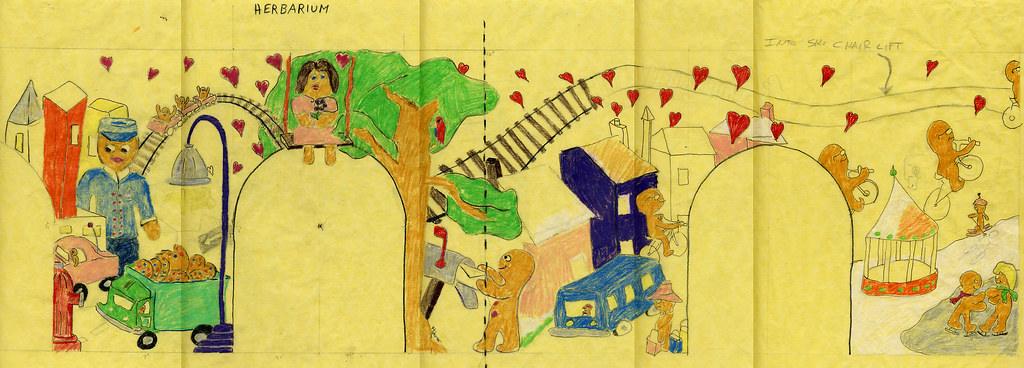
We had a great time creating the new decor for Gingerbread Adventures in the Everett Children’s Adventure Garden. We had wanted to do something a little different for its seventh season. I sat down with Jim Storm, senior museum technician, to brainstorm about the project, and we began to develop some initial ideas. Next, I did some preliminary sketches of a gingerbread town on a roll of vellum. Those series of drawings were the launching pad for the new look. As we started building, our concepts continued to evolve, we continued to collaborate, and Gingerbread Town took on a life of its own.
One aspect of our design was to have the gingerbread people look like they were occasionally popping out of the wall and existing in “our” space as well as having their own adventure. As it became a 3D reality, some things had to be reworked from the drawings because of the limitations of the physical space. The timeline was also very challenging: We started in early August and just kept plowing away at it until we installed it the week before Thanksgiving.
We completed the city scene first and then moved onto the country and farm scenes. Next came the gingerbread couple ice-skating under a cookie moon. But maybe I should stop there so I don’t give it all away. Jim and I were able to add pigment to caulk so we could “frost” the gingerbread people and make other objects look like big cookies. It was quite successful in that the gingerbread people and their world really do look good enough to eat. We wanted to have kids feel as if they walked into a fun-filled fantasy world and to light up their eyes and to spur their imaginations. We wanted a world that made them feel good. One little boy who visited made sure he said goodbye to all his gingerbread friends before he left the Adventure Garden. That was pretty nice.
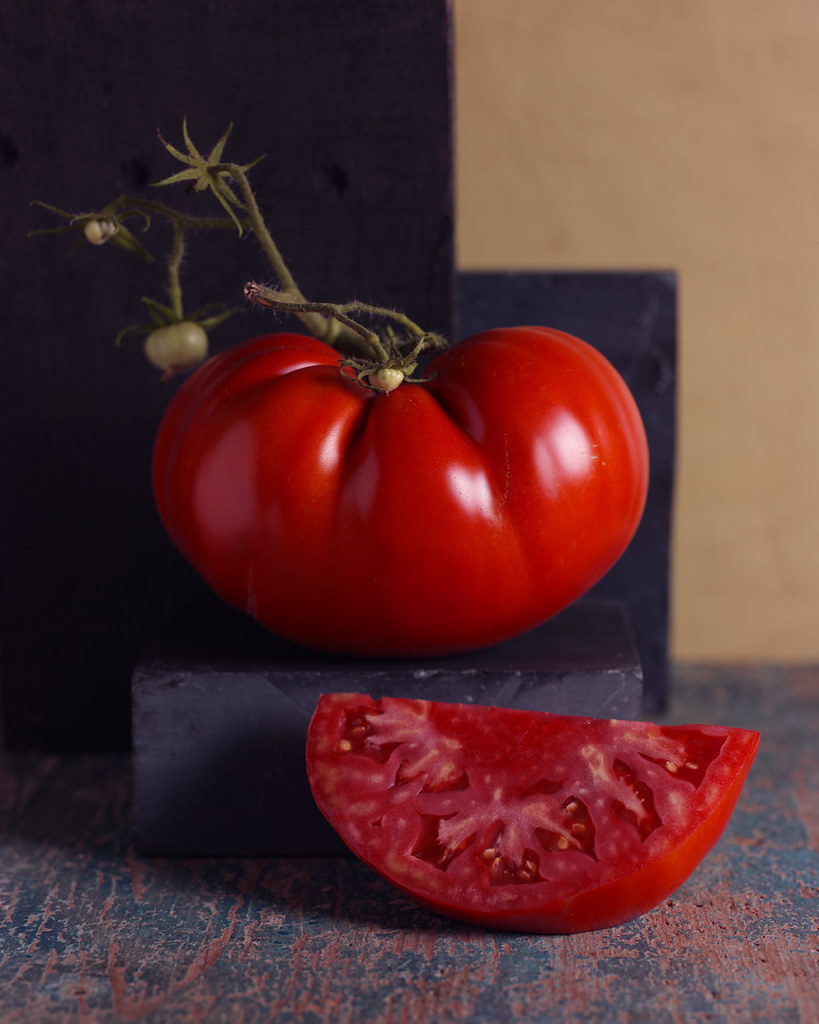
Visitors to the annual holiday puppet theater production of The Little Engine That Could™, which opens this weekend in the Arthur and Janet Ross Lecture Hall, will enter through the Ross Gallery, where they will be welcomed by The Heirloom Tomato, an exhibition of bold, bright photographic still lifes. Here, Victor Schrager, the award-winning artist behind the images, talks about how he made these magnificent portraits of historic tomato varieties from the gardens of Amy Goldman. The two have collaborated on several books, including the most recent The Heirloom Tomato: From Garden to Table as well as The Compleat Squash: A Passionate Grower’s Guide to Pumpkins, Squashes, and Gourds (2004) and Melons for the Passionate Grower (2002), all available at Shop in the Garden.
Victor Schrager is the photographer featured in the exhibition The Heirloom Tomato.
The shooting to produce Melons for the Passionate Grower took one year. The Compleat Squash was done over two years. The Heirloom Tomato was planned to be much more extensive than either of those: The photographs would have to be done when the fruit were ready, so the photographs were made at all times of day in all kinds of weather. The project eventually lasted five seasons.
It was important to give the work its own unified sense of time and place—a quality I find in the best botanical illustrations and photographs, in vivid distinction to garden catalogs. To achieve this, I used a single artificial light in a studio I made in a barn near Amy Goldman’s garden. So the photographs took place in their own time.
During the first three seasons, I used an 8×10 wooden Deardorff view camera (the kind where you put a dark cloth over the back of the camera to see better to compose); the last two seasons I used a Sinar 4×5 digital view camera—the closest digital approximation to the qualities of the large-format transparencies I had made during the first three seasons and the most similar in use to my film camera. I would like to think you cannot tell which are which.
Various objects—teacups, marble blocks, colanders, spice cans, etc.—were used to put the tomatoes on a pedestal, giving each picture a unique architecture derived from the tomato’s place in domestic life in the kitchen and garden over its long history.
George Shakespear is Director of Science Public Relations.
One of the pleasures of working at The New York Botanical Garden is meeting scientists from around the world and learning about their fascinating botanical exploration, biodiversity research, and conservation projects. The Garden is a nexus of international plant science, where scientists come to consult the incomparable collections in our herbarium and library, to confer with the Garden’s staff scientists, or, as happened the week before last, to accept a well-deserved award and to share information on current projects.
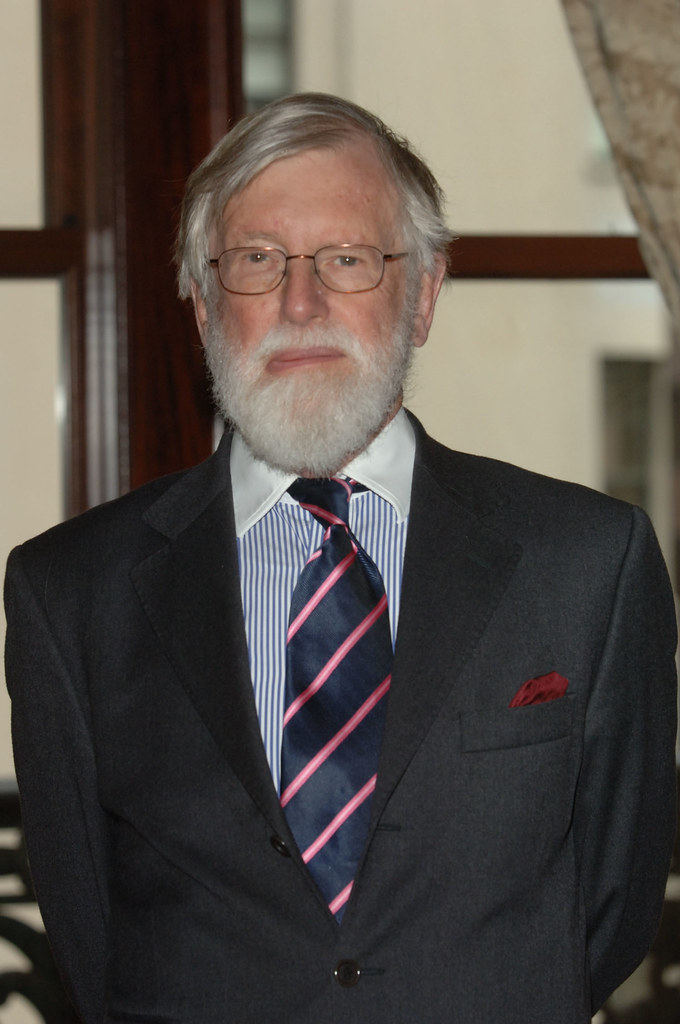
I attended the presentation by distinguished economic botanist and former Botanical Garden scientist Sir Ghillean (Iain) T. Prance on two current (and very different) projects. In the largest tract of rain forest in northern Argentina, he has been studying the ethnobotany of the Guaranà people, documenting their use of plants. The Guaranà are threatened by the expanding timber extraction industry. One result of his team’s documentation has been the purchase of more than 12,000 acres of land by the World Trust Fund to return ownership to the GuaranÃ. Sir Prance also talked about his systematic studies of Barringtonia, a genus of flowering plants.
Prance was in New York to receive the Gold Medal of The New York Botanical Garden. The medal, the highest honor conferred by the Botanical Garden and awarded very infrequently, acknowledges contributions made by individuals in the fields of horticulture, plant science, and education. Iain Prance served for more than a quarter century at the Garden, arriving as a post-doctoral researcher and departing as Senior Vice President for Science. In 1988, he returned to his native Great Britain to become Director of the Royal Botanic Gardens, Kew (1988–1999). He was knighted in 1995.
Prance is perhaps the most prominent scientist in botanical exploration of Amazonian Brazil and is vitally interested in the documentation of the use of plants by indigenous peoples in Amazonia. That led him to found in 1981 the Garden’s Institute of Economic Botany, whose programs continue to thrive and grow.

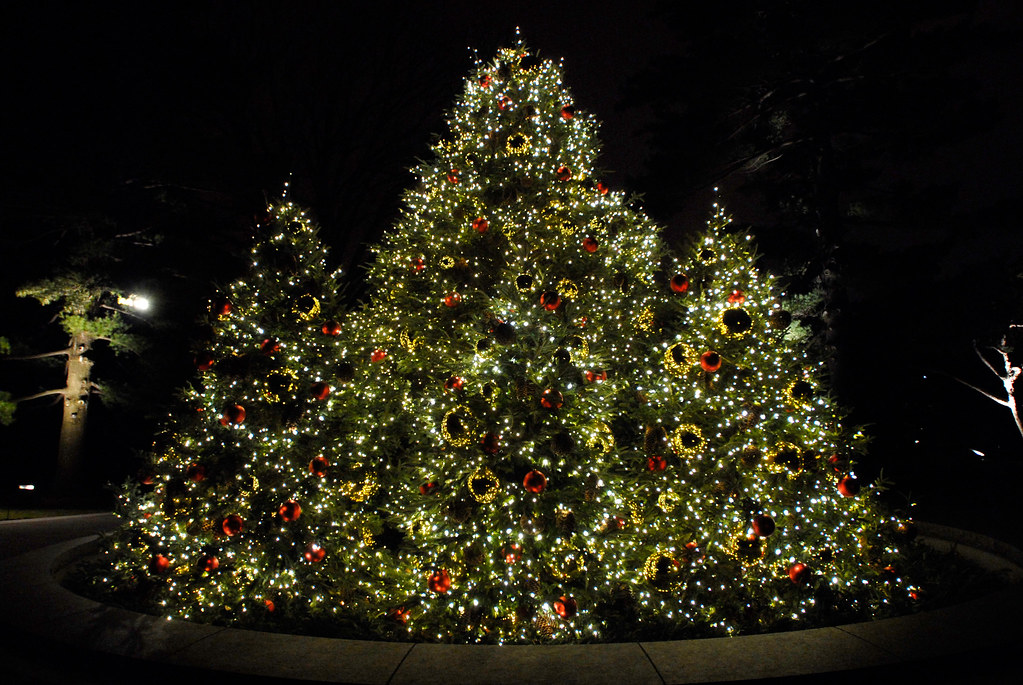 Planning for the holiday celebrations at the Garden starts long in advance. At this time last year the holiday display in the Reflecting Pool in the Leon Levy Visitor Center was evaluated and decisions were made concerning additions, deletions, and upgrades for this year’s display.
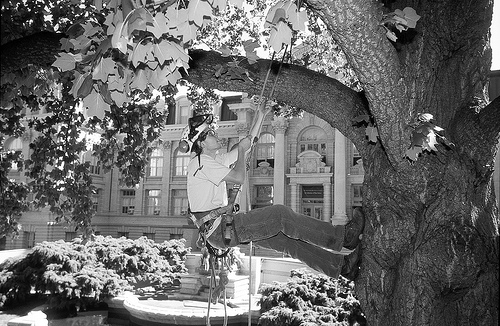 If someone had told me then that you could actually make a career out of climbing trees, I would have said, “Where do I sign up?” And now, when I speak with passionate recreational gardeners about the frustrating shortage of skilled horticulturists, many respond with similar wide-eyed surprise: “You mean I could do this for a living?”