Rustin Dwyer is Visual Media Production Specialist at The New York Botanical Garden.
Friends of The New York Botanical Garden, Barbara and Bill Friedrich, demonstrate their vintage-style apple press to make some delicious, fresh apple cider to share.
Dachell McSween is Publicity Coordinator at The New York Botanical Garden.
During this time of rising unemployment rates and slow economic growth, thoughts turn to job security and the possibility of having to find a new career.
Tonight and tomorrow evening, The New York Botanical Garden is offering free Career Information Sessions to help people discover “green” job opportunities in landscape design, horticulture, floral design, and horticultural therapy.
The Garden’s Continuing Education instructors, who are experienced professionals, will talk about each of these disciplines, and former students will discuss what it is like to be employed in these fields and how NYBG gave them the skills and knowledge needed to be successful.
For more than 80 years, the Garden has been helping people achieve their horticultural education goals. Many students who attend are career changers from a variety of occupations, including marketing, information technology, law, and medicine. They come to the Garden to follow their passions and explore new job opportunities. “Not only is it something they can be passionate about, but it is an area where there are opportunities,” Jeff Downing, Vice President for Education, told the Daily News.
Read about some of NYBG’s successful “graduates”: Margaret Ryan, who went from corporate speechwriter to floral designer; Curtis Eaves, who shifted from textile design to landscape design; and Bonnie Johnson, who worked as a package designer for two decades and in just two years found success as a floral designer.
If your dream job is to get out of the office and become closer to nature, the Career Information Sessions will get you started on the path to a new career.
Madeline Yanni is an instructor of Botanical Crafts in NYBG’s Continuing Education program.
With autumn and the holidays at hand, it’s an inspiring time to bring the outdoors inside by creating botanical centerpieces, topiaries, wreaths, gifts, and more. Handmade items can save you money and even time—I like to make crafts that, with some interchangeable elements such as candles or ribbons, can be used in more than one season.
The Continuing Education program offers a number of hands-on crafts courses to help you decorate your home with your own creations throughout the year, including this Saturday’s Holiday Crafts all-day program. Even if you’ve never done this before, don’t be inhibited. No experience is necessary. Come take a class or two.
I want to draw out your creativity and whet your appetite for this fun way to decorate with a step-by-step guide to creating a simple, inexpensive, wreath for your table. It can be changed from season to season and can also be used on your wall. It is made from a grapevine wreath adorned with parchment roses, seeded Eucalyptus, other botanicals, and pillar candles—materials available at a crafts store. Feel free to improvise and use other types of botanicals.
As with any crafts project, first read the instructions and collect the necessary materials.
Are you ready? Let’s begin!
See the materials checklist and detailed, step-by-step instructions for creating this seasonal holiday table wreath after the jump.
My fingerprints are all over this town, high and low, in all neighborhoods, including those with fancy addresses with sweeping views, luxury buildings, and hotels as well as low income housing project courtyards. A GreenStreets park I plant in my uptown neighborhood is a labor of love. New York is my city; my career is about enhancing its green beauty quotient and sustainable functioning.
NYBG’s Landscape Design Portfolio Lecture Series has served for me as an access ramp to the world of international design culture. The presentations of the past few seasons have offered a rich feast. Through a previous speaker, Fernando Caruncho, who was new to me, I found that some designs, such as his grids of olive trees and wheat field patterns, are best appreciated by helicopter—how exciting! This led me to view my own work in a fresh way, as strong patterns to view from afar.
Thus my perspective shifted on my work in general; I began to see my gardens as microcosms of the Big Picture of Garden Design and to approach the garden layout with new eyes.
It feels great to be making New York beautiful, garden by garden. I have designed so many, installed so many, and worked on, rejuvenated, or created so many from a wreck of a neglected courtyard, the back of a brownstone, a rooftop, or a terrace. I have reclaimed dreadful spaces and made them into havens, many with inspiration gained from the lecture series.
The Landscape Design Portfolio Lecture Series is a vital educational tool; the format is perfect, and Susan Cohen, coordinator of the Landscape Design Program, continues to choose exceptional speakers. The consistent high quality and world-class talent of the lineup makes the series a winner.
Carol Capobianco is Editorial Content Manager at The New York Botanical Garden.
With the recent wet weather you may have noticed that mushrooms are, well, mushrooming—in moist areas of your garden, on a pile of mulch, in a nearby woodland.
Here at the Botanical Garden, from the end of June to the first frost you may see Dr. Roy Halling, Curator of Mycology, walking about the grounds after a significant rainfall in search of his favorite subject. He has dedicated his life’s work to studying mushrooms. “I want to know what they are, where they grow, and how they are related to each other.”
The casual observer can see about 40 to 50 different types of mushrooms at the Garden over the course of the season. Roy’s top three spots are Twin Lakes, the bottom of Azalea Way, and the Arthur and Janet Ross Conifer Arboretum. At the base of pines and oaks are the best places to look because of the symbiotic relationship between the roots of these trees and mushrooms.
Although, after almost 25 years on staff at the Garden, he knows where to look, he’s not always certain what he’ll find. “I search near Twin Lakes and used to find mushrooms there. The oak tree is still there, but there are different mushrooms now. The others either aren’t there or they’ve moved.”
Moved? Yes, mushrooms will travel—or actually not return and appear elsewhere—according to their nutrient needs.
Roy travels, too. He’s been to many parts of the world and has co-authored a guide to mushrooms of Costa Rica, but his specialty has been researching the fungi (the group to which mushrooms belong) of Australia and Southeast Asia. His current project, with a grant from the National Geographic Society, is to explore for and document the mushrooms on the world’s largest sand island, Fraser Island, north of Brisbane. Roy has found that fungi provide the nutrients for the survival of the rain forest that otherwise implausibly exists on this island.
Learn more about Roy and his work with mushrooms after the jump.
Wendy Hollender is Program Coordinator for the Botanical Art and Illustration field of study in NYBG’s Continuing Education program.
Nature in New York, the first exhibition of NYBG’s Botanical Art and Illustration program, featuring the work of students, faculty, and alumni, is open and going strong at the New York Open Center in SoHo. The show features 48 pieces by 32 different artists.
As the coordinator of the program and an instructor at the Garden I became the organizer of the exhibit. We wanted this to be a professional, juried show and to choose the best work possible. The week before the opening, two prestigious botanical art shows also opened in Manhattan: the annual American Society of Botanical Artists juried show at the Horticultural Society of New York and the Florilegium Society exhibit at the Brooklyn Botanic Garden. I have personally exhibited in both these shows and find these to be truly breathtaking. How would our first show hold up by comparison?
Opening night came. Would there be enough food and drink? Would anyone come? The show itself had been beautifully hung thanks to two artist volunteers, Doris Downes and Linda Vredenburgh, who had offered to help me and Maria Rodriquez, Director of Exhibitions at the Open Center, where classes from the Botanical Art program are held. Doors opened at 7:30 pm and the gallery was immediately flooded with a steady stream of enthusiastic people. By night’s end at least 200 people came and didn’t seem to want to leave! One visitor said this was the best opening they had ever been to. “The work had precision, expertise, and artistry,” she went on to say. Some said it was hard to tell the work of students vs. faculty and that it was all beautiful and professional. The students who worked extremely hard on their botanical masterpieces were so proud to be included in an exhibition in a public venue. Instructors were happy to be a part of the exhibit and also pleased with the quality of the students’ work.
I encourage you to go and take a look at the exhibit. From fall’s harvest to spring’s first blooms it is truly a feast for the eyes.
Nature in New York is on through November 7. For hours, call 212.219.2527, Ext. 135. The Open Center is located at 83 Spring St., between Broadway and Lafayette, in Manhattan.
Also this weekend is a full slate of programming. Click here for details.
Sean Ealey is a student in the Continuing Education Department’s Landscape Design Program.
My experiences at the Botanical Garden have been tremendously rewarding ever since my first visit last spring to its wonderful gardens and classrooms. Being a student here has been not just a creative endeavor but a personal one as well.
NYBG has given me the ability to take the seeds of my design ideas, express them both verbally and visually, and watch them flourish. It has also provided me a sense of connection with my surroundings and the inspiration to share it with others.
The courses have given me a broad understanding of the landscape design industry and ways to communicate my personal and professional goals. I am especially thrilled about the Landscape Design Portfolio Series, the opportunity of seeing and hearing award-winning architects and designers.
I used to get such a thrill when my NYBG Continuing Education Catalog would come in the mail; I would fantasize about all the enjoyable things I could learn. I say this in the past tense because now it’s just so easy to peruse the Continuing Education Web pages anytime and find all the information I need about classes and instructors online. It’s easy to navigate, fluid, and reliable, making it so simple to sign up. And, I get an immediate reply so that I know that I’m registered.
Trust me, NYBG is full of inspiration. Come and see for yourself—or check it out online.
Chef Paul Yeaple, the Community Markets site manager for the Farmers Market held at The New York Botanical Garden, talks about some of the differences between the locally grown apples available for purchase.
Divide and Conquer Sonia Uyterhoeven is Gardener for Public Education at The New York Botanical Garden. From time to time, some of your perennials will start to languish. It’s not the heat or a lack of moisture that is the cause. Sometimes they just outgrow their space, start to sprawl all over the place, and slowly die out in the middle. When this happens, it is time to divide your perennials.
The general rule of thumb is to divide spring flowering perennials either immediately after flowering or in the fall, and to divide fall flowering perennials in the spring.
When you dig up the perennial be generous with the size of the root ball so that you get a good amount of roots. Garden forks often work better than spades since they do not slice through the roots.
If you are dividing in the fall, cut back the foliage to six inches—this will make it easier to see what you are doing and will help redirect the energy of the plant back into root growth. Water the perennial a day or two before you divide it to make digging easier and to make sure the plant won’t be stressed. Make your divisions large enough: A minimum of a quart-size pot is a good standard size.
Divide clumping plants such as astilbe (Astilbe), hosta (Hosta), ornamental grasses, or daylilies (Hemerocallis), with the double fork method or by slicing through them with a spade. For spreading plants such as lamb’s ears (Stachys), asters (Aster), and bee balm (Monarda), pull them apart by hand or sever with a knife or spade.
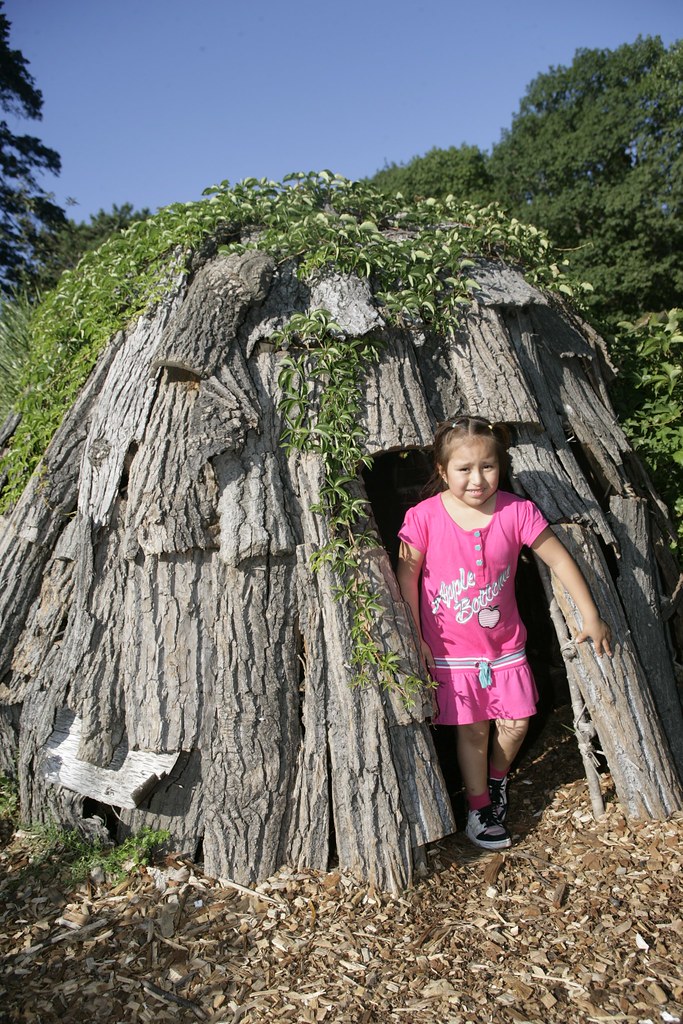
Indian Summer at the Howell Family Garden Annie Novak is coordinator of the Children’s Gardening Program. Two years ago, two men named Eric built a second home. It wasn’t a vacation spot nor was it particularly accommodating for men of their height. At first, the only inhabitants were chipmunks, squirrels, and the occasional investigatory rabbit.
Soon, however, the house was full of noise. Children busily explored the low dome of the interior and peered out the window into the neighboring garden. So it was that in 2006, the wigwam that Eric Wright and Eric Sanderson built became the latest structural addition to the Ruth Rea Howell Family Garden.
Although it’s the first wigwam in The New York Botanical Garden, it is by no means the first to grace the cliffs along the Bronx River’s shore. As Sanderson is quick to explain, for the 5,000 years before New York City’s skyline dominated the Hudson, Native Americans lived along the river system. Known as the Lenape, they inhabited the large area they called Leanapehoking all throughout New York and New Jersey, as far as the Delaware Water Gap.
Learn more about the wigwam in the Family Garden after the jump.