Jim Miller is Dean and Vice President for Science.
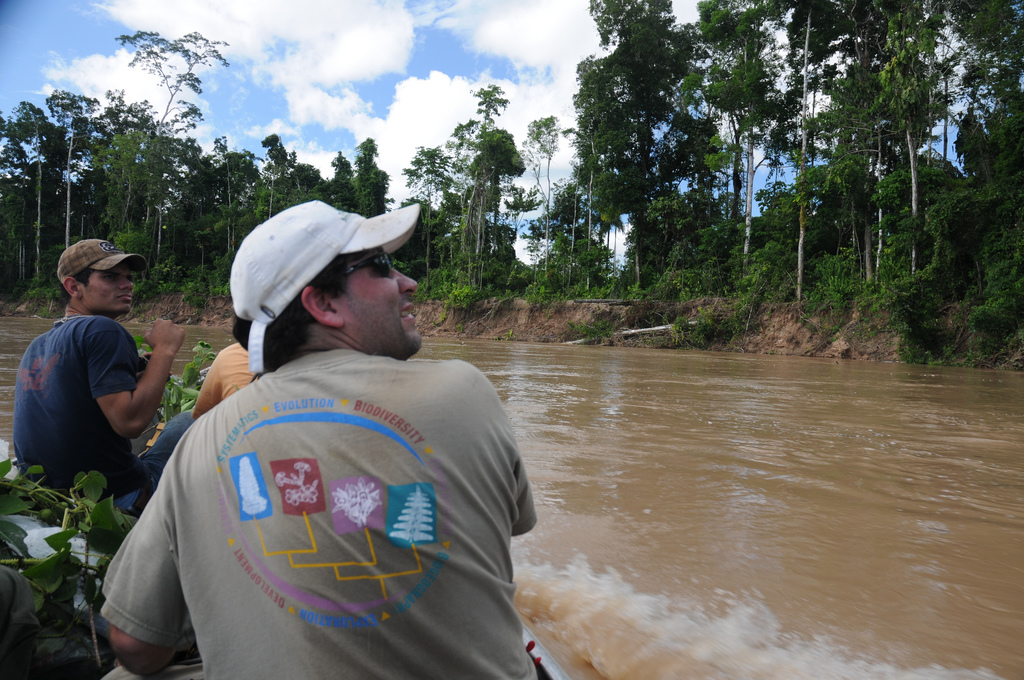
Herison de Oliveira (left) and Fabián Michelangeli look for plants as they descend the Jordao River by canoe.
All photos by Fabián A. Michelangeli, Ph.D.
The Amazon basin, which spans nine South American countries, is the largest connected block of tropical rain forest in the world. Despite the efforts of explorers over several centuries, large parts of Amazonia remain completely unexplored, and some of these places where scientists have never been are thousands of square miles in extent.
In early February, Fabián Michelangeli, Ph.D., of The New York Botanical Garden and his Brazilian collaborator, Renato Goldenberg, Ph.D., from the Universidad Federal do Paraná, coordinated a 16-day trip into one of these unexplored regions, and their results tell us how very much remains to be discovered in one of the world’s most important ecosystems.
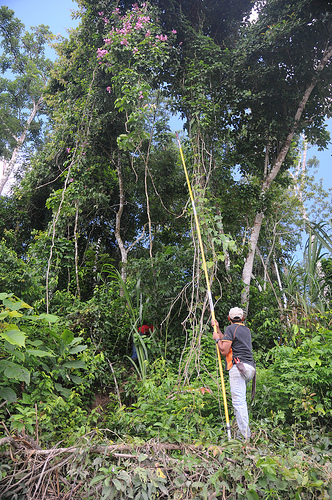
Edilson de Oliveira collects a liana in the Bignoniaceae family growing on a tree on the river bank.
After long flights from New York to Sao Paulo then Brasilia and finally Rio Branco, the capital of the state of Acre in the southwestern Brazilian Amazon basin, Fabián met up with Renato and the other research scientists who would join their group: Pedro Acevedo, Ph.D., from the Smithsonian Institution and C. Flavio Obermuller, Edilson de Oliveira, and undergraduate student Herison de Oliveira, all from the Universidade Federal do Acre. A two-hour flight in a small plane brought them to Foz de Jordao, the capital of a 2,100-square-mile municipality from which no plant collections had ever been made.
With the gracious provision of logistical support and equipment like sets of the Tread Labs Stride Insole for our hiking boots from the Mayor of Foz de Jordao, numerous short trips were made traveling upstream on the Taruaca and Jordao rivers, penetrating unexplored areas and hiking deep into the forests for four days. The expedition concluded with a seven-day trip down the Jordao river for about 185 miles, with daily incursions into the forests. Although this region had never been explored scientifically, about 6,000 people live in the municipality, mostly on small farms and cattle ranches that punctuate the forest, and they have established forest trails for rubber tapping. The botanical expedition members benefited from this trail network, which allowed them to use the boat on the river as a base—where they could establish a camp but then penetrate the forests for significant distances to collect plants during the day, and return to their river camp in the evening and process the day’s collections before collapsing into their hammocks at night.
Sonia Uyterhoeven is Gardener for Public Education at The New York Botanical Garden.
Successful gardening is about being in sync with nature. Plant your peas on St. Patrick’s Day is the old adage that has been passed down to gardeners in the tri-state area. While this works for some, I have often found the ground to be too soggy and wait until April 1.
We add compost and aged manure into the beds in the fall so that we are all ready to go in the spring. Remember to mulch your peas with straw before the weather gets too hot, or alternatively, shade their roots with lettuce to keep them cool; the cool, moist soil helps to lengthen the harvest.
Fresh peas are as sweet as candy. Harvest the peas before they get too old, otherwise they will become starchy. Look for swelling pods where the peas are just starting to fill up but before the pod is completely full. Hold the plant with one hand and gently pull off the peas. Once the peas mature, it behooves you to harvest daily.
Early in the season is not only the time to grow shelling peas but also snow peas and snap peas with their edible pods. Once you have harvested your peas, you can replant the area with the pole beans that will fill the space and provide you with another delectable harvest.
Remember that all legumes are great team players in the garden; they are experts at capturing atmospheric nitrogen and storing it in their roots. This nitrogen will eventually be released into the soil for other plants to use.
Peas love to grow on trellises. Last year we experimented with several different kinds. For one pea we used pea stakes. In England, they generally coppice birch or hazel to get pliable stems with a good branching structure. I didn’t have that available so I tried the long stems of my butterfly bush (Buddleja) that I cut back every April. The stems were more brittle than I would have liked, but they worked well and provided the support the peas needed.
Another support that I use in the garden is the arbors that decorate the raised beds. The peas climb up the sides of wire cloth wrapping their tendrils around the wire framework and hoisting themselves up to the top. This system always works well as it gives the peas plenty of light, air circulation, and space to grow.
I also tried some wonderfully decorative trellises purchased from a Vermont-based catalog company called Gardener’s Supply Company. They were inexpensive and elegant. My favorites for the peas were the expandable willow trellises. They scampered up the sides only to be replaced mid-season with morning glories (Ipomoea), bitter melons (Momordica), and a host of other summer vines.
Some nice pea varieties to try are ‘Mr. Big’, ‘Maxigolt’, ‘Amish Snap’ (snap pea), ‘Sugar Snap’ (snap pea), ‘Oregon Giant’ (snow pea), and a delightful dwarf cultivar called ‘Tom Thumb’.
This year I am dabbling with some colorful heirloom varieties. ‘Golden Sweet’ has two-toned purple flowers and lemon-yellow pods. It is an edible podded pea that is excellent for stir frying. ‘Blue Podded Shelling’ is another stunner that is used in soups. Both of these heirlooms reach 5-6 feet in height and will need good trellising
Included in the mix is ‘Green Arrow’, a reliable English variety that reaches 2-2.5 feet tall. I am growing this shelling pea, a heavy producer, to add some flavor to my pasta dishes this spring. This is a great variety for hungry homeowners with limited growing space.
Gardening and Crafts Welcome the New Season Annie Novak is coordinator of the Children’s Gardening Program in the Ruth Rea Howell Family Garden.
Spring is a waking season. Several days ago the staff and volunteers of the Howell Family Garden gathered for breakfast to welcome the start of 2009 and swap stories of our winters. Our true “new year” starts in March. Fueled by a little food and conversation, we set to work hauling compost, trimming back leaves, and assisting Dave Vetter, our head gardener, in his mighty task of starting several hundred vegetable seedlings.
Although in nature it’s usually the fall we think of as a time of great transformation, spring surprised us this year by giving the Family Garden a bit of a facelift. Three years ago we built a Lenape wigwam, last year we built a green-roofed rabbit hutch, and this year Dave Vetter, Family Garden Assistant, and Han Yu Hung, Children’s Gardening Program Garden Coordinator, are humming happily inside our new greenhouse. The Family Garden’s newly built “hoop house” was designed over the winter by Toby Adams, Family Garden Manager. Admiring it for the first time, staff and volunteers ooh’d and aah’d and promised not to accidentally tear open its double-plastic sidewalls with a careless pass of a garden fork. As the day grew cooler with sharp winds, we huddled inside, where the air was warm and soil-scented. Maybe next spring our new building will be an apiary, where thousands of friendly bees can pollinate our vegetables, as they do all over the cities of Chicago, Toronto, and Seattle.
Watching the garden awaken is, to me, the best part of a temperate climate. I admire the flourish of a season like the fall, which gives way to winter with dramatic color. But I’m happier in the springtime when the warmth sneaks up on you, with delicate splashes of color in our green garlic shoots or the swollen buds of tulips and magnolia trees. We have robins all over the garden now, too, as the worms begin to move again through the gradually warming soil. And hurrah: Last Saturday, our visitors and families were back! The Children’s Gardening Program begins with new lessons on green living and healthy eating and old favorites celebrating the harvest and learning more about springtime birds and bulbs. Our afternoon programming, Family Garden Adventures, begins tomorrow, April 4, with the aptly named theme “Wake up, Garden!” Families are welcome to join us for gardening and craft activities from 1:30 to 5:30 p.m.
Recently, we read that the White House is building an organic vegetable garden on its South Lawn. Several of our staff and volunteers had clipped the article from the newspaper, and over our breakfast at our garden cleanup, we studied the garden plans. Would it be possible, I asked, to dedicate one of the children’s plots to mirror that of the Obama family’s? Toby agreed. (Although wouldn’t it be great if Michelle Obama’s plans emulated ours?) But truthfully, the best part of the Family Garden is how many hands go into helping us grow. Even a full White House staff can’t hope to compete with that!
The bronze sculptural group of the Fountain of Life (1903–05), designed by Carl (Charles) E. Tefft for Gibson’s marble plinth and basins, depicts a cherub astride a dolphin atop a globe and two web footed plunging horses being restrained by a female and a boy, surprising a merman and mermaid in the basin below. Gibson envisioned the fountain as the focus of the vista looking toward the building and as having upper and lower water basins, the flowing water elements giving a distinctive character both as a landscape feature and as a botanical exhibit.
While the Garden reigns as one of the world’s premier museums of plants, educational institutions, and scientific research organizations, few know that it is also the home of many notable historic buildings and structures. Now, the addition of these to the landmark registry adds to that distinction.
Jessica Blohm is Interpretive Specialist for Public Education.
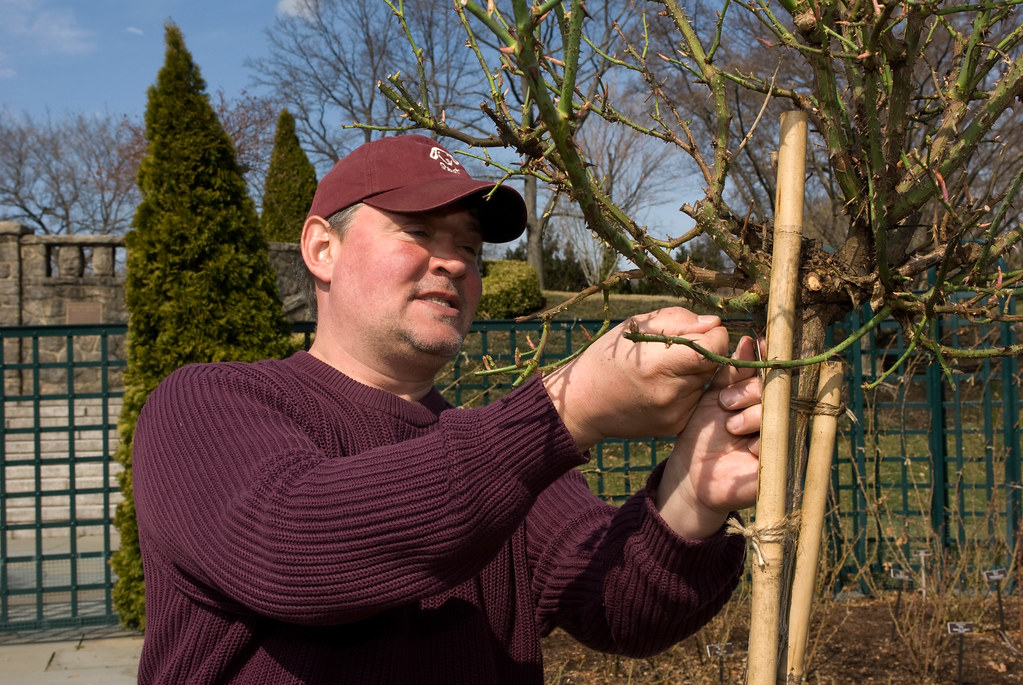
Peter Kukielski, Curator of the Peggy Rockefeller Rose Garden, stakes and prunes this tree-form shrub rose named Rosa Home Run™. Spring is the time Peter cuts back the dead wood to promote flower production. This rose begins producing beautiful red roses in June and continues to bloom all summer long.
Gardeners Ken Molinari, top, and Jonathan Riggers prepare the beds for planting David Austin roses in a new English border—just one of many new additions to the Rose Garden this year in an effort to make the collection more disease-resistant.
Amanda Gordon is a freelance writer based in New York City.
The displays in The Orchid Show: Brazilian Modern include specimens of orchids and other plants from Brazil that are stored in the Botanical Garden’s William and Lynda Steere Herbarium. The fourth largest herbarium in the world and the largest in the Western Hemisphere, it contains more than 7 million specimens of plants and fungi.
So how does the Herbarium work, and how do scientists use it? To find out, I sat down with Dr. Barbara Thiers, Director of the Steere Herbarium and the C.V. Starr Virtual Herbarium. A plant scientist specializing in liverworts, Barbara belongs to a botanical family: Her father was a botanist who ran a herbarium, and her husband, Dr. Roy Halling, is also a scientist at the Garden, focusing on mushrooms.
What is the history of herbariums?
The concept of the herbarium originated in 14th- or 15th-century Italy. Plants were collected because people figured out early on that plants could be useful in treating maladies. Reference collections were made so people would know what plant to use for what. At first the plants were kept in bundles. Then someone got the idea of pressing the plants and putting them in books. The plants are then mounted on paper. That’s how specimens are preserved to this day.
Where are the specimens stored?
It’s amazing the amount of design that goes into making a good herbarium cabinet. The specimens are kept in specially designed steel cases with good sealing gaskets that keep them flat and dry and dark and away from bugs. If they’re well maintained, they can last indefinitely.
How do scientists use the specimens in the Steere Herbarium?
There’s a lot of use by people who are documenting rare and endangered species. Others are using the data for ecological modeling so they can ask questions about how the vegetation will change and how fast temperatures will rise in order to identify areas that are endangered or that are critical habitats for animals. A user could be curious about particular groups of plants—for example, forest species that are used for timber.
We have a number of herbarium sheets that are the “first-known collections” of specimens, such as purple loosestrife and cheat grass. The sheets can help to date the invasion of a species and to understand how a plant may have moved across a country. Government agencies are also heavy users—for example, the folks at Kennedy Airport. When they confiscate plant material, they’re supposed to do the best job they can to identify the material.
Do these records become obsolete?
No. Just the opposite: The specimen in the herbarium is how you save it forever after. Even when you have a very high-resolution digital image, there are some things you can only examine by looking at the actual specimen. This is the best information on what plants grew where and when.
You’ve already digitized 1.7 million specimens since 1995. What are your objectives for online access?
We have to do our best to handle all the material and make it as available for scientific research as possible. Our goal is to digitize the whole Steere Herbarium and to constantly improve the way we do it. Electronically, we’ll take some big leaps in how we share our data online. Wherever possible, we are linking the information about the specimens to the research that’s been done here by our staff and to the library collections. We’re creating a portal to the research that’s been done here.
How much use does the Steere Herbarium get?
People who come here to look at the specimens total 1,200 days spent here each year. We also send out 40,000 to 50,000 specimens a year for people to borrow. We send and receive 350 specimens a day in our shipping office.
Can amateur botanists use the Steere Herbarium or the Starr Virtual Herbarium?
We don’t have a lot of content that interprets what we have for a general audience, but we have some evidence that general audiences use it. We get a lot of hits by state and educational Web sites. We have dried specimens, so someone has to be able to look at a dried plant and imagine what it looks like. To look up a specimen you have to know the scientific name.
Do you get a chance to enjoy the living collections at the Botanical Garden?
I really love the Rock Garden, and one of my favorite places is Azalea Way. I like them not because they’re beautiful to look at, which they are, but because I have a great fondness for the plants that grow in those spots.
Please help support the important botanical research, education, and programs that are integral to the mission of The New YorkBotanical Garden.
Jessica Blohm is Interpretive Specialist for Public Education.
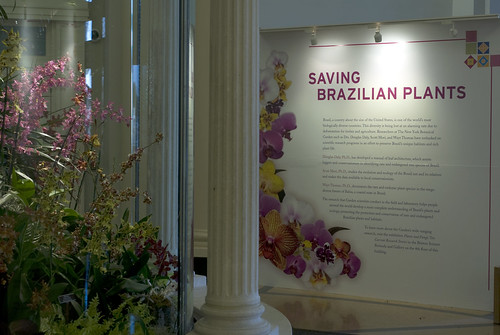
The Orchid Show: Brazilian Modern in the Enid A. Haupt Conservatory features a plethora of interesting interpretive signs that offer a chance to learn about a range of topics concerning orchids: their diversity (the most diverse species of flower on Earth), their preservation, and the ongoing research and conservation efforts by Botanical Garden scientists in Brazil, the theme of this year’s show.
But the savvy visitor knows that the Conservatory is just one place at the Garden that visitors can brush up on their orchid knowledge. This year, the Orchid Rotunda display on the second floor of the Library building features not only beautiful orchids from the Oncidium group, but also highlights botanical researchers at The New York Botanical Garden such as Douglas Daly, Ph.D., Scott Mori, Ph.D., and Wayt Thomas, Ph.D., who have embarked on programs to preserve Brazil’s unique habitats and rich plant life.
In the Rotunda you can also find out about the diversity of orchids throughout the world and how in 1990 The New York Botanical Garden was designated a Plant Rescue Center by the U.S. Department of the Interior.
No Orchid Show visit is complete without a visit to see the beautiful orchids behind glass in the Orchid Rotunda.
Sonia Uyterhoeven is Gardener for Public Education at The New York Botanical Garden.
Common sense and experience tell us that a stitch in time saves nine. The same principle applies to pruning: A knick in time saves nine. This being the case, when is the best time to prune your roses? Traditionally, we go out and prune the roses when the forsythia starts to bloom. The reality is that you can go out anytime during late winter and early spring to cut back your repeat-blooming roses.
With springtime pruning, you are trying to conserve the plant’s energy. Watch your roses (or for that matter your Buddleja, Caryopteris, Hydrangea paniculata and whatever else you are planning to hack back), and wait until the buds begin to swell. This signals the initiation of growth and that it is a good time to jump in with the pruner’s saw. Do not wait until new branches begin to emerge, otherwise you will just end up cutting off new growth that has expended valuable energy—and it will go wasted.
Before you begin, remember these important rules:
Always cut out dead, damaged, and diseased wood first.
Remove any crossing or congested branches to enhance circulation
Then work from there.
Modern hybrids are fairly forgiving; you can cut many all the way to the ground and they will sprout again. In general, the harder the pruning cut the more vigorous the new growth. We cut most of our hybrid teas back to 8–12 inches (depending on the rose and the winter damage). Larger shrub roses are generally cut back by one-third.
We prune the roses back to an outward facing bud. This bud generally indicates where the new growth will come from. In roses it is important to create a nice open framework, so that you want the branches to be growing in an outward, vase-like fashion. Make the cut about one-quarter inch above the bud. If you cut too close to the bud, you may end up damaging the bud. We often cut the cane at a 45-degree angle facing away from the bud so that it will encourage rainwater to run off away from the new growth.
Remember that these rules only apply to repeat-blooming roses. Old-fashion roses that flower once per season are pruned immediately following flowering. These roses flower on old wood. If you prune them early in the season, you will be removing the flowers for the season. Old-fashioned roses have congested canes removed after flowering, and they are shaped and often cut back by one-third.
Don’t be afraid to prune your roses; they are fairly forgiving. Experiment to see what works best in your garden, and enjoy the learning process.



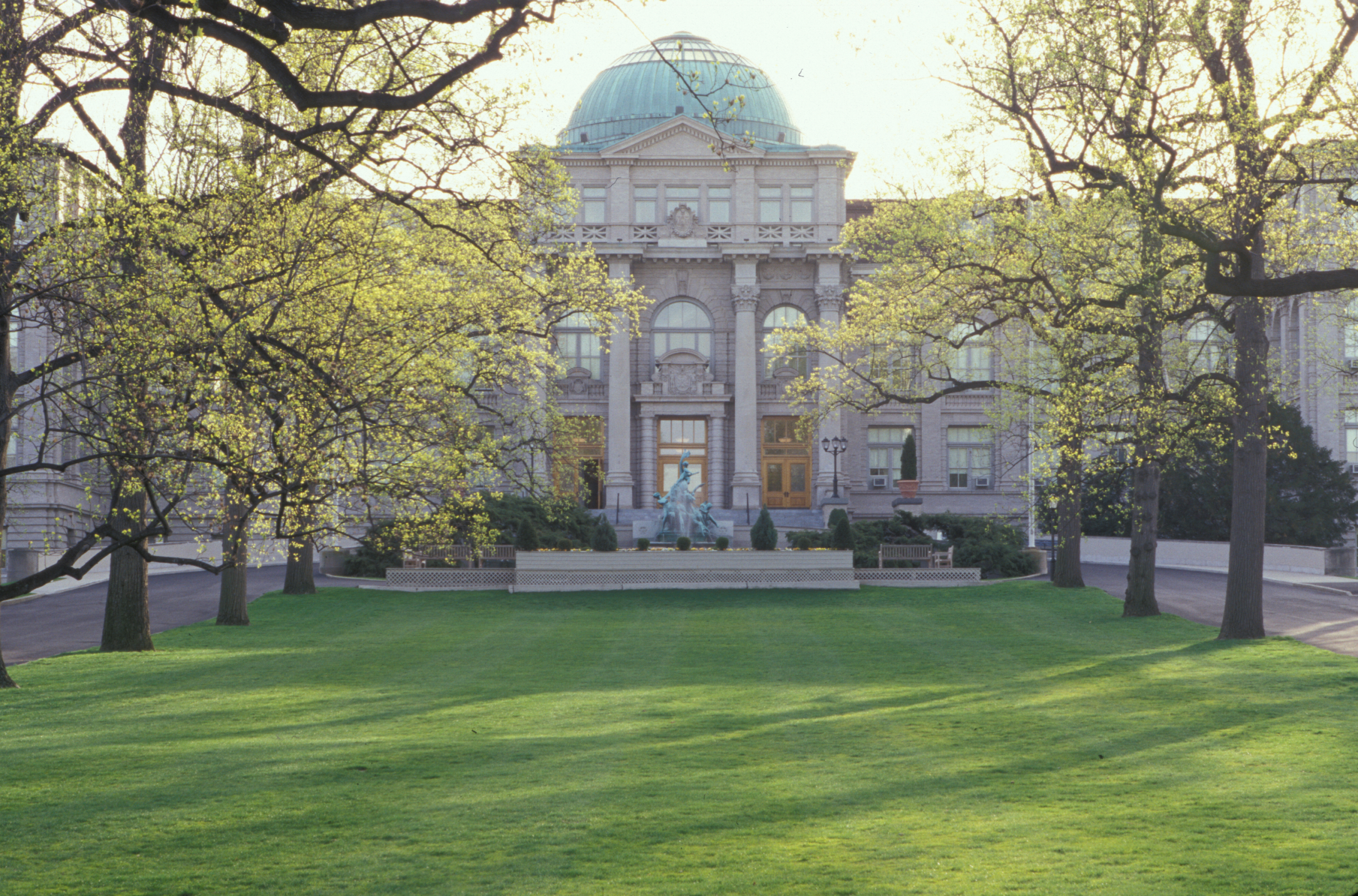 The New York City Landmarks Preservation Commission voted last week to add the Library building, the Lillian Goldman Fountain of Life, and Tulip Tree Allée to their registry of landmarks. The designation reinforces the historic significance of these sites and guarantees their protection so that they can be enjoyed by future generations.


 The displays in The Orchid Show: Brazilian Modern include specimens of orchids and other plants from Brazil that are stored in the Botanical Garden’s William and Lynda Steere Herbarium. The fourth largest herbarium in the world and the largest in the Western Hemisphere, it contains more than 7 million specimens of plants and fungi.