Sally Armstrong Leone is Editorial Director at The New York Botanical Garden.
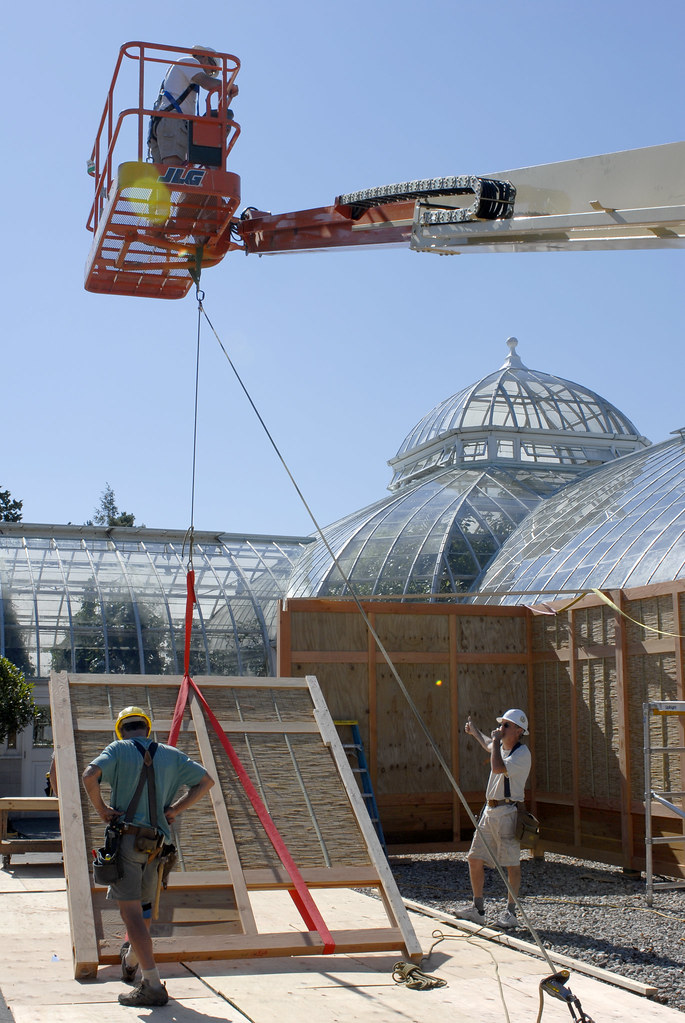
The Courtyards of the Enid A. Haupt Conservatory are abuzz with staff, designers, and volunteers creating and installing the upcoming exhibition Kiku: The Art of the Japanese Chrysanthemum. Four elaborate growing styles of chrysanthemums (kiku) make up the focal point of the show. These exquisite displays are housed in Japanese garden pavilions known as uwaya, intricate structures of bamboo and cedar delicately edged with ceremonial drapery that provide both shelter and a formal stage for kiku. The uwaya featured in the Garden’s exhibition were crafted by Tom Owens, President of High Country Timberframe & Gallery Woodworking in Boone, North Carolina, who recently talked about the design and construction for the show.
How are the structures that you made for the Botanical Garden different from those that are made in Japan?
In Japan uwaya are newly built each year for the annual Chrysanthemum Exhibition. The NYBG challenge was to provide traditional structures that could potentially be re-used for many years. That is, the design and construction techniques had to utilize traditional Japanese joinery, proportion, details, and materials while also facilitating the safe and orderly disassembly and storage of the pavilion components during the winter, spring, and summer months.
What was the production process like?
More than 4,000 man hours were spent from inception to raising to disassembly. Our crew of eight carpenters and I traveled to a bamboo farm in Charlotte, N.C., to harvest thousands of fresh bamboo poles by hand. Once cut, we brought them back to our shop and carefully cleaned and polished the poles and cut them to the required length before assembly into the uwaya. All of the timber layout, joinery work, and finishing took place in our shop in Boone. Upon completion, we pre-assembled the more intricate joinery to ensure proper fit and then, once final adjustments were made, sent the hundreds of components wrapped in paper via tractor trailer to NYBG for installation.
Can you explain how the uwaya used for the kengai* style is different from the uwaya used for the other styles? What is the significance?
The kengai uwaya differs significantly by relying primarily on a bamboo lattice to support its multi-tiered roof system. The materials are also much more varied and natural in their shapes. The post-and-beam elements of all uwaya are exposed, contributing their beauty, but the kengai is particularly spectacular as its materials are so rich and textured, providing striking contrasts with the cascading flowers. It is a building with a lot of soul!
*The kengai (cascade) style features hundreds of small-flowered chrysanthemums trained on a framework that is angled to evoke flowers growing down the face of a cliff.
Sean Ealey is a student in the Continuing Education Department’s Landscape Design Program.
My experiences at the Botanical Garden have been tremendously rewarding ever since my first visit last spring to its wonderful gardens and classrooms. Being a student here has been not just a creative endeavor but a personal one as well.
NYBG has given me the ability to take the seeds of my design ideas, express them both verbally and visually, and watch them flourish. It has also provided me a sense of connection with my surroundings and the inspiration to share it with others.
The courses have given me a broad understanding of the landscape design industry and ways to communicate my personal and professional goals. I am especially thrilled about the Landscape Design Portfolio Series, the opportunity of seeing and hearing award-winning architects and designers.
I used to get such a thrill when my NYBG Continuing Education Catalog would come in the mail; I would fantasize about all the enjoyable things I could learn. I say this in the past tense because now it’s just so easy to peruse the Continuing Education Web pages anytime and find all the information I need about classes and instructors online. It’s easy to navigate, fluid, and reliable, making it so simple to sign up. And, I get an immediate reply so that I know that I’m registered.
Trust me, NYBG is full of inspiration. Come and see for yourself—or check it out online.
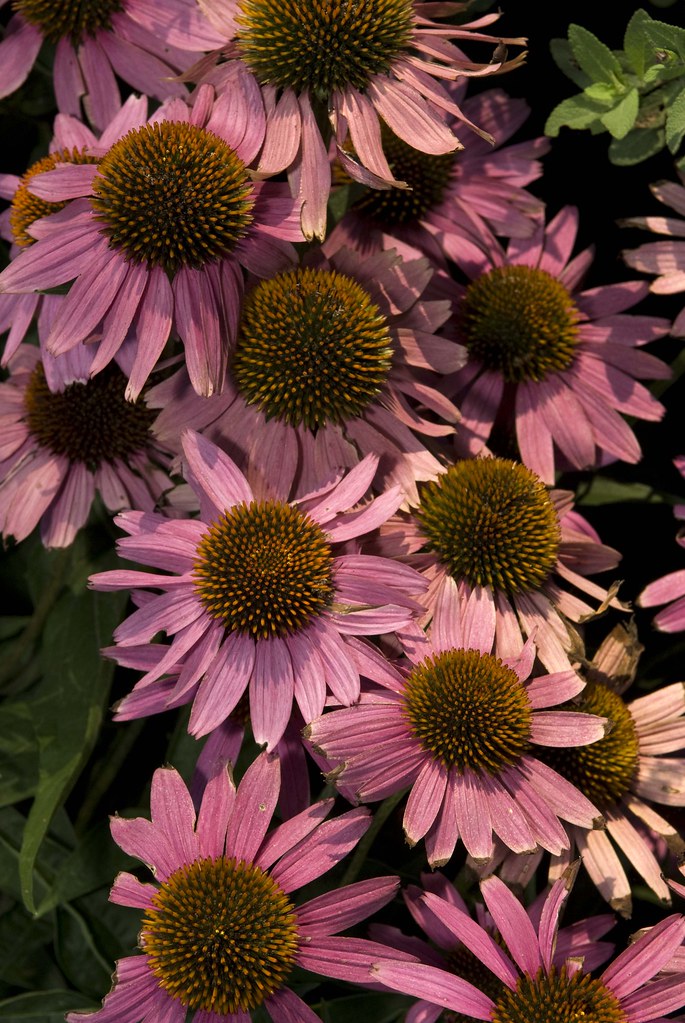
Birds Love Coneflower Seed Heads Sonia Uyterhoeven is Gardener for Public Education at The New York Botanical Garden. The other day I watched goldfinches fight each other for a chance to sit on the ripe seed heads of my coneflowers (Echinacea). Once the birds get a foothold, they perch precariously on the spiky seed heads and feast. This ability to attract birds is why I leave the seed heads on Echinacea, unlike most of my perennials, which I constantly deadhead to encourage more bloom.
The magenta flowers of Echinacea always bring a smile to my face. One of my favorite coneflowers is a cultivar called ‘Rubinstern’, sometimes touted as ‘Ruby Star’. It possesses a vibrant shade of magenta that flowers dependably and continuously from late summer into early autumn in my garden.
My favorite fragrant coneflower is a pure white cultivar called ‘Fragrant Angel’. On a sunny day the fragrance is delicious. Recently, I was swept off my feet by an orange-flowered cultivar named ‘Sundown’ or ‘Evan Saul’. I was impressed by its sturdy stems and beautiful flower—a brilliant rust-colored cone and iridescent flowers of orange streaked with yellow.
Regardless of your predilection, a good coneflower is not hard to find, and it will certainly please the birds if you leave the seed heads on to ripen. Just tug off the ray flowers once they have faded and have turned brown and leave the cone intact.
Debbie Becker leads a free bird walk at the Garden every Saturday from 11 a.m. to 12:30 p.m., beginning at the Reflecting Pool in the Leon Levy Visitor Center.
Autumn is that miraculous time of year when the leaves on the trees turn glorious colors. It is also time for the great fall migration. From August through November, thousands of birds leave their northern breeding grounds and return to their southern homes. As they pass through NYBG they stop and eat the luscious crab apples, berries, and nuts emerging from trees, bushes, and shrubs. It is a unique time of year to see tanagers, orioles, grosbeaks, and warblers in different stages of maturity as they move through the area.
Also migrating are raptors. Red-tailed hawks, red-shouldered hawks, kestrels, Cooper’s hawks, and sharp-shinned hawks are just some of the accipiters and buteos that glide on the thermals over Daffodil Hill. More than 5,000 broad-winged hawks have been spotted in one afternoon at NYBG. Bald eagles and golden eagles fly lazily over the Bronx River searching for a meal. Osprey circle above as they, too, fish the Bronx River.
On Twin Lakes, the wood ducks and mallards emerge from their state of eclipse and reclaim the lakes in full-colored feathers again. Joining them are autumn migrants: gadwalls, green-winged and blue-winged teals, northern shovelers, hooded and common mergansers, buffleheads grebes, coots, and many surprise visitors.
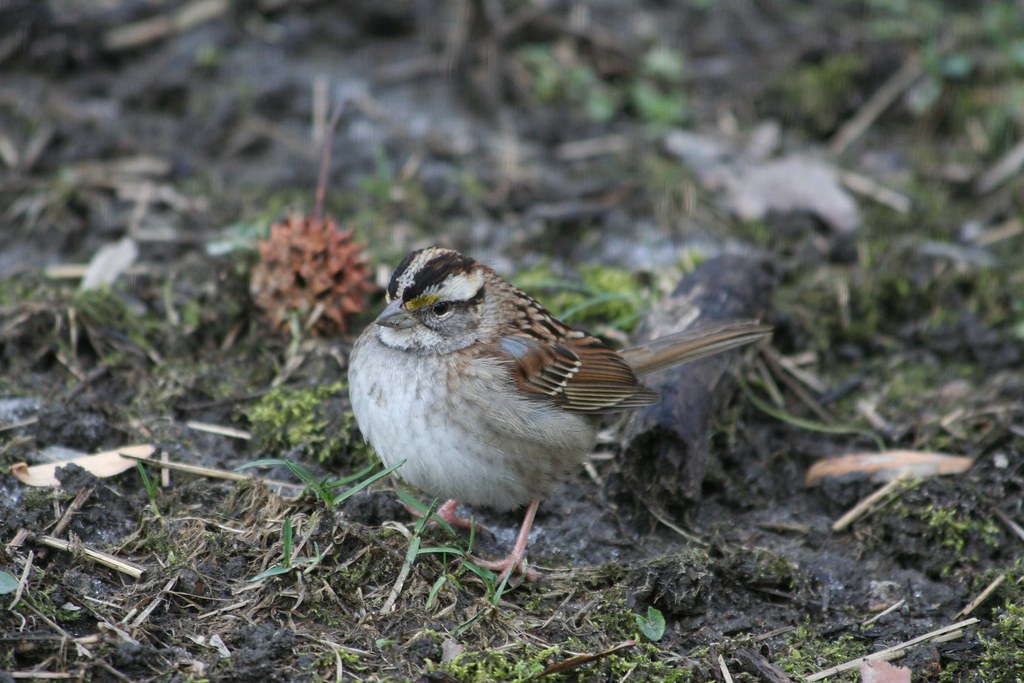
During October, the Garden plays host to a wide variety of sparrows: tree, field, savannah, song, swamp, fox, chipping, white-crowned, white-throated, and more. November brings the grackles and the blackbirds migrating in the thousands. Large flocks will sweep over NYBG and literally turn the trees black when they perch, all the while cackling loudly.
As autumn comes to an end during the middle of December, our great-horned owls begin to stir. Their breeding season will be just beginning as they emerge from the forest ready to entertain us with mating calls and rituals.
Autumn at NYBG is an exciting season. Come join us on a fall bird walk. You never know what or “hooo” you will see.
Karen Daubmann is Director of Exhibitions and Seasonal Displays.
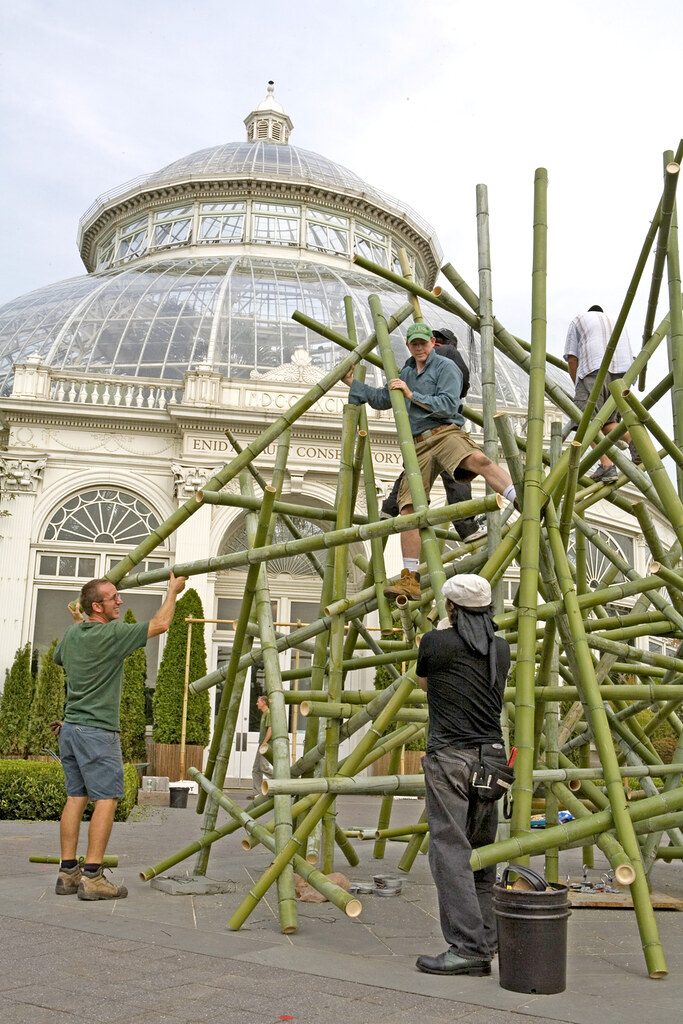
Last year, as one of my first projects as an employee of the Garden, I had the pleasure of working with artist Tetsunori Kawana as he and a crew of staff and volunteers (see photo below) assembled a bamboo sculpture for Kiku: The Art of the Japanese Chrysanthemum. The exhibition focuses on luscious displays of chrysanthemums but uses bamboo, maples, and other Japanese plants to showcase how important plants are to the Japanese, especially in autumn.
The towering sculpture provided a magnificent accent to last year’s Kiku display in the Enid A. Haupt Conservatory Courtyards. If you saw the sculpture, I’m sure you’ll agree with me that it was very cool and like nothing you’d seen before. Though it was untitled, I’d compare it to a bamboo volcano, a wide base narrowing at the top but giving way to an explosion of bamboo strands that danced through the air, rugged and powerful but graceful at the same time.
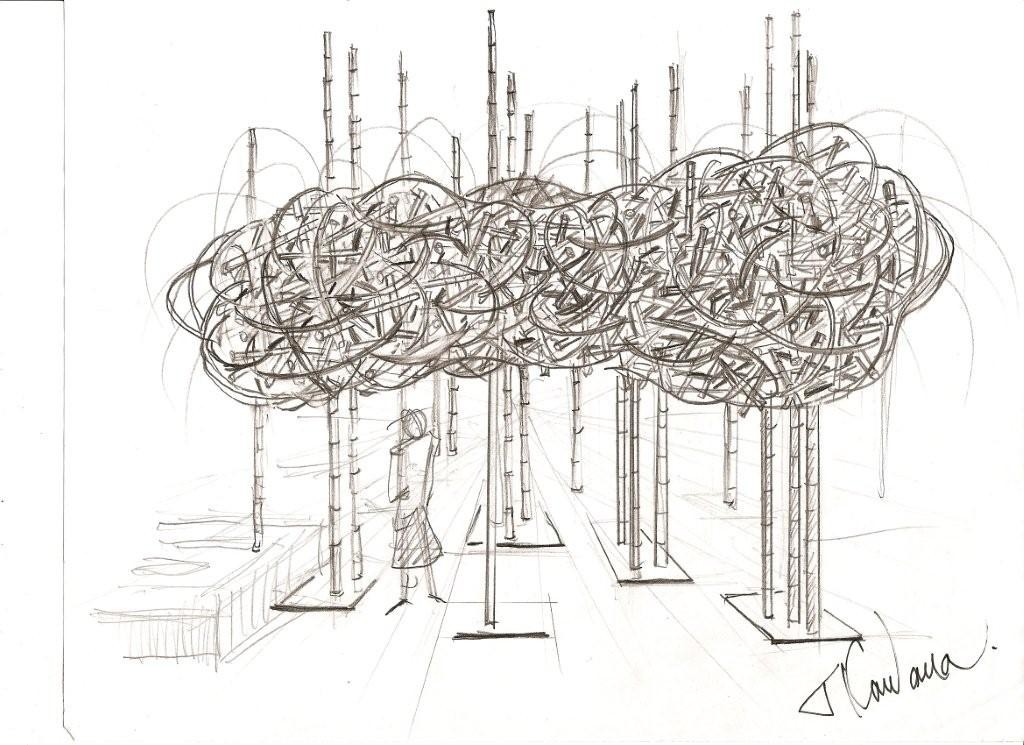
This year, Kawana-san is back with a bigger and even cooler project. He has designed what he calls a “cloud forest,” which visitors can walk through to experience it from within, immersing themselves in his work. On Monday, 350 pieces of 30-foot timber bamboo (Phyllostachys bambusoides) arrived here from Georgia. As the truck was unloaded, the excitement for the project began to build. The bamboo will be used in many ways—cut into sections to form triangles of support, split into segments and woven to create “clouds,” and used full length to create the “forest.”
Unless you’re a volunteer working on this project, you’ll have to wait until the show opens for the sculpture’s unveiling. However, if you’re willing to spend some time sawing, splitting, and wiring bamboo together and you are available October 2–11, please contact the volunteer office at volunteer@nybg.org or 718-817-8564.
Believe me, it is a treat to work alongside Tetsunori Kawana.
Chef Paul Yeaple, the Community Markets site manager for the Farmers Market held at The New York Botanical Garden, talks about some of the differences between the locally grown apples available for purchase.
Nick Leshi is Associate Director of Public Relations and Electronic Media.
Imagine my surprise this summer when I received a handwritten postcard from Academy Award-winning actress Joan Fontaine.
The story began in June when I received a phone call from a visitor to The New York Botanical Garden who was delighted to discover in the Peggy Rockefeller Rose Garden a white modern rose named after a friend. That friend happened to be Joan Fontaine, best known for her roles in the Alfred Hitchcock thrillers Rebecca (1940) and Suspicion (1941), for which she won an Oscar. Ms. Fontaine also appeared in many other film classics from Hollywood’s golden age, including Gunga Din (1939), The Women (1939), Jane Eyre (1944), and Ivanhoe (1952).
I sent an image of the Joan Fontaine rose to the caller and was delighted to learn that she forwarded the photo to the legendary actress. Needless to say, Ms. Fontaine’s resulting note of appreciation made my day.
The episode inspired me to think of other roses named after celebrities. To paraphrase Peter Kukielski, Curator of the Peggy Rockefeller Rose Garden, walking through the Beatrix Farrand-designed beds is like stumbling upon a tea party of the famous. The soft apricot flowers of the ‘Marilyn Monroe‘ rose are near the deep pink blooms of another hybrid tea named after Elizabeth Taylor. Also nearby is the ‘Julia Child’ floribunda, the 2006 All-America Rose Selections winner, with its buttergold petals and licorice candy fragrance. Watching over them all with its double pink flowers is the hardy grandiflora ‘Queen Elizabeth.’
Other roses are named after artists such as ‘Rembrandt‘ Portland or the floribunda ‘Henri Matisse‘ or the standard rose ‘Auguste Renoir‘ or the ‘Audubon‘ shrub. Wolfgang Amadeus Mozart has at least two roses with his moniker, the Hybrid Musk ‘Mozart‘ and the climber ‘Amadeus.’ Famed scientists also have their rose doppelgangers, including Charles Darwin and Madame Marie Curie. And still other roses honor Amelia Earhart, George Burns, and Johann Strauss. Famous names pop out from the world of fiction as well, such as ‘Othello,’ ‘Falstaff,’ and ‘Betty Boop.’
The Peggy Rockefeller Rose Garden is a delightful destination full of surprises, with wonderful color and fragrance right up until the first frost of the season.
Divide and Conquer Sonia Uyterhoeven is Gardener for Public Education at The New York Botanical Garden. From time to time, some of your perennials will start to languish. It’s not the heat or a lack of moisture that is the cause. Sometimes they just outgrow their space, start to sprawl all over the place, and slowly die out in the middle. When this happens, it is time to divide your perennials.
The general rule of thumb is to divide spring flowering perennials either immediately after flowering or in the fall, and to divide fall flowering perennials in the spring.
When you dig up the perennial be generous with the size of the root ball so that you get a good amount of roots. Garden forks often work better than spades since they do not slice through the roots.
If you are dividing in the fall, cut back the foliage to six inches—this will make it easier to see what you are doing and will help redirect the energy of the plant back into root growth. Water the perennial a day or two before you divide it to make digging easier and to make sure the plant won’t be stressed. Make your divisions large enough: A minimum of a quart-size pot is a good standard size.
Divide clumping plants such as astilbe (Astilbe), hosta (Hosta), ornamental grasses, or daylilies (Hemerocallis), with the double fork method or by slicing through them with a spade. For spreading plants such as lamb’s ears (Stachys), asters (Aster), and bee balm (Monarda), pull them apart by hand or sever with a knife or spade.
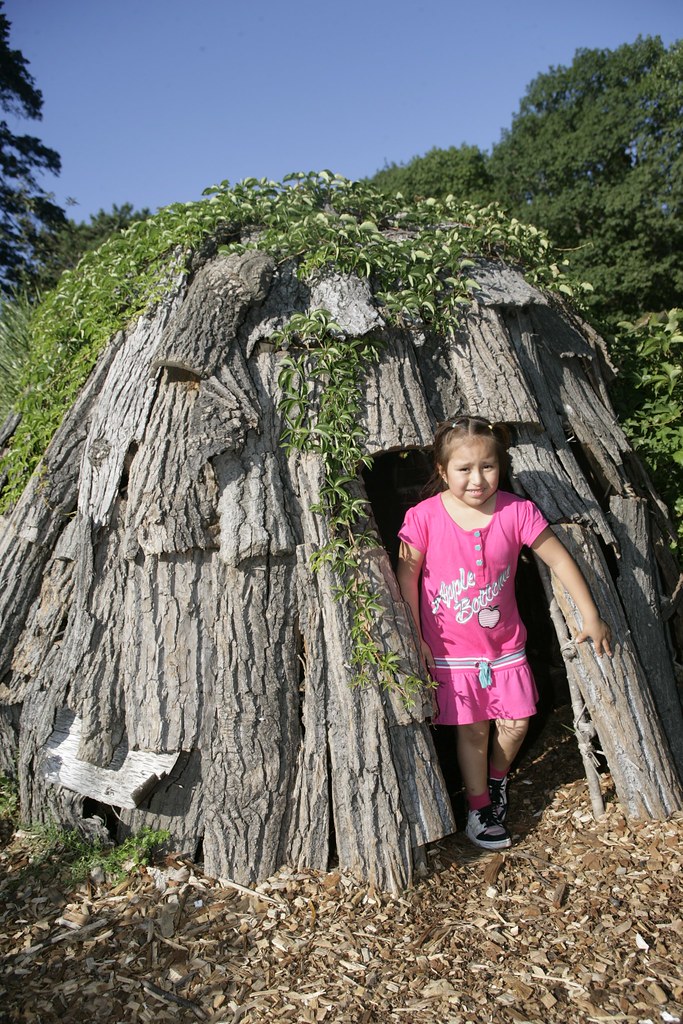
Indian Summer at the Howell Family Garden Annie Novak is coordinator of the Children’s Gardening Program. Two years ago, two men named Eric built a second home. It wasn’t a vacation spot nor was it particularly accommodating for men of their height. At first, the only inhabitants were chipmunks, squirrels, and the occasional investigatory rabbit.
Soon, however, the house was full of noise. Children busily explored the low dome of the interior and peered out the window into the neighboring garden. So it was that in 2006, the wigwam that Eric Wright and Eric Sanderson built became the latest structural addition to the Ruth Rea Howell Family Garden.
Although it’s the first wigwam in The New York Botanical Garden, it is by no means the first to grace the cliffs along the Bronx River’s shore. As Sanderson is quick to explain, for the 5,000 years before New York City’s skyline dominated the Hudson, Native Americans lived along the river system. Known as the Lenape, they inhabited the large area they called Leanapehoking all throughout New York and New Jersey, as far as the Delaware Water Gap.
Learn more about the wigwam in the Family Garden after the jump.