Each day had its findings. Each day came with at least one amazing plant that brought all work to a stop. That plant could be one we thought was special because of its rarity (restricted geographic distribution), or one that locals use in some interesting way; sometimes a plant could be deemed special just because it is simply too beautiful. We have selected some of our favorite plants to share them with you.
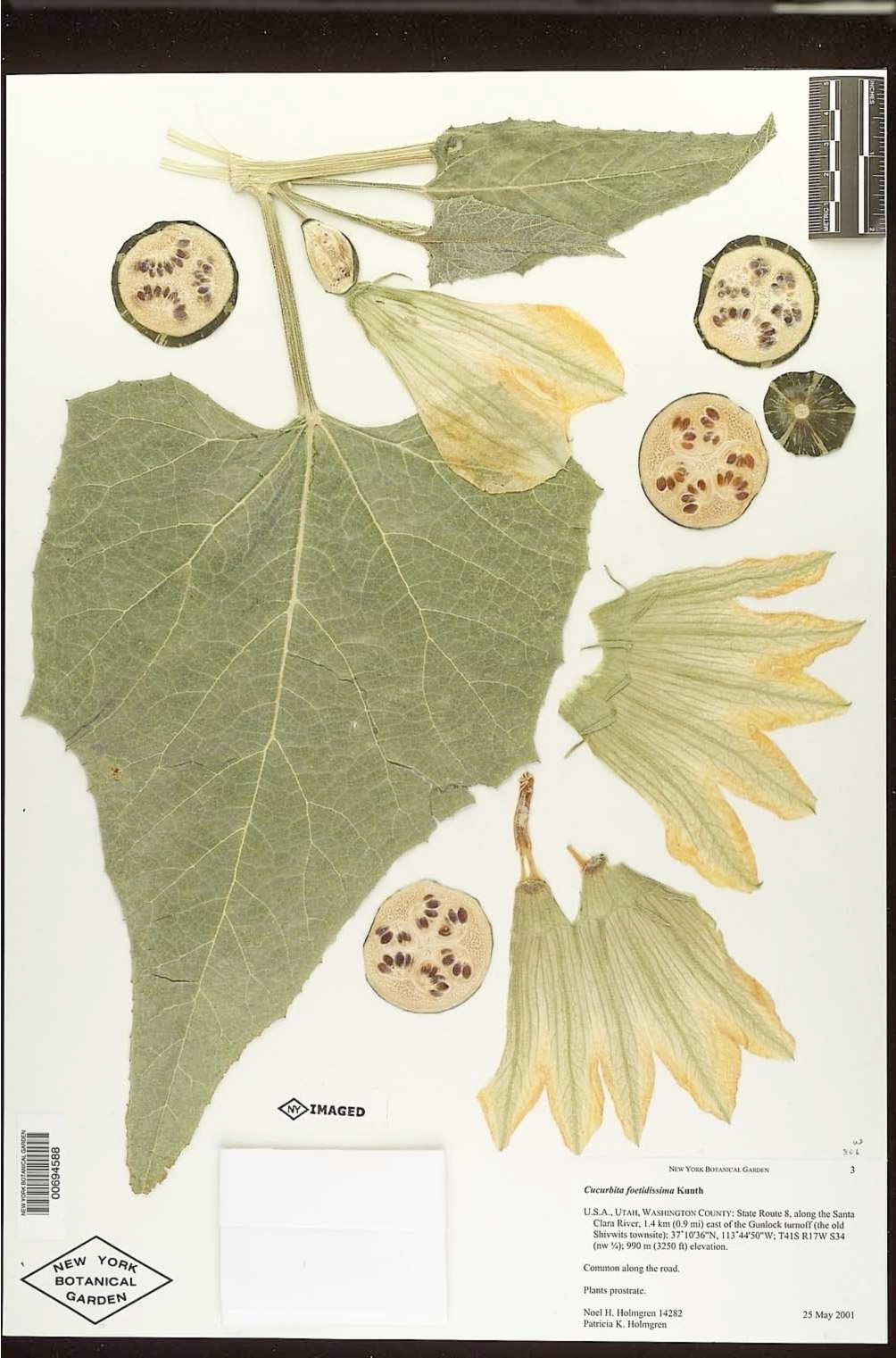
So what exactly does a botanist do in the field? In the field we look for plants that are in reproductive state, those bearing flowers or/and fruits. Reproductive structures are necessary to differentiate between closely looking species. For each species, we collect flowers, fruits, and leaves; these samples are processed and later dried for future study. The dried and mounted plant samples are called herbarium specimens and they are known to last for hundreds of years.
Las Orquídeas National Park is tucked into the westernmost mountain chain of Colombia, a part of the great Andean Cordillera. In the park the terrain is steep and rough and is crossed by many rivers and streams that originate in the upper part of the mountains. The constant presence of water makes these humid forests a source of abudant epiphytic plants. Epiphytes, like many bromeliads and orchids, are plants that grow on other plants without killing them. Epiphytes root in the humid mixture of mosses and decaying matter that cover the branches of the trees; they are a forest on top of the forest.
The Andes mountain chain, which crosses South America from north to south, is the longest in the world. The Andean forests of the northern range (Tropical Andes hotspot) are home to a level of plant diversity that is without match anywhere else in the world; they are also subject to high rates of deforestation, thus these forests are considered a top priority for conservation. Unfortunately, Andean forests remain insufficiently studied and protected. This lack of baseline information is often times the first impediment to effective conservation: It is impossible to efficiently protect what we do not know or understand.
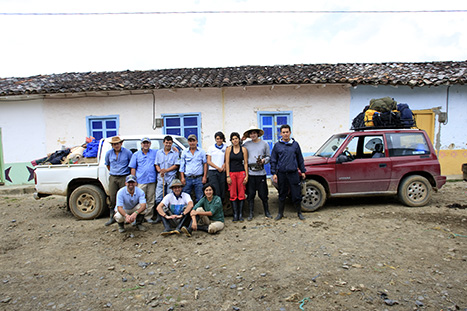
Clean and fresh travelers. First day, at La Encarnación. Top row: Alirio Montoya, Hector Velásquez, Javier Serna, Arley Duque, María Fernanda González, Camila González, Giovanny Giraldo, Fredy Gómez. Lower row: Felix Escobar, Julio Betancur, Paola Pedraza-Peñalosa.
After 14 days collecting plants in the field, we returned to Bogotá, Colombia’s capital with nearly 700 plant collections, and more than 10,000 photographs. Behind us we left Las Orquídeas National Park‘s 32 thousand hectares of rare and endangered tropical and montane forests, which make it part of one of the most biologically rich ecosystems of the world: the Andean and Chocó forests. We left behind more than 2,000 species of vascular plants, some of them still unknown to the science and probably not found anywhere else.
Worldwide trends notwithstanding, the chief concern of our William and Lynda Steere Herbarium management team on a daily basis is not the decline in the use of natural history collections, as reported in a New York Timesarticle this summer, but rather how to keep up with the needs of all our users.
Scientists use the Steere Herbarium to answer the most critical questions about plant diversity, namely: How many species are there? How are they related to one another? What environmental factors control their growth? Given that plants supply most of the food, fuel, shelter, and medicines for the earth’s population, predicting how these organisms may respond to climate change is one of the most pressing questions for scientists today.
Visitors are sometimes surprised that most of the scientists who use to the Herbarium are still doing the fundamental work of documenting the Earth’s biodiversity. “Don’t we know all the species yet?” some have asked. The answer is “No, not by a long shot.” Estimates are that we know only about 75 percent of the world’s plant species and less than 10 percent of the species of the fungi, the two major groups of organisms represented in the Herbarium collections.
Scott A. Mori, Ph.D., Nathaniel Lord Britton Curator of Botany, has been studying New World rain forests for The New York Botanical Garden for over 30 years. Over the course of his career, Dr. Mori has witnessed an unrelenting reduction in the extent of the tropical forests he studies.
On August 22, an image showing a small green patch of forest in the midst of a treeless area prepared for soybean cultivation appeared on the front page of The New York Times. The accompanying article explained that the fertile soils underlying forests in the state of Mato Grosso, Brazil, are suitable for supporting large soybean plantations. As evidence of the magnitude of the forest destruction, the author noted that an increasing demand for Brazilian soybeans led to the conversion of 700 square miles of forest to soybean fields in that state during the last five months of 2007 alone!
The future of plant and animal diversity in Latin American forests depends on an understanding of how fragile the plant/animal interactions of tropical ecosystems are and the role human consumption plays in altering natural ecosystems. The relationships between plants and animals in the tropics are so closely co-evolved that man’s utilization of tropical forests almost always results in some loss of biodiversity. Soybean cultivation is an extreme example, because in this agricultural system soybeans entirely displace the plants and animals that formerly occupied the destroyed forests.
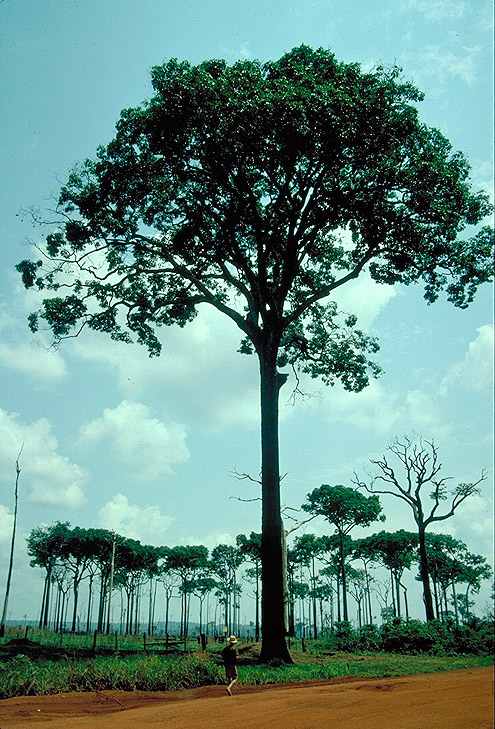
Trees remaining after forest destruction such as the Brazil nut tree above, photographed by W. W. Thomas, do not effectively reproduce. While this tree and others like it may still live for many years, they no longer produce the next generation of trees because the forest conditions needed for the pollination of their flowers, the dispersal of their seeds, and the growth of their seedlings into adult trees no longer exist.
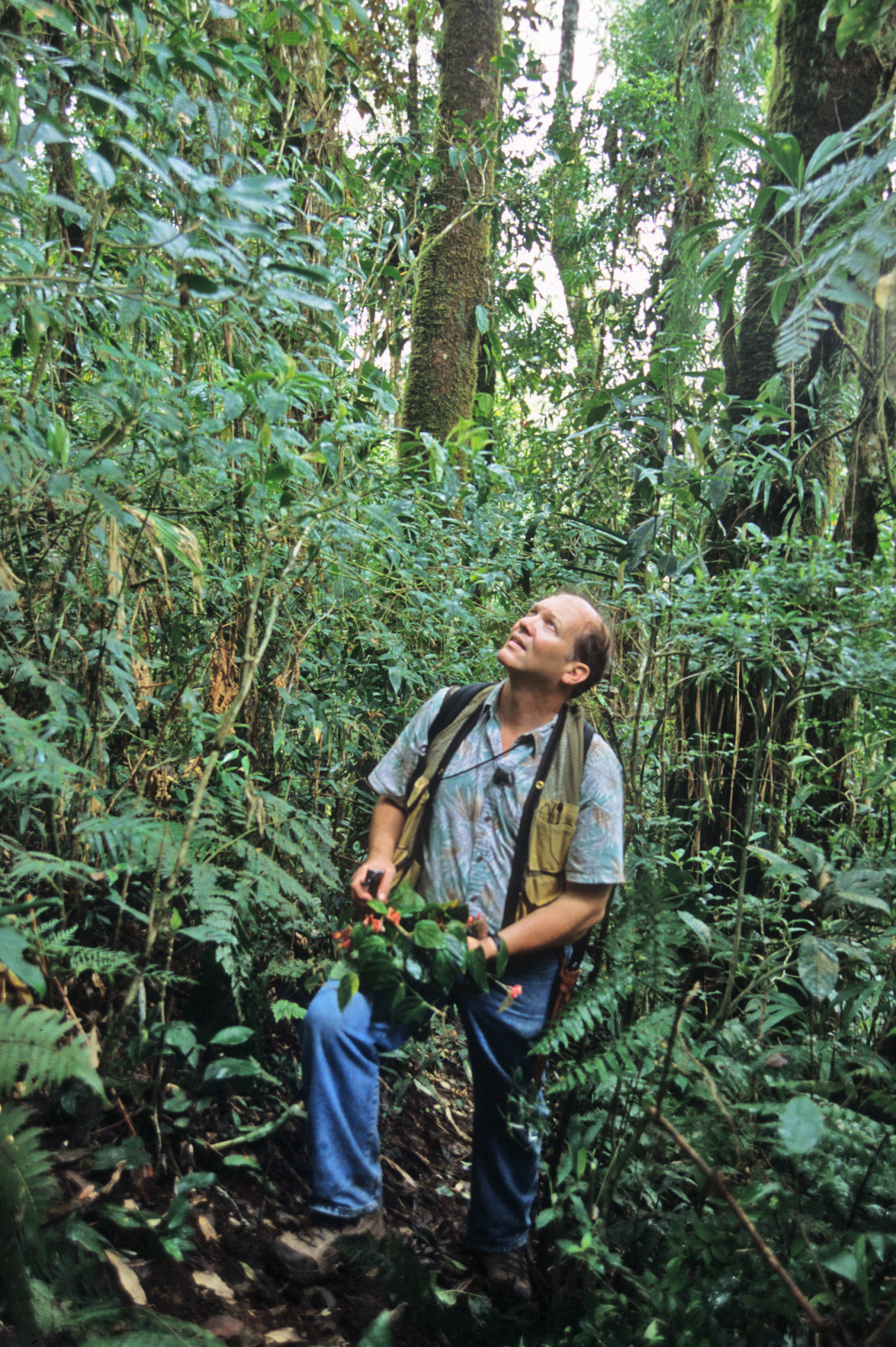
Dr. Wayt Thomas holds a begonia he’s just collected in the montane tropical forest of the Serra Bonita Private Reserve in Bahia, Brazil.
Photo by Rogerio Reis/Black Star
During The Orchid Show: Brazilian Modern, Plant Talk takes a look at some of the research and conservation efforts of The New York Botanical scientists whose work is focused in Brazil. This interview was conducted by Jessica Blohm, Interpretive Specialist for Public Education.
Botanical Garden scientist Dr. Wayt Thomas knows first-hand the importance of his research in Brazil. A planned highway that would have cut through the sensitive Serra Grande Forest in coastal Bahia was diverted thanks, in part, to the identification by him and his Brazilian collaborators of 458 species in an inventory of 2,500 trees—one of the highest forest diversity levels ever recorded.
“Our data about the high diversity of this forest came out while [local officials] were in the planning stage for this highway/road project. The local NGO [non-governmental organization] got our data, and they ran with it,” Wayt says.
The impressive data led officials to change the path of the road from a straight shot through the forest to a park-like road following the contours of the land and avoiding big patches of forest. In addition, a state park was created to protect that section of the forest, one of the world’s most critically endangered rain forests. Less than 5 percent of the original forests in the region remain.
“I can do my science and really have an impact on local conservation,” Wayt says.
He frequently finds species that no one has ever studied before: In Bahia, 7 percent of the tree species his team has found were unnamed. Wayt suspects that the area supports such diversity because three or four different kinds of forest intersect there. “Seeds are going to go where they want to. So you have plants that are from one forest that end up in another type of forest. The populations mix,” he says.
Wayt specializes in research of the sedge family, especially the beaked rushes, and the Tree-of-Heaven family. “In this research, I define species concepts, describe species and genera new to science, and use molecular techniques to understand the evolution of each group,” he says.
He also heads the international Organization for Flora Neotropica, which promotes the preparation of systematic monographs of plants and fungi in the American tropics.
“I have been working in this region for at least 17 years. There is no end to stuff to do here,” Wayt says.