While attending New England Grows—a regional tradeshow and educational forum that takes place in Boston each year—I was lucky enough to hear the ecologist and public spokesperson, Nalini Nadkarni, give a lecture on rain forest ecology and its importance as a biological system.
Dr. Nadkarni’s research was not conducted on the forest floor, but rather at great heights above it. She quite literally harnessed the tools of the arborist’s trade and hoisted herself and a team of researchers 100 feet up in the air to explore the biological communities that thrived in the upper layers of the rain forest’s canopy.
Up in the treetops, Nadkarni and her team found a surprising diversity. The plants they came upon were expected: orchids, bromeliads, ferns, mosses, and lichens. These epiphytic plants are an important component of tropical arboreal communities, surviving and thriving by collecting water and nutrients from rainfall trapped in their foliage. What surprised the researchers, however, was the complexity of the arboreal ecosystem.
Scott A. Mori, Ph.D., Nathaniel Lord Britton Curator of Botany has been studying New World rain forests for The New York Botanical Garden for nearly 35 years. He has witnessed an unrelenting reduction in the extent of the forests he studies and, as a result, is dedicated to preserving the diversity of plants and animals found there.
Female carpenter bees visiting flowers of the sapucaia tree. Painting by M. Rothman.
Several posts ago, I introduced the cannon ball tree and nominated it as the most interesting tree on earth. I then challenged others to nominate additional plants for this honor, receiving suggestions such as the wiliwili tree, a species of legume in the genus Erythrina; and the sapodilla, a species so important and interesting that it is the common name for the Sapotaceae or chicle family. In fact, there are so many fascinating trees to examine that I have decided to tackle yet another unique specimen studied during my career.
Scott A. Mori has been studying New World rain forests for nearly 40 years. He has witnessed an unrelenting reduction in the extent of the forests he studies and, as a result, has become concerned about their future.
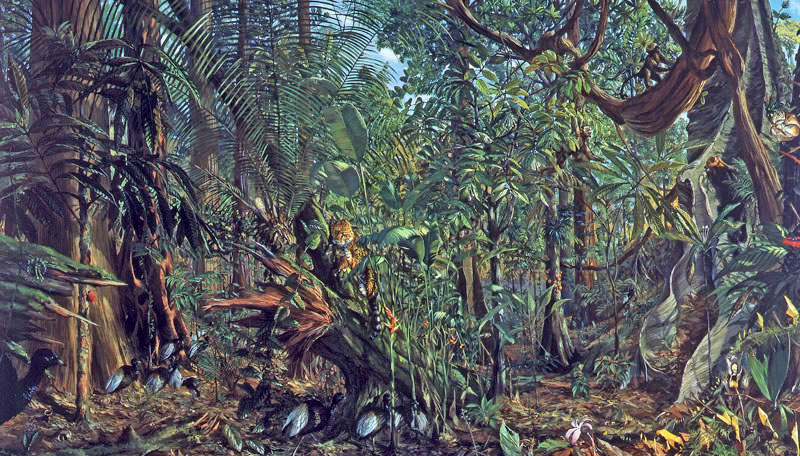
From December of 1995 onward, the Institute of Systematic Botany at the NYBG has periodically worked with Michael Rothman to prepare paintings representing the research of our curators. Over the next year, the curators and the paintings that represent their work will be presented in a series of essays on Plant Talk. Today, I introduce the artist and discuss his painting of the understory of a lowland rain forest in French Guiana. I chose this painting to start with because it illustrates the rich biodiversity of lowland tropical rain forest, an area where I have studied plants for many years. If you wish to see rain forest or cloud forest throughout the year without traveling, you can enjoy tropical plants and get out of the cold at the same time by visiting the Garden’s Tropical Paradise exhibition in the Enid A. Haupt Conservatory.
“A Terrestrial View of a Rain Forest in Central French Guiana” by Michael Rothman.
Botanical art and the study of plants are inseparable. In the course of my career, I have relied on Bobbi Angell for the preparation of the line art accompanying my species descriptions of the Brazil nut family, as well as those depicted in the Guide to the Vascular Plants of Central French Guiana, and the Flowering Plants of the Neotropics. In all, Bobbi has prepared a total of 600 illustrations for me.
Scott A. Mori, Ph.D., Nathaniel Lord Britton Curator of Botany has been studying New World rain forests for The New York Botanical Garden for nearly 35 years. He has witnessed an unrelenting reduction in the extent of the forests he studies and, as a result, is dedicated to preserving the diversity of plants and animals found there.
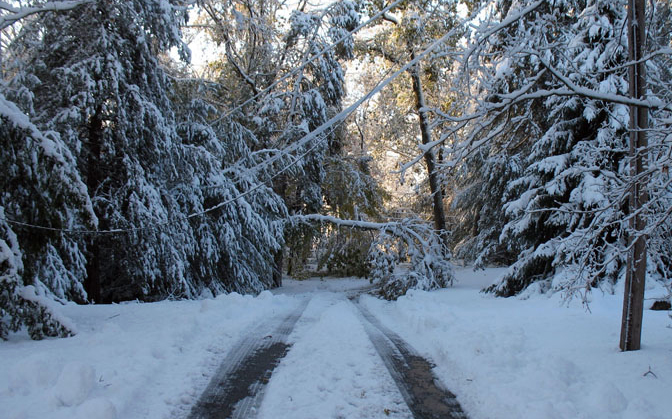
Snow in South Salem, New York in October 2011.
“So what,” you must be saying to yourself. In spite of how obvious the title is, the lack of cold weather in the tropics contributes both directly and indirectly to tropical biodiversity, the topic of this blog.
One of the many reasons that there are high numbers of species represented by low numbers of individuals in old growth tropical forests–compared to the opposite situation in temperate forests–is because of the greater number of plant/animal interactions in the former. In one of our 2.5 acre tree study plots in central Amazonian Brazil, we registered 285 species of trees with diameters at or above four inches at breast height. Because our plots average 600 trees above this size class per plot, almost every second tree we sampled represented a different species. In contrast, there are fewer than 100 species of trees of all size classes in the entire state of Wisconsin, where I grew up.
Scott A. Mori has been studying New World rain forests for The New York Botanical Garden for over 35 years. He has witnessed an unrelenting reduction in the extent of the tropical forests he studies and as a result has become interested in the ecosystem services provided by them.
Manisha Sashital, a student in Environmental Engineering at Carnegie Mellon University, worked on a botanical glossary under the supervision of Dr. Mori as an intern at the Garden this past summer.
Just like languages, the sciences have vocabularies that must be mastered before their literature can be understood. Without understanding vocabulary, one cannot speak or write a language—just like one can not understand the morphology and anatomy of plants; their ecological relationships with other plants and animals; and their interactions with the environment in which they live without understanding the terms that describe the features of plants and their interactions. Learning the terminology of Botany is frustrating to beginners and experienced botanists alike because the vocabulary is vast, there are many synonyms for the same terms, and terms are a combination of Latin, Greek, and English words. There are numerous botanical glossaries available, for example the classics: A Glossary of Botanical Terms by B. D. Jackson and Botanical Latin by William T. Stern, and too many others to mention in this blog. Why then is there a need for another glossary?
The answer is that electronic glossaries provide those with an interest in botany access to more information than hard copy publications. For example, electronic glossaries can be illustrated with more images than hard copy publications because of the high costs of printing, especially of images in color, and they can be immediately corrected when a mistake is brought to the attention of the authors. Electronic glossaries are instantaneously available to anyone with a connection to the internet, and links can be made to definitions of other terms related to a particular term under consideration. In addition, electronic glossaries can be attached to electronic keys to break down complex terminology used to identify unknown plants; for example, if a choice in a key asks if the ovary of a flower is superior or inferior, a link can be provided to these terms in a glossary where they are defined and illustrated.
Tai Montanarella is the Manager of School and Family Programs at The New York Botanical Garden.
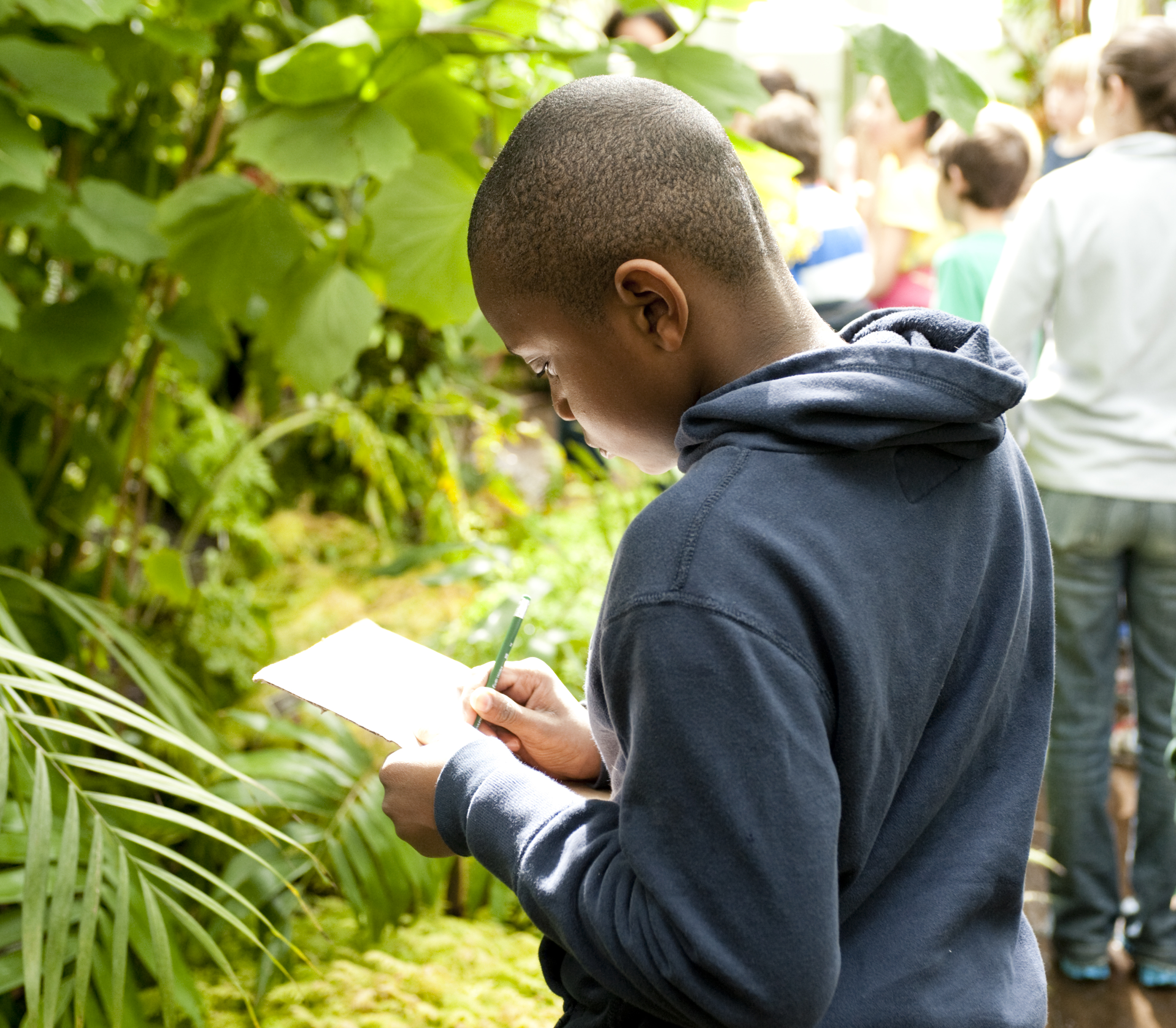
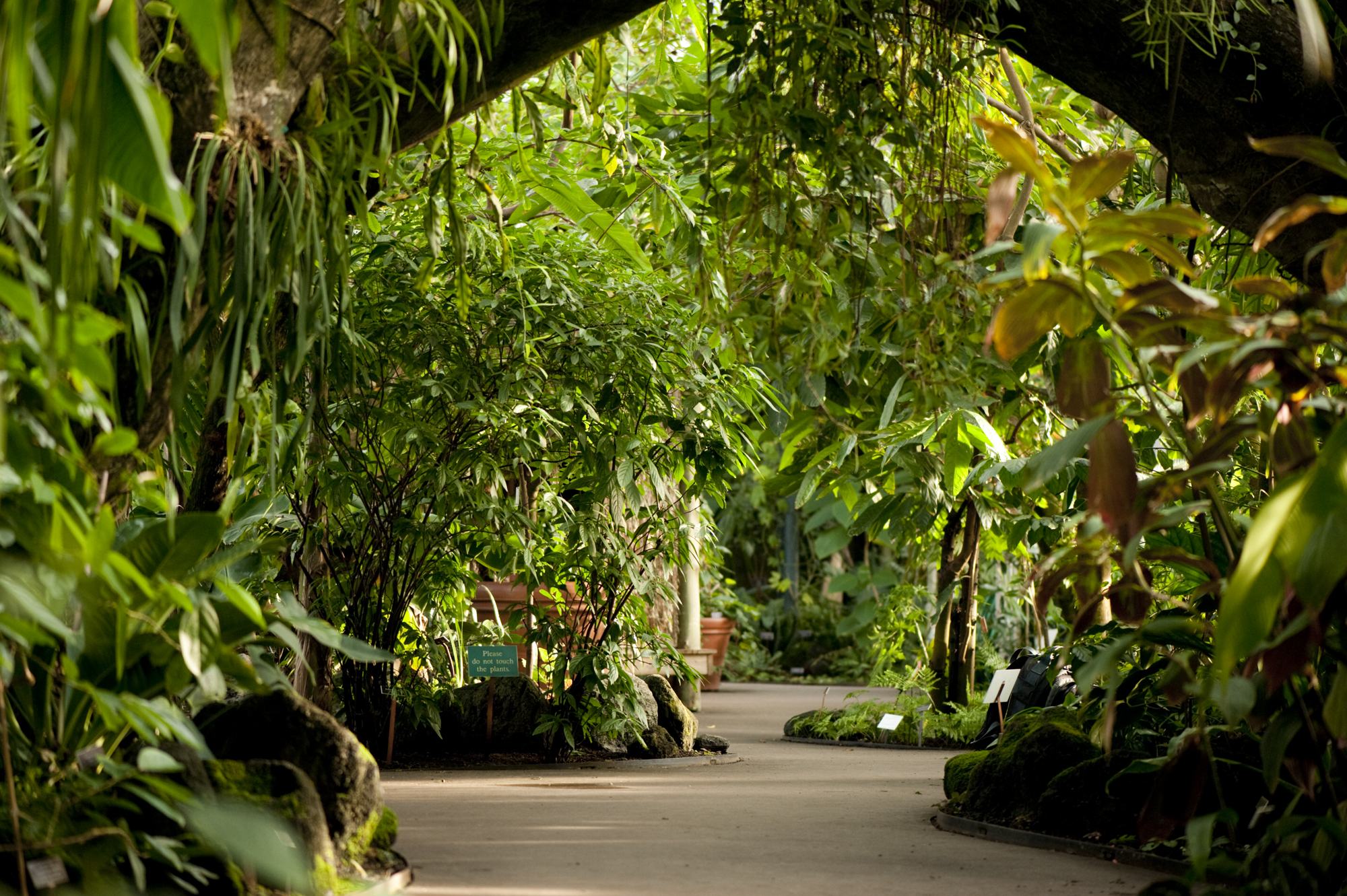
How do plants in the rain forest survive? This was the question on the minds of Prospect Hill Elementary School students as they explored the Enid A. Haupt Conservatory. It was here at the NYBG that they became first-hand field scientists for a day, embarking on their own botanical expedition through the diverse tropical rooms of our glasshouse.
While they did not have to get on a plane to visit these rain forests, these third graders did have to travel through extreme biomes before they could reach them. This is a museum of plants, after all. Their journey began when they got off the bus, where they were not only greeted by GreenSchool educator Pilar Okeson, but by a fantastic Zelkova tree (Zelkova serrata). Hailing all the way from Japan, this deciduous tree does equally well in the temperate climate of New York City, and can reach 100 feet tall. It was only the first of many exotic plants the children would encounter.
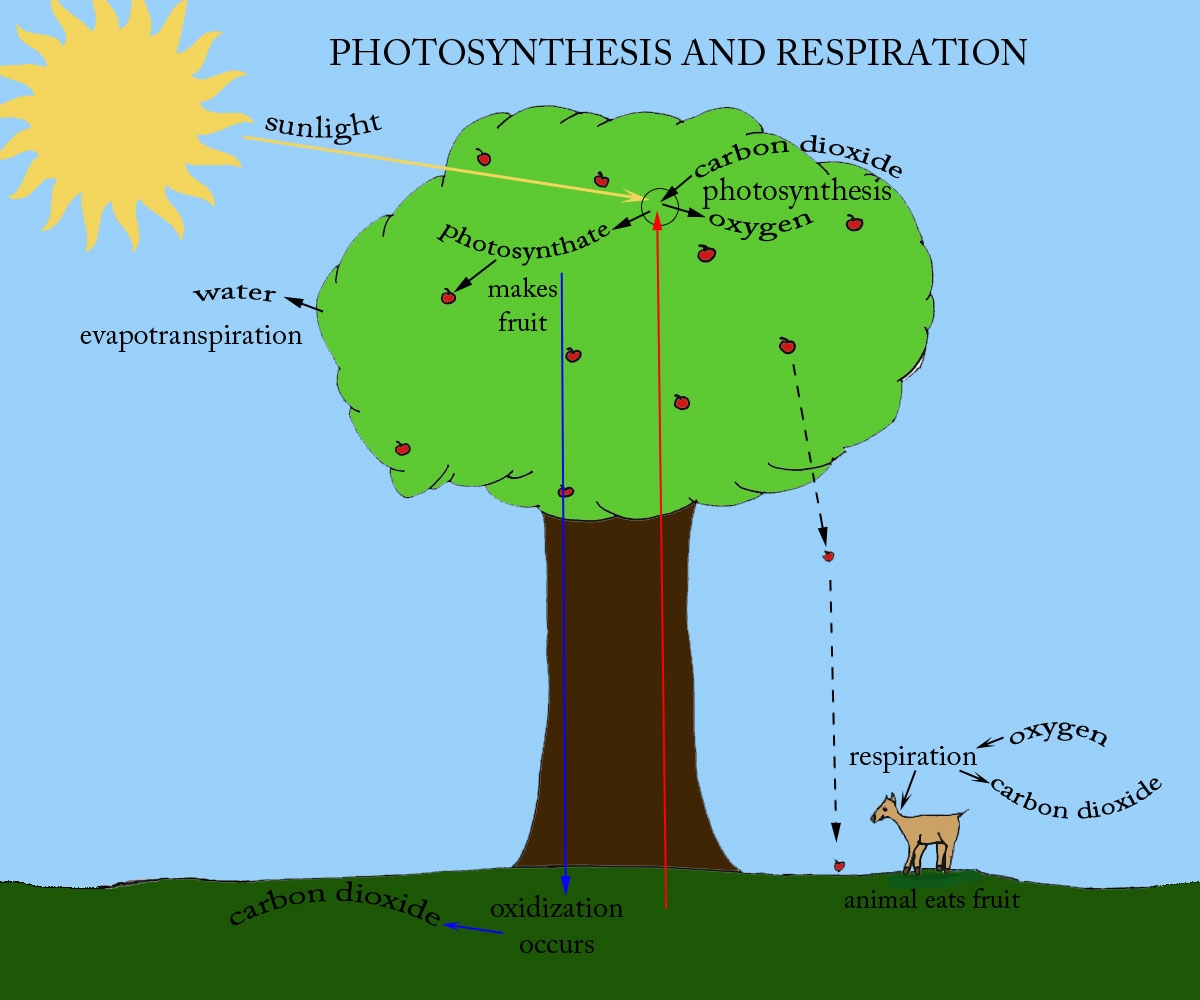
Manisha Sashital, a student in Environmental Engineering and Environmental Policy at Carnegie Mellon University, worked on a botanical glossary under the supervision of Dr. Mori at the Garden this summer. As part of her internship she prepared a cartoon illustrating the relationship between photosynthesis and respiration.
Scott A. Mori has been studying New World rain forest plants for The New York Botanical Garden for over 35 years. His interest in tropical forests as carbon sinks have been stimulated by his studies of trees in old growth tropical forests.
Global warming has become one of the planet’s deadliest threats. Since the Industrial Revolution, carbon dioxide concentrations have risen from 280 ppm to nearly 390 ppm, with the potential to reach 550 ppm by 2050 if carbon emissions from fossil fuel combustion are not controlled. The earth has experienced major warming three times; but the Cretaceous warming period took place over millions of years and the Paleocene/Eocene warming happened over thousands of years. In contrast, today’s temperature changes are happening over decades. As a result, many species, perhaps even humans, may not be able to adapt to such rapid and high increases in temperature. One concern that is generally unknown to the public is that photosynthesis, the source of energy for nearly all organisms on the planet, shuts down at around 104° F. Mankind’s extreme disruption of the carbon cycle is causing and will continue to cause serious consequences for life on earth.
Carbon dioxide levels contribute to global warming through the greenhouse effect. Greenhouse gases trap radiation from the sun in the atmosphere, which causes global temperatures to rise because the radiation is not reflected back out of the atmosphere. The reason for today’s increased atmospheric carbon levels can be attributed to the combustion of fuels used for the production of electricity and in transportation, both of which are essential to modern societies; as well as to cutting and burning forests throughout the world. Since there is no precedent for the rapidity of current temperature increases, it is impossible for humans to predict which areas of the world will be affected and at what magnitude. The unpredictability of global warming makes it an especially serious environmental problem.
Rain forests as well as other vegetation types play an important role in reducing the levels of carbon dioxide in the atmosphere. Annually, plants in tropical rain forests around the world take in millions of tons of carbon dioxide and release millions of tons of oxygen through photosynthesis, and this balances the respiration of microbes, plants, and animals, which take in oxygen and expel carbon dioxide. As seen in the accompanying cartoon, plants take in carbon dioxide and water and use the energy of the sun to create carbohydrates that are, in turn, oxidized to produce the energy needed for plants to sustain themselves. The carbohydrates are also the building blocks plants use to make leaves, stems, flowers, and fruits. Oxygen, the byproduct of respiration, is used by organisms to break down ingested carbohydrates to produce the energy needed for them to grow and reproduce. Mankind’s extreme disruption of the carbon cycle is and will continue to have serious consequences for life on earth.
Scott A. Mori, Ph.D., Nathaniel Lord Britton Curator of Botany, has been studying New World rain forests for The New York Botanical Garden for over 30 years. Over the course of his career, Dr. Mori has witnessed an unrelenting reduction in the extent of the tropical forests he studies.
On August 22, an image showing a small green patch of forest in the midst of a treeless area prepared for soybean cultivation appeared on the front page of The New York Times. The accompanying article explained that the fertile soils underlying forests in the state of Mato Grosso, Brazil, are suitable for supporting large soybean plantations. As evidence of the magnitude of the forest destruction, the author noted that an increasing demand for Brazilian soybeans led to the conversion of 700 square miles of forest to soybean fields in that state during the last five months of 2007 alone!
The future of plant and animal diversity in Latin American forests depends on an understanding of how fragile the plant/animal interactions of tropical ecosystems are and the role human consumption plays in altering natural ecosystems. The relationships between plants and animals in the tropics are so closely co-evolved that man’s utilization of tropical forests almost always results in some loss of biodiversity. Soybean cultivation is an extreme example, because in this agricultural system soybeans entirely displace the plants and animals that formerly occupied the destroyed forests.
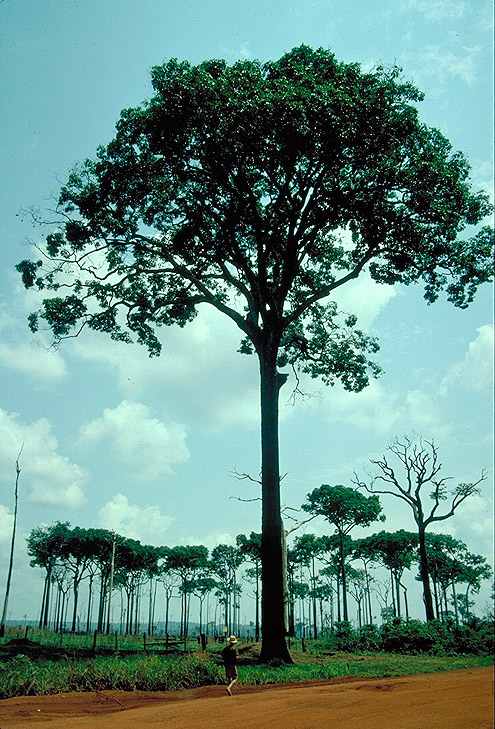
Trees remaining after forest destruction such as the Brazil nut tree above, photographed by W. W. Thomas, do not effectively reproduce. While this tree and others like it may still live for many years, they no longer produce the next generation of trees because the forest conditions needed for the pollination of their flowers, the dispersal of their seeds, and the growth of their seedlings into adult trees no longer exist.

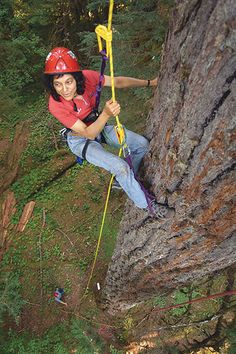 While attending New England Grows—a regional tradeshow and educational forum that takes place in Boston each year—I was lucky enough to hear the ecologist and public spokesperson, Nalini Nadkarni, give a lecture on rain forest ecology and its importance as a biological system.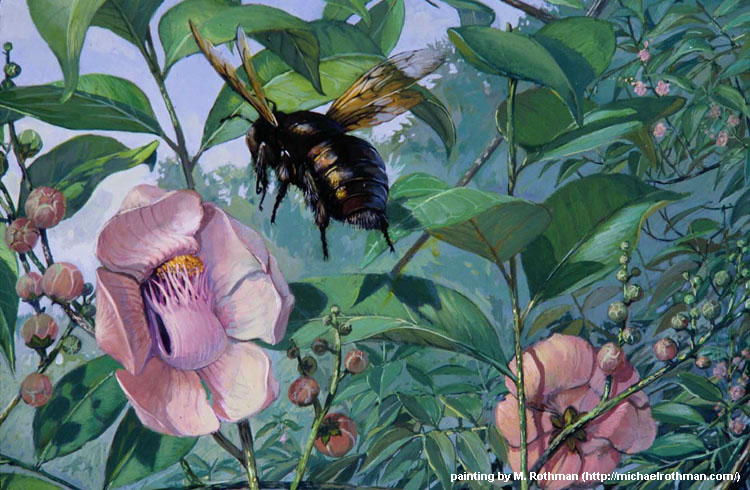
 Manisha Sashital, a student in Environmental Engineering and Environmental Policy at Carnegie Mellon University, worked on a botanical glossary under the supervision of Dr. Mori at the Garden this summer. As part of her internship she prepared a cartoon illustrating the relationship between photosynthesis and respiration.
 Scott A. Mori has been studying New World rain forest plants for The New York Botanical Garden for over 35 years. His interest in tropical forests as carbon sinks have been stimulated by his studies of trees in old growth tropical forests.