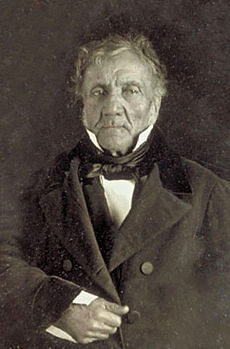
Aimé Bonpland, the author of the scientific name of the Brazil nut.
In our continuing discussion on botanical taxonomy, we now delve into the discovery of the Brazil nut and explain where it fits into the plant kingdom. But don’t be mistaken—when I say “discovery,” I am referring to the scientific naming and classification of the species rather than the first physical discovery of the plant by humans. Nearly all economic plants were discovered and given common names long before scientists became aware of them.
As part of their travels to the New World (between 1799 and 1804), the German scientist Alexandre von Humboldt and the French botanist Aimé Bonpland traversed the Rio Orinoco, making natural history collections and observations along the way. At one point, they subsisted for three entire months on rancid chocolate and plain rice alone. Fortunately, these explorers came upon Brazil nut collectors, allowing them to feast on great quantities of Brazil nut seeds. They were also impressed by the magnificent tree itself, and so interested in obtaining its flowers that Humboldt offered an ounce of gold to any one of the collectors who could find and retrieve them—an impossible task, as fruiting Brazil nut trees were not in flower.
Nevertheless, the expedition made collections of the leaves and fruits, and Bonpland described the species as Bertholletia excelsa Bonpl. Although the authorship of this species is sometimes attributed to both Humboldt and Bonpland, it is clear that the latter is the author of the scientific description and name for this species. Bonpland dedicated the genus to Claude Louis Berthollet, a chemist who, along with Antoine Lavoisier, developed a system of modern chemical nomenclature.
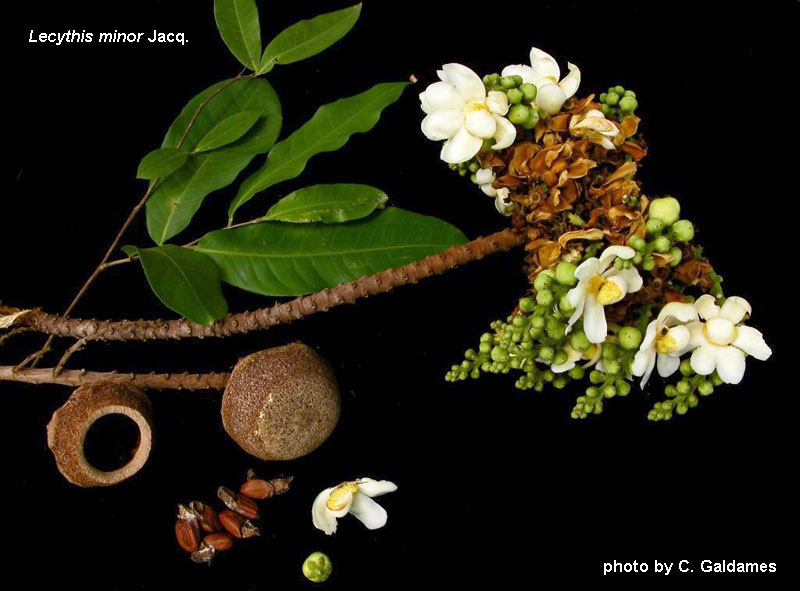
Lecythis minor is the accepted name for the species shown in this image.
Memorizing scientific names can be an exasperating experience for nature lovers, especially when learning that those names occasionally change for complicated reasons. Last week I discussed the structure of scientific names based on the Linnaean binomial system. Now, I explain some of the most common ways scientific names change based on the law of priority, a rule stipulating that the first name validly published for a species is the correct name for it. Be aware that this may not be the most beginner-friendly topic, but it is integral to understanding the complex business of botanical nomenclature.
The rules of botanical nomenclatures are formalized in the International Code of Nomenclature (ICN), which is updated every five years at the International Botanical Congresses; the most recent such congress took place in Melbourne, Australia, in 2011. Although the ICN defines the rules for naming plants, it does not provide guidance for determining if a species is distinct from other published species, thus justifying a new name. The taxonomic validity of species is determined by reviewers of scientific papers in which names are either proposed or changed, as well as by the acceptance of the names by the scientific community in their scholarly works such as Floras.
In telling the tale of one of the great Amazonian explorers, C.V. von Martius, I wrote that, “… Martius was carrying with him 20,000 botanical specimens which served, and continue to serve, as the basis for countless botanical studies, including Flora Brasiliensis which remains the only published complete Flora of Brazil to this day.” To clarify, I was not suggesting that Flora Brasiliensis contains all Brazilian species, but that it is the only Brazilian Flora that included all documented plant species in Brazil at the time of its writing. In fact, there are at least twice as many species known in Brazil today as there were back then!
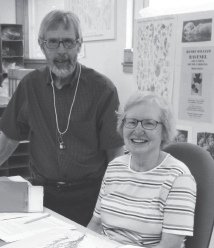
The New York Botanical Garden is home to some of the planet’s most talented, accomplished, and prolific botanical scientists. It’s a serious point of pride around here! But we still feel a spark of gratification whenever our staff members earn recognition outside the gates, from a global community of scientists that understands the significance of their contributions. And of the many botanists to receive accolades, especially deserving are Drs. Patricia and Noel Holmgren, 2012’s recipients of the prestigious Asa Gray Award for lifetime achievement in their field.
It’s a special few that can measure out their dedication to this institution in decades. Fewer still who’ve done it all in tandem with their spouse. But for Patricia and Noel, who spent a combined 68 years with the NYBG, this award from the American Society of Plant Taxonomists is something of a highlight for two celebrated careers. The recognition comes in light of the Holmgrens’ work with the Index Herbariorum, an NYBG-based index of the world’s nearly 3,400 herbaria and 10,000 associated curators. First printed in 1952, this internationally-recognized collection has since come under the Holmgrens’ stewardship, now maintained by the pair in both current print editions and a comprehensive digital database.