The Amazon Rain Forest still holds many mysteries for botanists. Dr. Douglas Daly and his Brazilian collaborators are in the Jacundá National Forest of Brazil’s Rondônia state to collect plant specimens and investigate the extent of damage from recent fires. Today’s efforts uncovered a species of tree that Dr. Daly and his team had never seen before, and could even be new to science. Follow along with Dr. Daly’s ongoing expedition here.
Douglas Daly, Ph.D., is the B.A. Krukoff Curator of Amazonian Botany and the Director of the Institute of Systematic Botany at The New York Botanical Garden.
“Destruction [of forests] represents an attack on humanity, an affront to the sources of life, and an assured means of destroying future generations.”
—Roberto Burle Marx, “Garden and Ecology,” 1969
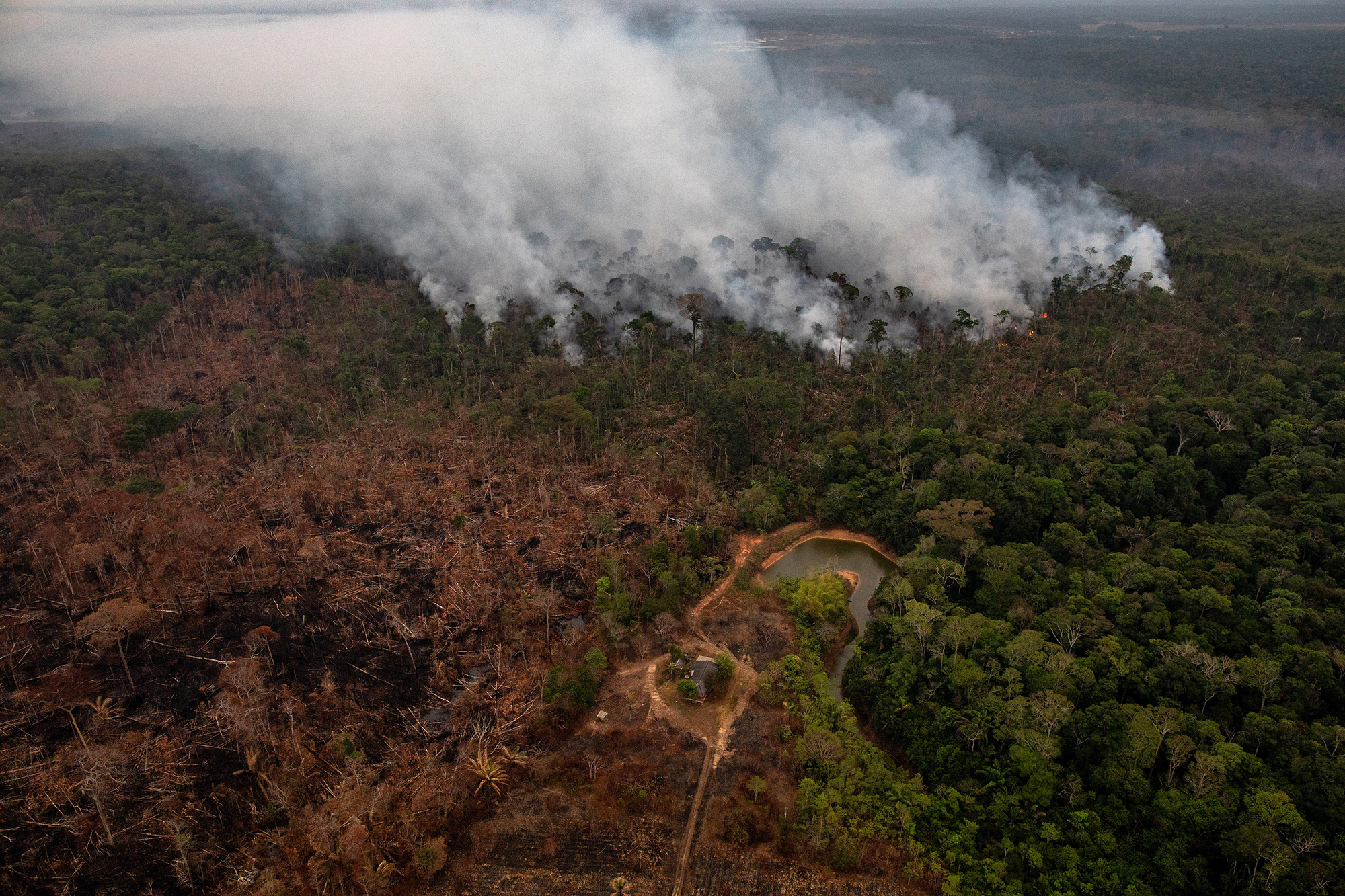
Forest burning near Porto Velho, the capital of the Brazilian State of Rondônia. (Victor Moriyama/The New York Times/Redux)
The Amazon is the world’s largest tropical forest, spanning nine South American countries and housing 10 percent of the world’s living plant and animal species. Its trees absorb about 25 percent of carbon emissions taken in collectively by all forests on Earth, replacing harmful CO2 with the oxygen we breathe. Recent reports indicate the number of fires blazing in the Amazon in late August 2019 is the highest on record, representing an 83 percent increase over the number of fires at the same time last year.
Brian M. Boom, Ph.D., is Vice President for Conservation Strategy at The New York Botanical Garden.
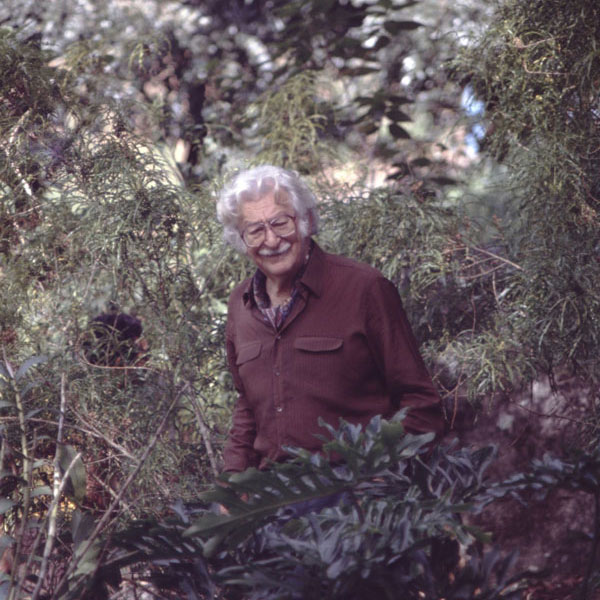
A photo of Roberto Burle Marx in Brazil, taken by his protegé, Raymond Jungles.
The recent report about the fires in the Brazilian Amazon compels us to reflect on how painful the Amazonian fires would have been to Roberto Burle Marx (1904–94), one of Brazil’s earliest and most important advocates for the rain forest and the subject of our current major exhibition, Brazilian Modern: The Living Art of Roberto Burle Marx.
A renowned landscape architect, Burle Marx was also a passionate, outspoken conservationist. His writings on environmental topics in Brazil—powerful when written a half-century ago—have a renewed, relevant resonance in 2019. For example, in Burle Marx: Homenagem à Natureza¹, he is quoted as saying, “You have to understand that it is my obligation to oppose everything that I consider an ecological crime … the sacrifice of nature is irreversible.” In 1969, he wrote: “This destruction [of forests] represents an attack on humanity, an affront to the sources of life, and an assured means of destroying future generations.”² A more powerful, fitting response to the news of the Amazonian fires could not be penned today.
Stevenson Swanson is the Science Media Manager at The New York Botanical Garden.
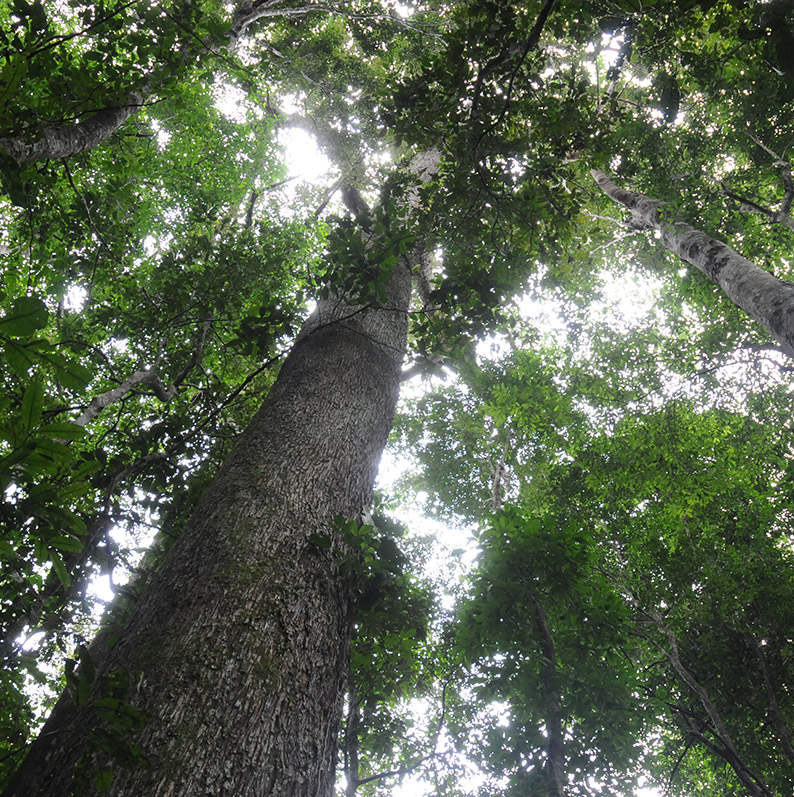
Rain forest in the Brazilian state of Acre
Representing a major advance in understanding and conserving the plant life of one of the world’s greatest biodiversity hotspots, an international team of scientists—including four researchers from The New York Botanical Garden—has created the first scientifically vetted list of known plant species in the Amazon Basin.
Based on documented plant specimens held in research collections worldwide and verified by specialists in tropical plants, the team cataloged 14,003 species of seed plants in the Amazon Basin, including 6,727 species of trees. Their research paper, which has just been published in the Proceedings of the National Academy of Sciences (PNAS), is available here.
Until now, the number of plant species that live in the Amazon Basin has been hotly debated, with estimates ranging from the tens to the hundreds of thousands. But those numbers have been based on ecological models or unverified species lists. This study assembles comprehensive species information based on plant specimens identified by specialists.
Julia Beros has worked or interned at The New York Botanical Garden for more than two years, including at the Pfizer Plant Research Laboratory and the Ruth Rea Howell Family Garden. In May, she graduated from Sarah Lawrence College.
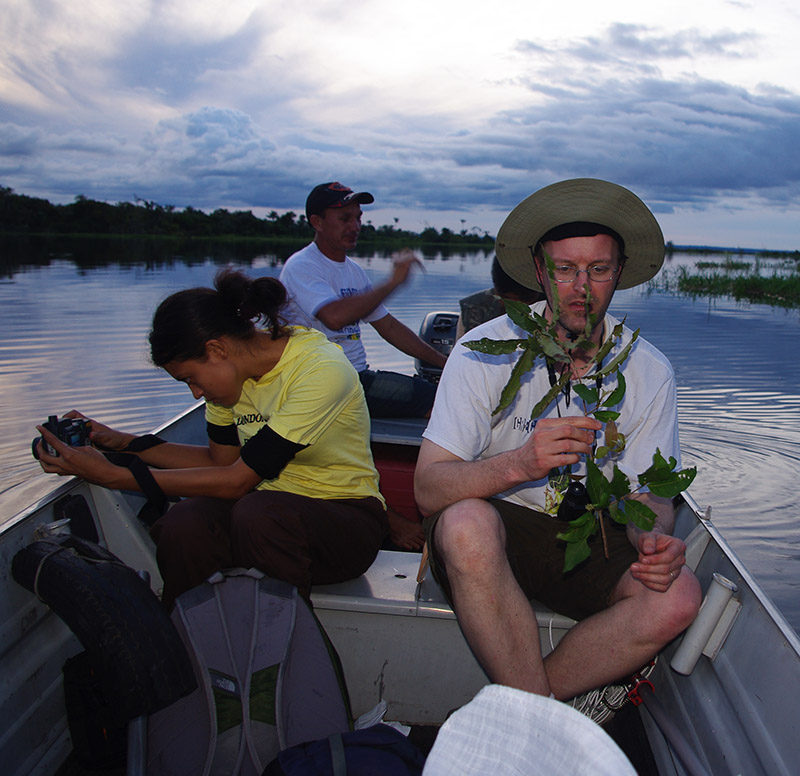
Dr. Benjamin Torke, in a boat on the Tapajós River, studies a plant specimen.
It’s hardly a secret that the Amazon rain forest, the largest expanse of tropical rain forest on earth, houses great biodiversity and that environmental degradation from climate change and human enterprise is a massive and looming threat throughout the region. The most critically threatened areas also happen to be the least studied and inventoried, but they are estimated to have the highest biodiversity within the Amazon rain forest. NYBG scientist Benjamin Torke, Ph.D., is working to fill in the gaps in our understanding of the rich plant life in one such area in the state of Pará in the southeastern part of the Brazilian Amazon.
Recently, environmental degradation has threatened the potential for capturing and sharing this knowledge. In the southeastern regions of the Amazon, many of the detrimental effects of climate change are heightened by expanding human development. Ranching, logging, soy bean farming, mining, and settlement all contribute to the loss of natural habitat. The construction of a highway that bifurcates the forest has simultaneously created isolated regions of biodiversity and increased the rate of forest degradation. The potential loss of biodiversity is almost visible from satellite images in which beige hatched lines scratch across the dense green rain forest.
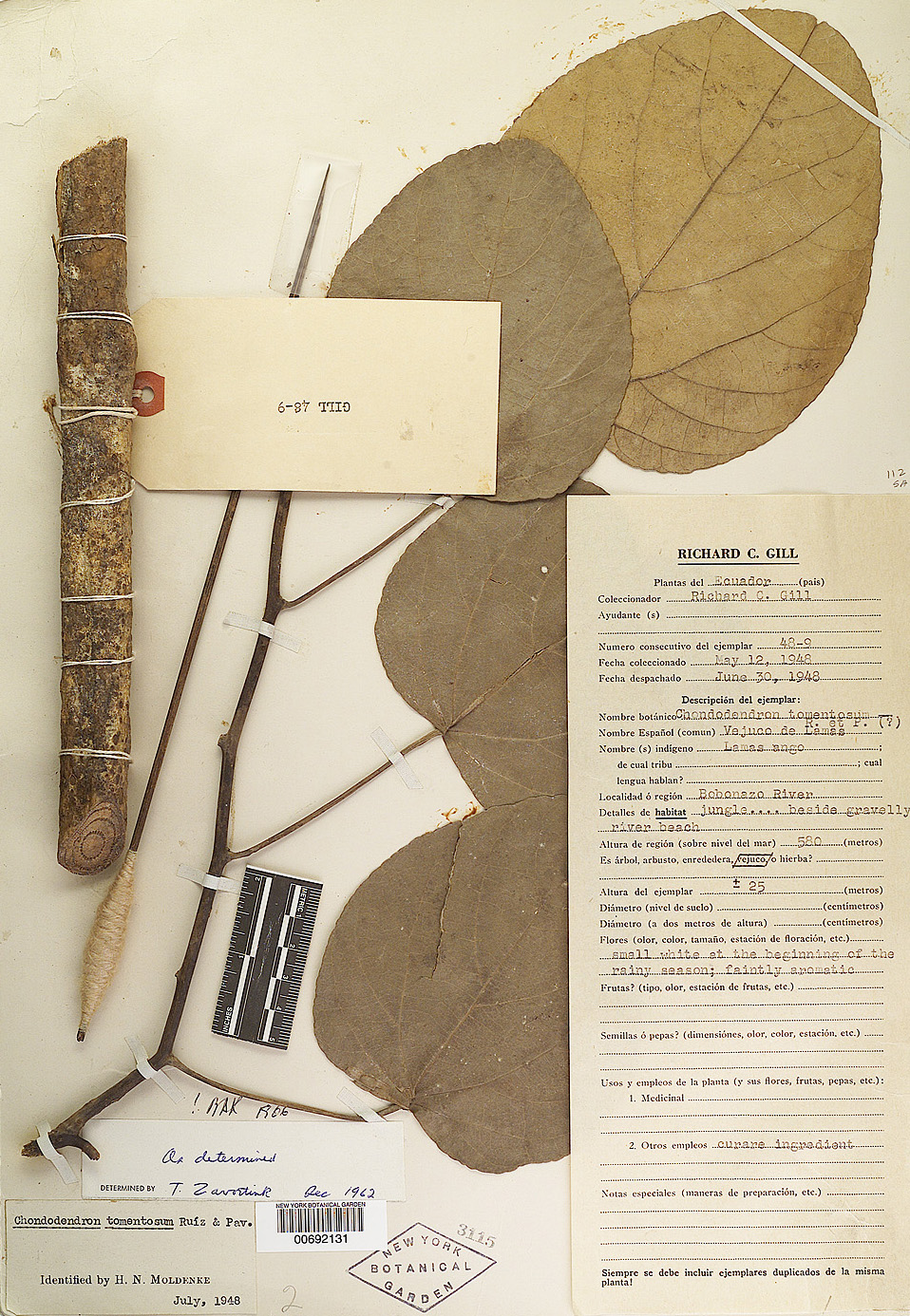
A curare specimen originally collected by Richard C. Gill
With 7.4 million specimens, the William and Lynda Steere Herbarium of The New York Botanical Garden is a repository of thousands of scientifically significant, historic, or interesting plant specimens collected from around the world. Among these are specimens of the plants that are used to make curare, or blow-dart poison, which were collected during an intensive investigation of the poison for medicinal use in the late 1930s. That research was the start in the chain of events that revolutionized medical anesthesia.
Curare is extracted from a mixture of varying botanical sources, including species of the Menispermaceae and Loganiaceae families. Indigenous tribes of the Amazon region and elsewhere around the Neotropics have been credited with formulating curare, which induces muscular paralysis upon entering the bloodstream but is not toxic when ingested, making it ideal for hunting. Peter Martyr d’Anghiera, who chronicled Spain’s discoveries during the Age of Exploration, first described the poison in 1516. In 1595, Sir Walter Raleigh of England met the tribesmen of the Amazon region and returned with preparations of the poisonous herbs known by the natives as “ourari,” which later evolved into “curare.”
The New York Botanical Garden recently welcomed our distinguished former head of scientific research, Sir Ghillean Prance, one of the most important explorers of the Amazonian rain forest in modern times, who was back for an all-too-brief visit.
Sir Ghillean, who spent 25 years at the Botanical Garden before leaving in 1988 to become the Director of the Royal Botanic Gardens, Kew, was here to celebrate the publication of his new book, That Glorious Forest: Exploring the Plants and Their Indigenous Uses in Amazonia, published by The New York Botanical Garden Press.
In a lifetime devoted to the study and conservation of tropical plants, Sir Ghillean has participated in 39 expeditions to the Amazon, beginning with a 1963 trip to Suriname as a young Garden researcher, which he describes in That Glorious Forest.
Douglas C. Daly, Ph.D., is the Director of the Institute of Systematic Botany and the B. A. Krukoff Curator of Amazonian Botany at The New York Botanical Garden. Among his research activities, he is a specialist in the Burseraceae (frankincense and myrrh) family of plants.
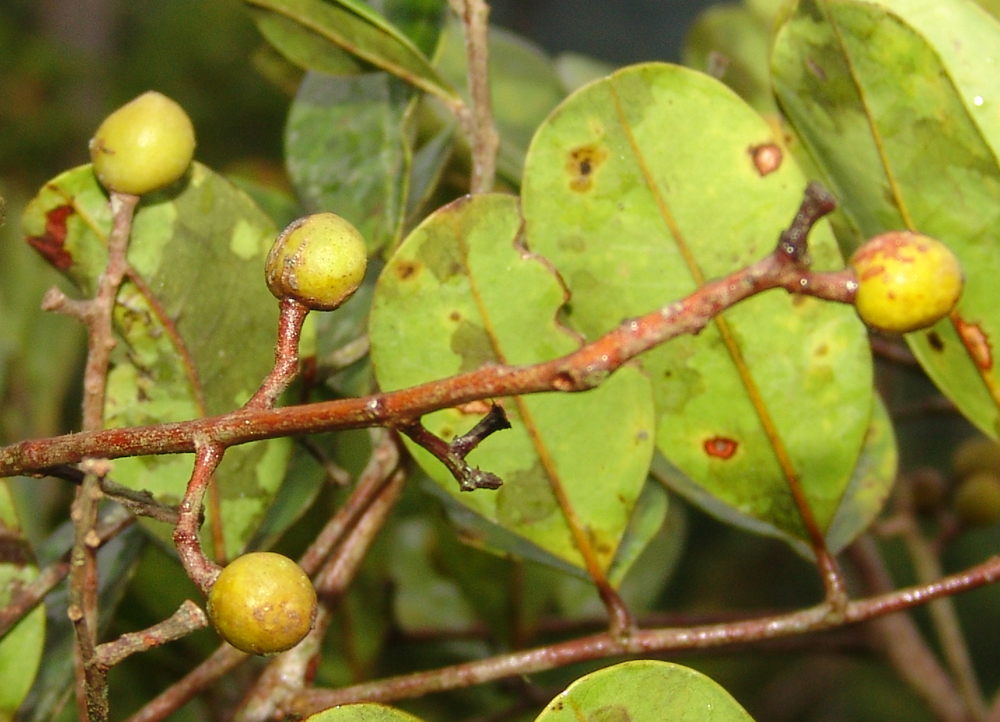
The oil-rich fruit of the newly described species Dacryodes urut-kunchae attracts many game animals. (Photo: David Neill)
When plant scientists discover new species—as I discussed in the first post of this series—their discovery is often an extremely rare plant, and frequently the specimens they see are incomplete. For example, there might be fruits but no flowers, and we have to search for more specimens or wait for other scientists to send us more examples before we can thoroughly describe and publish a species as new. But when a region is first explored botanically, sometimes we are amazed to find that a conspicuous member of the plant community has no name.
Scott A. Mori, Ph.D., is the Nathaniel Lord Britton Curator of Botany at The New York Botanical Garden. Francisca Coelho is the Vivian and Edward Merrin Vice President for Glasshouses and Exhibitions.
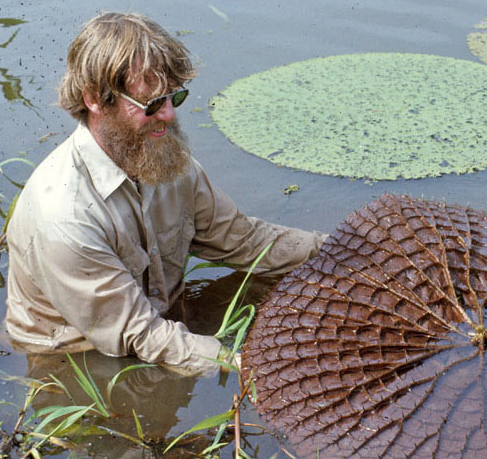
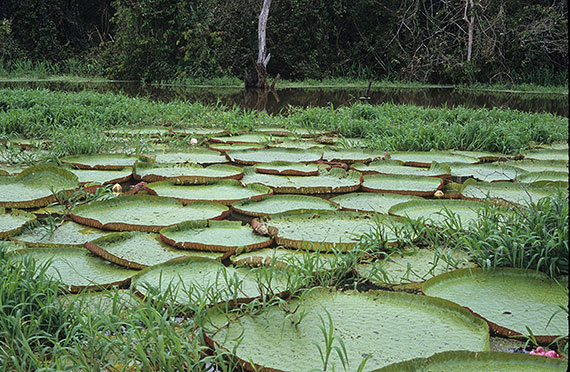
Victoria amazonica in its native habitat along the Amazon River.
In a post on Plant Talk, Scott described the fascinating life cycle of the Amazon water lily. But how did this iconic Amazonian species receive its scientific name, and how did this popular late-summer attraction come to be cultivated so far from its native habitat at major botanical gardens such as The New York Botanical Garden?
The Amazon water lily was discovered by Eduard Friedrich Poeppig in Peru and, because he thought it was related to an eastern Asian water lily belonging to the genus Euryale, he named it Euryale amazonica in 1836. The species was rediscovered by the German botanist Robert Hermann Schomburgk on a botanical expedition supported by Great Britain to what was then known as British Guiana. Schomburgk shipped his detailed notes, drawings, and collections to the Royal Botanic Gardens, Kew, where John Lindley described the species as Victoria regia in 1837 in honor of Queen Victoria.
Benjamin M. Torke, Ph.D., is an Assistant Curator at the Garden’s Institute of Systematic Botany. He is one of the leaders of a project to document the plant diversity of the Tapajos River basin in northern Brazil, an area roughly the size of France.
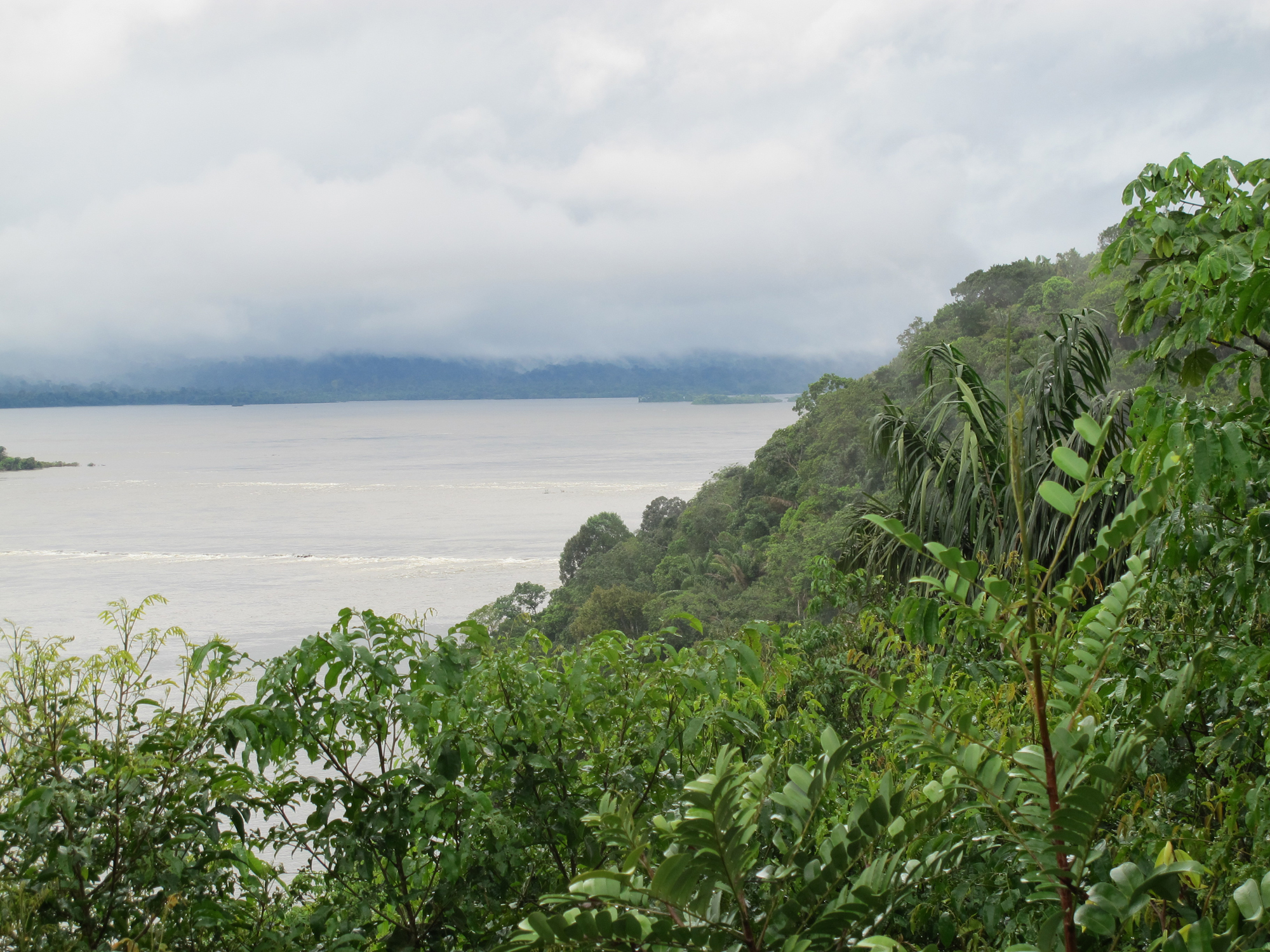
Threatened by deforestation, climate change, and high levels of poverty in local communities, the Amazon rain forest and its immense diversity of plant life have a very uncertain future. During a recent expedition in Brazil’s Amazonia National Park, I awoke to a cloud of fog hanging low over the San Luis rapids on the Tapajos River, one of the largest tributaries of the Amazon River.
The scene struck me as an apt metaphor, not only for the Tapajos region—the area in the photo is slated for a massive hydroelectric development that will flood portions of the national park—but also for the entire Amazon basin. My Brazilian collaborators and I hope that our race to inventory threatened plant diversity in the Tapajos region will yield information useful to local communities and governments as they struggle to strike a balance between much-needed economic development and conservation of irreplaceable plant species.