| Horticultural
Therapy |
Click here for printable

pages from catalog
|
Horticultural
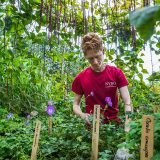
Therapy is the use of live plants and the growing environment
to heal and rehabilitate people. Greenhouse and gardening
programs use the relationship between people and the natural
environment to affect human wellness. Horticulture is used
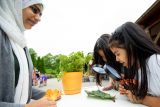
as a therapeutic tool with many different populations, young
and old. Programs are currently operating in hospitals, skilled
nursing facilities, schools, and social service agencies.
In these programs, plants are used to help individuals meet
physical, social, psychological, vocational, and educational
goals.
Pursue a Certificate in Horticultural Therapy or enroll in
individual courses. The objective of the Horticultural Therapy
Certificate program is to offer healthcare professionals,
horticulture specialists, and students (new
to the field) the technical knowledge and practical experience
necessary to plan, implement, and evaluate horticulture programs
for special populations.
The Program Coordinator, Phyllis
D'Amico HTR is a registered Horticultural Therapist with
the American Horticultural Therapy Association. She is also
a multi-certified teacher who has worked with developmentally
disabled children and adults for over 25 years. She is the
Lead Science Teacher at the New Jersey Regional Day School
at Newark where she has created an award-winning horticultural
therapy program that uses gardening, nature studies and environmental
education with special needs students of all ages and abilities.
Ms. D'Amico specializes in children's garden design, organic
gardening, nutrition education, service-learning projects
and inclusion programs. She earned a certificate in Horticultural
Therapy from the Garden where she has also been an instructor,
helping to prepare horticultural therapists for the last 15
years. Ms. D'Amico is the past president of the Mid-Atlantic
Chapter of the American Horticultural Therapy Association.
Horticultural
Therapy Certificate Program
What Is a New York Botanical
Garden Certificate?
| Horticultural Therapy
Certificate Requirements |
| Code |
Course/Quarter(s)
offered |
Hours |
| BOT 300 |
Introduction to Plant Science /Fall, Winter |
16
|
| GAR 301 |
Fundamentals of Gardening /Fall, Winter |
12
|
| THR
301 |
Introduction to Horticultural Therapy/ Spring,
Fall |
12
|
| THR 302 |
Indoor Tropical Plants/Winter |
12
|
| GAR
311 |
Introduction to Plant Propagation and Grafting/
Fall, Spring |
18
|
| THR 325 |
Greenhouse Operation for Horticultural Therapists/Winter |
15
|
| THR
330 |
Activities Analysis for the Horticultural
Therapist/Spring |
18
|
| THR
402 |
Horticultural Therapy for Exceptional Children/Spring,
Fall |
12
|
| THR
403 |
Horticultural Therapy for Patients with
Physical and Neurological Disabilities/Spring, Fall |
12
|
| THR
404 |
Horticultural Therapy in Behavioral Health
Settings/Spring, Fall |
12
|
| THR
405 |
Horticultural Therapy: Program Development,
Design, and Process/Summer, Winter |
12
|
| |
Horticultural Therapy Site Visits /all quarters |
8
|
| |
Elective THR Certificate Courses /all quarters |
24
|
| |
Total |
183*
|
*Plus three 100-hour internships.
Summer
Horticultural Therapy Intensives
Horticultural Therapy Intensive I:
3 Weeks, Mon., July 11-Fri., July 29, 9 a.m.-6 p.m.
Horticultural Therapy Intensive II:
2 Weeks, Mon., Aug. 1-Fri., Aug. 12, 9 a.m.-6 p.m.
Summer 2005 is your opportunity to begin a new career in
the field of Horticultural Therapy. Learn about populations
which can benefit from horticultural therapy programming,
and participate in hands-on activities designed to demonstrate
the principles of Horticultural Therapy.
In Intensive I you will earn 104 hours of credit and in Intensive
II earn 79 hours toward the 183 hours required for the Garden's
Horticultural Therapy Certificate. You will be equipped to
pursue internship opportunities in horticultural therapy and
begin to incorporate a horticulture component into your own
school, social service, or health care setting.
The curriculum is designed to cover three areas of the Horticultural
Therapy Program:
People/Plant Relationships
Professional Horticultural Therapists provide an overview
of many different special needs populations and how Horticultural
Therapy can help them attain their goals.
Plant Science and Gardening
Gain a basic understanding of plant science and gardening
on the grounds of the Garden. Knowledge of the plant world
will become an effective tool for therapy.
Tours and Site Visits
The curriculum includes tours of therapeutic gardens. Students
visit existing Horticultural Therapy programs and observe
professional therapists in action.
Questions about the Intensive?
Call 718.817.8747, or E-mail: conted@nybg.org.
Courses in Horticultural Therapy
Intensive I:
- Introduction to Horticultural Therapy
- Introduction to Plant Science
- Activities Analysis
- Horticultural Therapy for Patients with Neurological-Muscular
Impairments and Disabilities
- Horticultural Therapy in Behavioral Health Settings
- Indoor Tropical Plants
- Horticultural Therapy Site Visits
SU THR 950 Three
weeks, five days a week, 9 a.m.-6 p.m., Monday-Friday,
July 11-29, Rm. 302
Tuition and refunds
$2,290 non-members, $2,260 members.
$765 is non-refundable. As an option, a
payment schedule is available if requested: April 11, May
9, and the final payment on June 13. No refunds will be processed
on or after Monday, June 13.
Courses in Horticultural Therapy
Intensive II:
- Fundamentals of Gardening
- Introduction to Plant Propagation and Grafting
- Greenhouse Operations for Horticultural Therapists
- Horticultural Therapy for Children
- Horticultural Therapy: Program, Development, Design and
Process
- Horticultural Therapy Site Visits
- Prerequisite: Introduction to
Horticultural Therapy-THR 301.
SU THR 960 Two
weeks, five days a week, 9 a.m.-6 p.m., Monday-Friday,
Aug. 1-Aug. 12, Rm. 302
Tuition and refunds
$1,650 non-members, $1,620 members.
$550 is non-refundable. As an option, a
payment schedule is available if requested: May 9, June 13,
and the final payment on July 11. No refunds will be processed
on or after Monday, July 11.
Introduction
to Horticultural Therapy
Certificate Requirement, Classroom
Hours: 12
Explore the field of horticultural therapy and learn about
the use of plants as a way to reach physical, psycho/social,
and educational goals with a variety of populations. This
course covers an introduction to the field and certificate
requirements, a history of horticultural therapy, an overview
of the many clinical applications of horticultural therapy,
and information
on professional registration and employment potential. Please
bring lunch for classes meeting all day.
$256 non-members, $231 members
(Includes a $10 materials fee)
Charles
Sourby, MS Ed. CTRS & Phyllis
D'Amico, HTR
SP THR 301 Section
A: 2 Saturdays, April 2 & 9, 9 a.m.-3:30 p.m., Rm. 301
Kathleen
Silberstein, HTR
SP THR 301
Section B: 4 Thursdays, April 7-28, 6:15-9:15 p.m., Rm. 301
Kathleen
Silberstein, HTR
SP THR 301 Section
C: 2 Tuesdays, June 21 & 28, 2 Thursdays, June 23 &
30, 6:15-9:15 p.m., Rm. 301
Plants
for Therapeutic Programs
Certificate Elective, Classroom
Hours: 6
Expand your selection of plant material to include proven
and exciting herbs, flowers, vegetables, fruits, grasses,
trees, shrubs and unusual tropicals that have specific applications
for horticultural therapy goals. Explore how to use these
plants through hands-on and disability-simulating activities.
$138 non-members, $126 members
(Includes a $15 materials fee)
Phyllis
D'Amico, HTR, & John
Beirne
WI THR 307
2 Wednesdays, March 23 & 30, 5:15-8:15 p.m., Rm. 102
Aromatherapy
for Horticultural Therapy
Certificate Elective, Classroom
Hours: 6
Discover the aromatic world of essential oils and how they
can be safely and effectively used in a variety of horticultural
therapy programming. Learn the history of aromatherapy and
how and why it works. Experience activities for affecting
mood, blend oils and create products that can be used for
therapeutic activities. Add a whole new dimension of sensory
stimulation to your horticultural therapy program.
$133 non-members, $121 members
(includes a $10 materials fee)
Gwenn
Fried
SP THR 309
2 Wednesdays, April 27 & May 4, 5:15-8:15 p.m., Rm. 301
Spirituality
in Gardening
Certificate Elective, Classroom
Hours: 12
Horticultural therapy dovetails perfectly with the current
emphasis on mind/body healing. Explore the healing of the
soul that gardening and gardens offer. Palliative care, biblical
gardens, labyrinths, and the garden archetype are discussed.
Explore the use of horticultural therapy for stress reduction.
Please bring lunch.
$246 non-members, $222 members
Matthew
Wichrowski,
HTR & Charles
Sourby, M.S, Ed. CTRS
SP THR 320
2 Saturdays, June 4 & 11, 9 a.m.-3:30 p.m., Rm. 301
Adaptive
Tools and Accessible Gardening
Certificate Elective, Classroom
Hours: 3.5
Horticultural therapists must be creative in designing both
tools and spaces for a variety of special needs. In this class,
students design and construct adaptive tools and assistive
devices through problem-solving activities. Also, learn how
to make both indoor and outdoor areas accessible.
$92 non-members, $85 members
(includes a $20 materials fee)
Phyllis
D'Amico HTR
SP THR 327
Saturday, June 25, 9 a.m.-12:30 p.m., Rm. 301
Activities
Analysis for the Horticultural Therapist
Certificate Requirement, Classroom
Hours: 18
Keep clients and patients engaged with a variety of horticultural
projects and botanical craft ideas. Analyze projects that
can be used by the therapist. See what physical, cognitive,
and social skills are necessary for performance of these tasks.
Prerequisite: Introduction to Horticultural Therapy-THR 301.
$394 non-members, $364 non-members
(Includes a $25 materials fee)
Sonia
D'Andrea, M.S. Ed. & Kim
Yaffe, HTR
SP THR 330 6
Thursdays, May 5-June 9, 6:15-9:15 p.m., Rm. P201
Horticultural
Therapy and the Aging Population
Certificate Elective, Classroom
Hours: 3
Older adults, the fastest growing segment of the population,
present an increasing need for therapeutic services. Learn
about the physical, sensory, cognitive, psychological and
social aspects of aging and their implications for horticultural
therapy programming. Explore how horticulture can be an important
component in the various levels of geriatric care.
$62 non-members, $56 members
Kathleen
Silberstein HTR
SU THR 340
Tuesday, September 20, 6:15-9:15 p.m., Rm. 301
Recreational
Floral Therapy
Certificate Elective, Classroom
Hours: 6
Working with flowers has been documented to improve emotional
wellness, self-expression and self-esteem. Learn how flower
arranging can be adapted to work in all therapeutic settings
in this one-day seminar. Lecture and demonstration in the
morning is followed by hands-on workshop in the afternoon.
Discuss the floral industry and all that it has to offer the
HT professional. Please bring lunch.
$163 non-members, $151 members
(Includes a $40 materials fee)
Cheryl
Wilks
SP THR 350
Sunday, May 15, 10 a.m.-4:30 p.m., Rm. 101
Consulting
for Horticultural Therapists
Certificate Elective, Classroom
Hours: 6
Discuss the basics of launching your own consulting business
in this full-day workshop. Explore legal and financial aspects
involved in being an independent contractor. Learn how to
develop a business plan and how to market your services. Gain
an understanding of the operational components of running
your own business. Benefit from the instructor's expertise
and experience in creating her own company that provides horticultural
therapy services for both the private and public sectors.
Prerequisite: Introduction to Horticultural Therapy-THR 301.
$123 non-members, $111 members
Patricia
Czarnecki
SP THR 360 Saturday,
May 21, 9 a.m.-3:30 p.m., Rm. 301
Site
Visit: The Enid A. Haupt Glass Garden at The Rusk Institute
Certificate Requirement and Elective,
Classroom Hours: 4
This individualized intensive training offers an overview
of horticultural therapy treatment in a physical rehabilitation
setting. The focus is on physical medicine and rehabilitation-history,
philosophy, and team functions. Participate in horticulture
treatment sessions with a focus on patient functioning, treatment
goals, and precautions. Prerequisite: THR 301.
$96 non-members, $86 members
Nancy
Chambers, HTR and staff
THR 525 by
appointment, call the Registration Office
Site
Visit: Terence Cardinal Cooke Health Care Center
Certificate Requirement and Elective,
Classroom Hours: 4
Visit a 720-bed chronic and long-term care facility that serves
geriatric patients, patients with AIDS, Alzheimer's Disease,
dementia, Huntington's Disease, and patients on short-term
rehabilitation. Students accompany the horticultural therapist
on rounds. Please bring lunch. Travel directions are mailed
with your confirmation letter. Prerequisite: THR 301.
$96 non-members, $86 members
Donna
Arabian
SP THR 528 Friday,
May 20, 10 a.m.-3 p.m., OFFSITE
Site
Visit: Monsignor Murray Therapeutic Sensory Garden
Certificate Requirement and Elective,
Classroom Hours: 3
This Garden, at the Schervier Nursing Care Center in Riverdale,
N.Y., was designed for the Center's award-winning Alzheimer's
program, Magic Moments, that combines music therapy, recreation
therapy, art therapy, and horticultural therapy. Program goals
include creative expression, use of gross motor skills, fine
motor skills, and cognitive skills. Travel directions are
mailed with your confirmation letter. Please bring lunch.
Prerequisite: THR 301.
$72 non-members, $65 members
Charles
Sourby, M.S. Ed.
SP THR 529
Friday, June 17, 1-4 p.m., OFFSITE
Site
Visit: The Children's Village, Dobbs Ferry, NY
Certificate Requirement and Elective,
Classroom Hours: 3
Since 1851, this residential treatment facility has been serving
at-risk youth with programs designed to give stability and
nurturing. The WAY (Work Appreciation for Youth) is a multi-step
program to help older boys gain skills necessary to become
productive adults. Tour the campus and work with students
at the Greenhouse. Please dress comfortably. Prerequisite:
THR 301.
$72 non-members, $65 members
Barbara
Fischer
SP THR 530
Wednesday, May 11, 2-5 p.m., OFFISTE
Site
Visit: Project FIND at the Hamilton Senior Center, NYC
Certificate Requirement and Elective,
Classroom Hours: 4
Explore horticultural therapy in action with members of the
Hamilton Senior Garden Club. Through Project FIND, seniors
participate in activities designed to encourage recreation,
physical fitness, nutrition education self-advocacy and inclusion
in the community. Hear testimonials from the participants
and tour the gardens. Travel directions are mailed with your
confirmation letter. Prerequisite: Introduction to Horticultural
Therapy-THR 301.
$96 non-members, $86 members
Gwenn
Fried
SP THR 532
Tuesday, June 7, 12-4 p.m., OFFSITE
Site
Visit: NewBridge Services, Pompton Plains, N.J.
Certificate Requirement and Elective,
Classroom Hours: 4
NewBridge Services Inc. is a community organization providing
comprehensive behavioral health-related services and education
to residents of all ages in Morris and Passaic counties since
1963. Experience the innovative horticultural therapy program
Project ENRICH as you tour the tropical garden with the clients
who created it. Travel directions are mailed with your confirmation
letter. Prerequisite: Introduction to Horticultural Therapy-THR
301.
$96 non-members, $86 members
John
Beirne
SU THR 533 Monday,
Sept. 19, 10 a.m.-3 p.m., OFFSITE
SPECIAL
CLASSES
Core Sequence in Horticultural
Therapy-THR 402, 403, 404, and 405.
These classes were formerly known as the People/Plant
Relationships Series. THR 402, 403, and 404 can be taken in
any order, provided you have completed Introduction to Horticultural
Therapy-THR 301. Upon completion of THR 402, 403, and 404,
you can take Horticultural Therapy: Program Development, Design,
and Process-THR 405, which ties together all you have learned
in the prior courses and gives you the tools to apply your
education to practical development and execution of horticultural
therapy groups and programs.
Horticultural
Therapy for Exceptional Children
Certificate Requirement, Classroom
Hours: 12
Gain an understanding of the practice of horticultural therapy
as it relates to children and adolescents with developmental,
sensory, physical, behavioral and learning challenges. Explore
a variety of methods and programs to meet the goals of pre-school
through high-school aged special needs students. Engage in
active, cooperative activities to develop lessons and curricula
that can be used in settings for youth of all abilities.
$261 non-members, $236 members
(Includes a $15 materials fee)
Phyllis
D'Amico, HTR
SP THR 402 2
Saturdays, May 7 & 14, 9 a.m.-3:30 p.m., Rm. 301
Horticultural
Therapy for Patients with Neurological-Muscular Impairments
and Disabilities
Certificate Requirement, Classroom
Hours: 12
Students explore the effects that left or right-sided stroke,
Alzheimer's disease, multiple sclerosis, cerebral palsy, spinal
cord injuries, and automobile accidents have on patients.
Case studies are presented and students will develop their
clinical skills regarding assessment, treatment, and individualized
horticultural therapy goals. Prerequisite: Introduction to
Horticultural Therapy-THR 301.
$261 non-members, $236 members
(Includes a $15 materials fee)
Matthew
Wichrowski, HTR
SP THR 403
4 Wednesdays, June 1-22, 6:15-9:15 p.m., Rm. 301
Horticultural
Therapy in Behavioral Health Settings
Certificate Requirement, Classroom
Hours: 12
The foundations of horticultural therapy date back to the
middle ages when psychiatric patients were encouraged to participate
in gardening activities. Today, horticultural therapy is practiced
in a multitude of behavioral health settings including hospitals,
day treatment programs, group homes and with individuals.
Learn the diagnostic criteria for common mental disorders
and review actual case studies. Create treatment plans utilizing
horticulture activities for specific client needs. Please
bring lunch. Prerequisite: Introduction to Horticultural Therapy-THR
301.
$261 non-members, $236 members
(Includes a $15 materials fee)
Maxine
Kaplan, HTM & John
Beirne
SP THR 404
2 Saturdays, April 16 & 30 (no class April 23), 9 a.m.-3:30
p.m., Rm. 301
Horticultural
Therapy: Program Development, Design, and Process
Certificate Requirement, Classroom
Hours: 12
This course is the culmination of three horticultural therapy
courses-THR 402, 403, 404 (formerly the People/Plant Series).
Learn how to implement and design a horticultural therapy
program. Learn about the various activities, goals, budgeting
concerns, and staffing issues. Program operations and organizational
responsibilities are also included. The second half of this
course explores group process, program planning, program schedul-ing,
and clinical responsibilities. Prerequisite: Horticultural
Therapy for Children; Horticultural Therapy for Patients with
Neurological-
Muscular Impairments and Disabilities; & Horticultural
Therapy in Behavioral Health Settings-THR 402, 403 and 404.
$271 non-members, $246 members
(Includes a $25 materials fee)
Nancy
Chambers, HTR and Gwenn
Fried
SU THR 405
4 Thursdays, Sept. 8-29, 5:15-8:15 p.m., Rm. 230
|