| ·· Design & Planning ·· |
Creating a garden inspired by Shakespeare using plants mentioned in his plays and sonnets is an intriguing project. In more than 20 of his works, gardens and plants are often metaphors for life, with many important scenes taking place in garden settings. The Bard describes the plants of his world in fresh, pithy, and often poignant ways, and his characters are often compared to gardeners.
Elements of Design
Aristocratic Elizabethan gardens were usually formal in design with geometrically shaped planting beds laid out symmetrically. The overall shape of the garden might be a large square subdivided into quadrants. Focal points were created with sculptural elements like sundials, stone urns, fountains, and statues placed at the end of a central axis or in the center of a planting area. Hedges, fences, and stone walls enclosed garden areas and kept livestock away. Well-placed benches provided seating while allées of clipped trees gave much needed shade and privacy. Espaliered fruit trees were formal and decorative as well as edible.
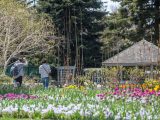
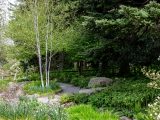
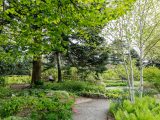
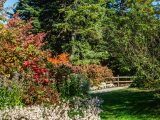
Today, a Shakespeare garden might include these formal design features as well as plantings in a less formal cottage and herb garden style. Elements of the English countryside such as woodlands, meadows, and hedgerows might also be incorporated. The plant palette for all these areas would be chosen from the hundreds of plants mentioned and described in the plays and sonnets.
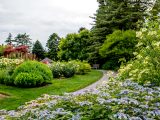
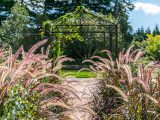
A decorative hedge or stone or brick wall might define the garden. Geometric planting beds could be symmetrically placed around a central feature or along a central axis. Shade-providing fruit trees might fill the corners of the design. At each entrance, there might be gates with arbors overhead draped with roses or other vines. The view through the arbors might be of a meadow or woodland garden. Beds within the garden could even be devoted to the plants mentioned in individual plays.
Plantings
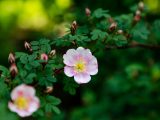
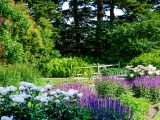
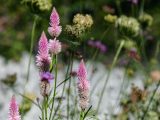
Surrounding hedges could be boxwood, yew, or closely spaced trees such as pleached linden or hawthorn. Espaliered roses and fruit trees might be trained along a sheltering brick wall. Herb gardens could include a useful and fragrant mix of medicinal and kitchen herbs like parsley, chamomile, caraway, fennel, lavender, and rosemary. Accents could be pyramidal evergreen shrubs such as English holly (Ilex aquifolium), the more modern Meserve holly (Ilex ×meserveae) or English yew (Taxus baccata). Planting beds might contain a mix of flowering annuals, biennials, and herbaceous perennials such as pansies (Viola), foxgloves (Digitalis), monkshood (Aconitum) and many others. Spring-flowering bulbs could include daffodils (Narcissus), tulips (Tulipa), crocus (Crocus), hyacinth (Hyacinthus), English bluebells (Hyacinthoides), and fritillaries (Fritillaria). Climbing and shrub roses would grace arbor entrances and formal beds while small shrubs such as lavender-cotton (Santolina) and germander (Teucrium) might edge the smaller flower and herb beds.
Selection of Plants for a Shakespeare Garden
Spring Bulbs
Crocus
Daffodil
Crown imperial Fritillaria imperialis
English bluebell Hyacinthoides non-scripta
Hyacinth Hyacinthus orientalis
Iris Iris germanica, I. florentina, I. pseudocarus
Star-of-Bethlehem Ornithogalum umbellatum
Tulip
Herbs
Bay Laurus nobilis
Chamomile Chamaemelum nobile
Fennel Foeniculum vulgare
Leek Allium porrum
Lavender Lavandula angustifolia
Lavender-cotton Santolina chamaecyparissus
Marjoram Origanum majorana
Mint Mentha spicata
Parsley Petroselinum
Rosemary Rosmarinus officinalis
Rue Ruta graveolens
Creeping thyme Thymus serpyllum
Garden Flowers
Carnation Dianthus
Columbine Aquilegia vulgaris
English daisy Bellis perennis
Foxglove Digitalis purpurea
Poppy Papaver
Monkshood
Rose Rosa
Pansy
Sweet woodruff Galium odoratum
Sweet violet Viola odorata
Trees and Shrubs
Crabapple Malus floribunda
English hawthorn Crataegus oxyacantha
English Holly
Woodbine Lonicera periclymenum
Yew
English ivy Hedera helix
Box Buxus semperviren
| ·· Design & Planning ·· |
Generous support for the Home Gardening Center has been provided by Kenneth and Ellen Roman.
Pauline Gillespie Gossett Plant Trials Garden
Tuesday - Sunday: 10 a.m. - 6 p.m.
Closed most Mondays, Thanksgiving & Christmas Day.
Please confirm hours on the day of your visit by calling 718.817.8700.
Metro-North Railroad
Take the Metro-North Harlem local line to Botanical Garden Station.
By becoming a Member today, you'll not only get a whole year's worth of benefits, you'll get the knowledge that you are helping the Garden's renowned horticulture, science, and education programs to flourish.