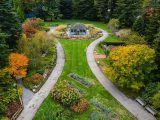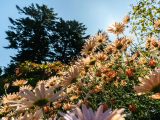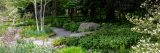
Claude Monet’s successful garden designs came about through continual practice. As a master gardener, horticulturist, and colorist, he perfected his style of blending multitudes of flower and foliage colors, textures, and shapes. His house and three-acre garden in Giverny, France, became Monet’s passion—a fascination that would last a lifetime. His love of nature helped create his world-famous garden, as well as nurture his artistic style. He redesigned, adjusted, and developed his garden, perfecting nature’s compositions and enabling him to capture glorious moments that shaped his impressionistic art.
How did he do it?
He used succession planting of colorful annuals and bulbs with perennials.
He planned colorful borders to bloom throughout the year.
Utilizing scale, he borrowed surrounding landscape to increase visual size of the garden.
He used large blocks of monochromatic colors, creating visual impact.
He also used complementary colors to intensify the visual interest.
He increased atmospheric effects of sunlight and mist by using specific colors
He used reflections of sky and landscape on water as a design feature and artistic inspiration.
In the vegetable-flower garden, he planted a quilt-like pattern of lettuce and cabbage, surrounded by pink peonies.
He worked, and reworked until he was dazzled.
(Fact: At present, Monet’s garden displays 200,000 annuals, biennials, and perennials each year. Monet had a two and a half acre vegetable and flower garden on a separate property.)
It takes some planning to achieve your own impressionistic garden for the 21st century. First you must decide what your needs are to put your plan into action.
- Time of interest through the year (spring, summer, autumn, or winter)
- Color choices of plants/foliage (consider house color)
- Time and cost
- Plant selection and cultural requirements
- Plant size, shape, and texture
- Architectural elements
(
Fact: To improve pockets of alkaline soil, Monet added peat moss and manure to create a more favorable pH.)
(Secret: The liberal planting of white flowers was used among bright colorful flowers, helping to produce much-needed sparkle in the landscape. One such planting of white flowers consisted of scattered white peonies among showy highlights of blue, bicolored Irises.)
One of the key elements to make a strong design is repetition. Monet repeated color, plants, and architectural accents, which makes a big impact as opposed to using random dots of color here and there. When Monet returned from painting in the garden, he would be welcomed with a riot of colorful flowering plants growing under the “Grande Allée Tunnel.” This made quite the entrance from the gate to the house. White, pink, rose, or lavender Penstemon and stock three feet high graced the path. Later, flowering red Phlox, reaching three to five feet in height, enriched the color scheme. Flowering hollyhocks (
Alcea) in soft pastels, foxgloves (
Digitalis) in deep mauves and purples, and larkspur (
Delphinium) in many shades of blue shot color into the sky.
Make your own “Grande Allée”
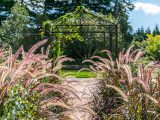
Let’s make a scaled-down version of Monet’s “Grande Allée Tunnel” of shrubs and perennials. Plants that bloom in spring, summer, and fall, like roses, asters, sunflowers, larkspur, bearded iris, nasturtiums, poppies, and leopard’s bane, can be used. Over the path, position three arches spaced evenly apart. The arches connect the borders, as well as raise the eye’s focus up and over to either side, achieving a charming and cohesive design. Nasturtiums can be planted at each border’s edge, and will eventually trail into the path. Rambling roses planted to scramble up and over the arches will add to the tunnel effect. Repeat the plants in each side of the path, varying their placement a bit. The repetition of plants and colors gives a pleasing visual effect. To practice, Monet used the cut flower technique to plan his designs. He would arrange cut flowers in hand to see how color, texture, and shape could work together harmoniously.
(
Secret: Monet’s favorite color combinations in the garden were blue and pink, yellow and blue (gold and sapphire), red, silver, and green, and blue/purple, pink, and white.)
Who hasn’t seen Monet’s famous waterlily paintings of fluid colors, exhibiting Monet’s passion for the mirrored flora and light effects on water? He later added a Japanese foot bridge to the pond, but favored the original water view to create his masterpieces. The original Japanese wisteria is growing over a 34-ft long iron arbor, which borders the northeast edge of the waterlily pond. Flowering rhododendrons and array of gladioli, irises, and rare species of lilies, add a touch of drama around the water’s edge of the waterlily pond. The yellow, blue, mauve waterlilies are spread throughout, supported by glistening, flat, green lily pads. Atmospheric effects on Monet’s garden were created by planting rich orange, pink, gold, and bronze wallflowers and tulips together to emphasize the effects of the setting sun.
(
Facts: Monet considered Lenten roses (Helleborus orientalis) and Primroses Barnhaven, which were planted near the pond, to be the perfect plant pairing . He planted many cherry and crab apple trees along with masses of tulips.)
Although Monet’s waterlily garden is well known today, it didn’t exist when he first started the landscape’s transformation at Giverny. There was no pond, much less a water feature. His plan to dig a pond, which meant diverting the water from the Ru River, came with much resistance by the locals, and getting the necessary permits was quite an ordeal.
There are dwarf waterlily varieties available in many flower colors and unusual leaf color variations to consider when planning your pond, but one color repeated will present more of an impact in a small pond.
(
Secret: The sensation of shimmer set Monet’s garden plantings apart. To achieve this effect, he combined the following five elements into a planting: White flowers sprinkled throughout the garden, fleecy foliage, translucent blooms, bi-colored flowers, and iridescent plants in the landscape design.)
(
Fact: Monet planted lavender colored wisteria over the Japanese Bridge’s metal frame to cascade down and create a lacy canopy. Monet loved lace.)