Program
10 a.m. to 12 p.m.
- Welcome & Opening Remarks
Welcome by Jennifer Bernstein, NYBG
Opening remarks by Stefan Schmitz, Crop Trust - Introduction from the International Treaty
Álvaro Toledo, International Treaty on Plant Genetic Resources for Food and Agriculture, FAO - Global Conservation Consortium for Food Plants: One-Year Anniversary
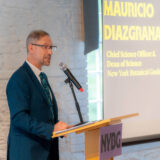
Mauricio Diazgranados, NYBG and Colin Khoury, Crop Trust & NYBG - Launch of the World Food Map
Anna Herforth and Chris Vogliano, Wageningen University & Research
- Opportunity Crops and Food Composition Diversity
Nile Nair, Periodic Table of Food Initiative (PTFI), and Jenny Gallo-Franco, PTFI and Alliance Bioversity/CIAT - Keynote by Arielle Johnson, author of Flavorama
- Stories of Food
Listen to short stories about food diversity told by scientists, activists, and practitioners, and contribute your own stories to the event. Speakers include:- Michael Kotutwa Johnson, University of Arizona
- Maarten van Zonneveld, International Potato Center
- Vivian Bernau, Seed Savers Exchange
- Bronwen Powell, Penn State University & Center for International Forestry Research (CIFOR), and Abderrahim Ouarghidi, Penn State University
- James Borrell, Royal Botanic Gardens, Kew
- Michael Balick, New York Botanical Garden
- Andy Jarvis, Bezos Earth Fund
- Devin Dotson, United States Botanic Garden
- Alex McAlvay, New York Botanical Garden
- Helena María Viramontes, Cornell University
- Eloy Rodriguez, Cornell University (emeritus)
- Transition: The Living Table
Annalyn Lavey, Genus Land
Lucio Usobiaga, Founder, Arca Tierra
Elixir of flavor from ancient Xochimilco chinampas gardens: Mujer Medicina
12 to 1 p.m.
- Networking Lunch
- Closing Remarks
John de la Parra, Rockefeller Foundation
1:15 to 2 p.m.
- Optional: Tour of the Edible Academy
Event moderated by Kate Geagan, Food + Planet