The Grapevines All Around Us
Colin Khoury is Project Manager of the Global Conservation Consortium for Food Plants (GCCFP) in the Center for Plants, People, and Culture at the New York Botanical Garden.
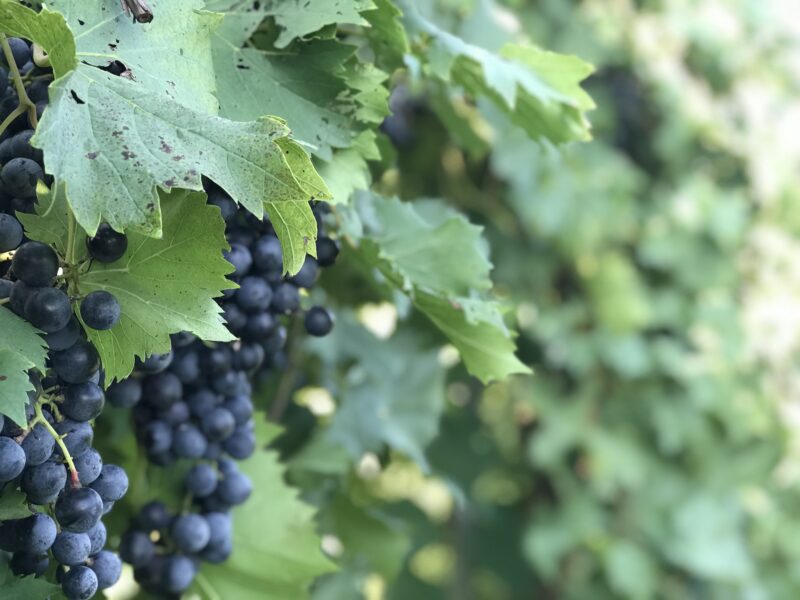
French-American hybrid grapevine cultivar ‘Chambourcin’ growing in an experimental vineyard at the University of Missouri Southwest Research Farm.
“Great love springs from great knowledge of the beloved object, and if you know it but little you will be able to love it only a little or not at all.” —Leonardo da Vinci
Among the great joys of being a scientist is the opportunity to be part of research that causes one to exclaim: “I had no idea that this even existed! And my life will never be the same hereafter!” Those of us who are fortunate enough to get to study plants often experience this appreciation for our subjects deepen the further we dive in, becoming ever richer the more we know…and the more we realize we don’t yet know. The resulting enthusiasm is why botanists make great party guests—as long as fellow partygoers don’t mind hearing about plants!
Grapevines have been an area of focus in my research over the last five or so years, involving a tremendous amount of learning and an equivalent increase in appreciation for these wondrous lianas. I came into this research as a conservation scientist, having developed methods that could be applied to better understand how well we are protecting species in their natural habitats as well as safeguarding them in botanic gardens and similar repositories. I had little knowledge of grapevines themselves, even though they are one of the oldest cultivated fruits and are now one of the world’s most consumed fruits. As we began to apply these methods, I started to understand just how deeply the diversity within grapevines intertwines with human history, is essential to modern societies, and offers us opportunities for the future.

USDA grapevine curator Erin Galarneau examining North American native species V. cinerea. Photo by Nan McCarry.
Grapevines are actually a remarkably diverse group of plants and biocultural processes. The genus Vitis contains around 80 taxa, many of which are used by people, and over 20,000 different varieties of cultivated types are recorded. Although the fruit that makes up almost all of our wine and table grapes worldwide—V. vinifera—was domesticated in Eurasia, almost all of the species and genetic diversity in the genus are found in North America and East Asia.
In the 19th Century, the introduction of the soil-borne pest phylloxera from North America to Europe devastated V. vinifera vineyards, whose root systems were highly susceptible. This led to the adoption of grafting V. vinifera onto rootstocks from North American species, which were resistant to the pest. To this day, wine, raisins, or table grapes consumed almost anywhere in the world are from grapevines grafted onto North American rootstocks. Along with being rootstocks, North American species also lend their diversity to the above-ground grapevine itself. Due to ongoing challenges in viticulture, including from climate change and many pests, vineyards increasingly rely on hybrids of V. vinifera and North American species for resistance. In short, this “crop” is actually many species working together to fend off pests and diseases and to adapt to new conditions.

Hybrid grapevine varieties “Cynthiana” and “Norton” being examined by Smithsonian’s Dr. Jun Wen and ampelographer Lucie Morton. Photo by Nan McCarry.
Mapping North American grapevines has made me realize that they are virtually all around the region, and now I see them everywhere I go! There are over 30 species, occurring from the forests of the Northeast, across the plains of the Midwest, to the drylands of the West, and south into the tropics (reaching as far as Colombia!). New species are still being described, especially in the tropics.
Unfortunately, many populations of the wild species are disappearing as their natural habitats are disturbed, and most of the species are poorly represented in botanic gardens and other repositories. While the scientific world is making incremental progress in understanding the depth of the diversity present in grapevine species and how it interacts in different environments and with different soil and airborne microorganisms to produce terroir—the term used to encompass all the interrelated factors that give a food its unique flavors and other characteristics—we are in serious danger of losing our future opportunities unless we act quickly.
Five years ago at a meeting at Oak Spring Garden, grapevine curators, conservationists, breeders, and other scientists identified major research needs for the North American species, including updating threat assessments, determining how well conserved the species are, and identifying the taxa and geographic areas where we need to concentrate our efforts to better protect them. It is wonderful to announce that much of this work has been completed and compiled in a new special collection in Plants, People, Planet.

North American muscadine (V. rotundifolia) grapes growing in Arkansas. Photo by Allison Miller.
Even more exciting, this research is inspiring action in the region. Many botanic gardens, genebanks, land managers, and agricultural research organizations are stepping up to better protect the species in their natural habitats and collect and conserve them in repositories. Working together, we plan to more comprehensively safeguard this biocultural heritage and to make it available for the future of viticulture. With these lianas intertwining the connections among these institutions, I can’t wait to experience what the next five years brings.
Our grapevine research is a part of the activities of the Global Conservation Consortium for Food Plants (GCCFP), hosted at NYBG. This new global initiative unites organizations to better understand, conserve, increase the use of, and raise awareness about diversity in food plants, including cultivated species and their wild relatives, as well as wild edible species. The Consortium brings together the botanic garden community with agricultural genebanks, as well as other sectors working with food plant diversity as conservationists, growers, breeders, marketers, chefs, and educators. The United States Botanic Garden provided support for some of this research.
Read the editorial about the special collection on Vitis at Plants, People, Planet:
Khoury CK, Fennell A, Migicovsky Z, Miller AM, and Wen J (2026) Grape (Vitis L.) biodiversity – historical uses, current status, and future potential. Plants, People, Planet. doi: 10.1002/ppp3.70244.
Read the conservation gap analysis article at Plants, People, Planet:
Carver D, Khoury CK, Frances A, McCarry N, Diaz-Garcia L, Galarneau E, Gora S, Haidet M, Heinitz C, Knapp W, Meyer A, Miller A, Mims R, Sapkota S, Spurrier C, and Wen J (2026) Conservation gap analysis for wild grapevines (Vitis L.) of the Americas. Plants, People, Planet. doi: 10.1002/ppp3.70246.
SUBSCRIBE
Enter your email address to subscribe to this blog and receive updates on new posts.