NYBG Science Year in Review: 2025
In 2025, NYBG launched a new Science Strategy, a pathway through 2030 to position the Garden as an innovator in future science and research conservation through three cross-cutting initiatives: Plants for Climate Resilience, Food Plants: A Global Conservation Priority, and Artificial Intelligence: Unlocking the Power of Plants and Fungi. Through these initiatives, NYBG brought together partners to advance and scale nature-based solutions, food security, and AI-driven research to contribute to conservation, sustainability, and scientific discovery on a global scale. In 2025, we convened the scientific community to champion plants as critical solutions to the climate crisis during Climate Week NYC and at COP30 in Brazil, and launched the Global Conservation Consortium for Food Plants in New York City, Rome, and Peru. NYBG Science carries out research and conservation efforts on the ground in the Bronx and around the world, and is dedicated to sharing stories of the important relationships between plants and people.
Plants for Climate Resilience
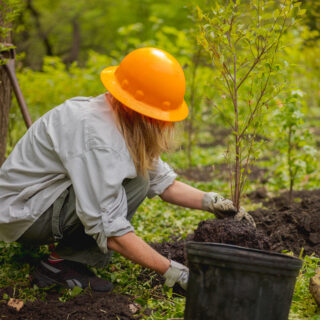
As the climate crisis accelerates, plants will play a central role in climate adaptation and mitigation efforts, offering nature-based solutions that enhance resilience at multiple scales. NYBG is researching and applying nature-based solutions, such as the Nurturing Nature Initiative, Welikia Map Explorer, and other climate-related projects, to support this initiative. We’re working to harness the power of plants through habitat restoration, sustainable land management practices, and urban greening efforts. Our Flagship Project in this initiative is Nurturing Nature Through Plant-Based Solutions for Long-term Climate Resilience. This project addresses urgent global environmental challenges—climate change, biodiversity loss, and ecosystem degradation—by activating plant-forward solutions rooted in science, community, and collaboration for the establishment of long-term solutions.
On Earth Day in April, the Urban Conservation team launched the newly redesigned Welikia Map Explorer, a historical ecology mapping tool that reveals what the landscape, plants, animals, and people might have been like on your block in New York City, 400 years ago. The Welikia Project aims to illuminate the rich ecological history that underwrites the development of New York City, drawing awareness to how drastically our own neighborhoods have changed over time, and provides alternative futures that are rooted in our natural history.
During Climate Week NYC in September, we brought together community and experts to discuss the Nurturing Nature Initiative and nature-based solutions involving plants. We welcomed guests for our annual lecture, including Keynote Speaker Carlos Nobre, Earth System Scientist at the Institute for Advanced Studies, University of São Paulo, who discussed tipping points in the Amazon. His keynote was followed by a panel of distinguished scientists and practitioners, who discussed putting nature-based solutions into action. We also had our very first NYBG 5k Fun Run, which directly supported our work to protect biodiversity and develop plant-based solutions to climate change.
In November, a delegation from NYBG attended the UN Climate Change Conference (COP30) in Belem, Brazil, to share how botanical gardens are driving climate and biodiversity solutions. Our delegates spoke about the Garden’s three cross-cutting initiatives and the important role botanical gardens can play in scaling plant-based solutions.
Food Plants: A Global Conservation Priority
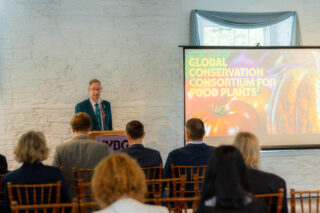
Food plant diversity is essential to food security, human health and nutrition, and culture, and is critical to agricultural sustainability. With the world facing an unprecedented loss of biodiversity accelerated by the climate crisis, we launched a new global collaboration in September, called the Global Conservation Consortium for Food Plants, to create a sustainable, coordinated global effort to enhance our food security and protect the planet’s edible biodiversity for future generations. NYBG will act as the Secretariat of the GCCFP for the first five-year term, in collaboration with the other institutions originally involved. It will serve as the central coordinator globally, bolstering links between genebanks, botanical gardens, and research organizations, as well as raising awareness of their importance. NYBG was proud to launch this global initiative during Climate Week NYC, followed by launches in Rome and in Peru as part of the 11th Session of the Governing Body of the International Plant Treaty on Plant Genetic Resources for Food and Agriculture.
Artificial Intelligence: Unlocking the Power of Plants and Fungi
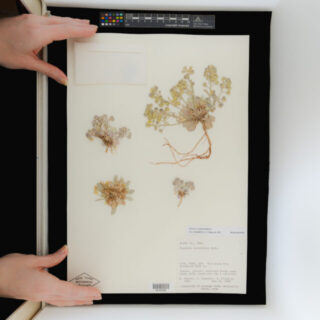
Artificial intelligence is revolutionizing botanical research, offering unprecedented tools to explore, conserve, and utilize plant and fungal diversity. NYBG is actively integrating responsible AI into its research infrastructure and scientific endeavors, enhancing and accelerating work on species identification, climate mitigation, biodiversity conservation, remote sensing, land-use planning, and collections-based discovery.
NYBG is honored to be among the 15 global recipients of Phase II of the Bezos Earth Fund’s AI for Climate and Nature Grand Challenge. Our team at NYBG has been awarded a grant to harness the power of cutting-edge AI to unlock the vast, underutilized data in herbarium collections. Herbaria are scientific collections of plant specimens that contain data about species’ distributions, traits, and environmental responses that are critical for conservation, restoration, ecology, and foundational biology. Using AI, we are building scalable, open-access tools that can transform biodiversity science and conservation planning by unlocking the extraordinary amount of data contained in herbaria and other biodiversity collections worldwide.
Additional Scientific Accomplishments This Year
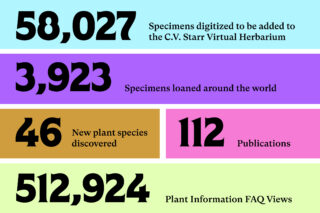
Underpinning NYBG’s work across research and conservation is its continual dedication to botanical discovery and knowledge. In 2025, NYBG Scientists discovered 46 new species and contributed to 112 new publications. We digitized 58,027 specimens to be added to the C.V. Starr Virtual Herbarium and sent 3,923 specimens in loans to herbaria around the world. Our Plant Information Hotline continued to serve as a resource for plant-related questions, with over 500,000 visits to our Plant Information FAQ webpage.
One major publication in 2025 is the two-volume book Plants, People, and Culture in Tafea Province, Vanuatu. This publication is the result of over a decade of scientific research led by Dr. Gregory Plunkett, Senior Curator, Center for Plants, People, and Culture, NYBG; and Dr. Michael Balick, Vice President for Botanical Science, Director and Philecology Curator, Institute of Economic Botany, NYBG, in close collaboration with local communities, the Vanuatu Ministry of Forests, and the Vanuatu National Cultural Council. The book launched as part of New York City’s Climate Week and the UN General Assembly, with senior representatives from the Vanuatu Ministry of Environment and the Ministry of Foreign Affairs, and featured a dual launch in Vanuatu. During the events, the Government of Vanuatu expressed its gratitude to NYBG for the longstanding and fruitful partnership.
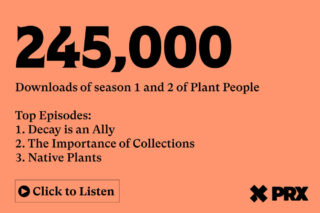
NYBG’s Plant People podcast, which launched just last year, carried out a strong second season with guests ranging from acclaimed author and poet Camille Dungy, to Dr. Jacob Suissa and Dr. Ben Goulet-Scott, founders of Let’s Botanize. We rounded out the year with a 2025 Gold Signal Award in Sustainability and Environment, following last year’s 2024 Silver Award in Best New Podcast. Be on the lookout for Season 3, dropping this winter.
At the core of NYBG’s scientific mission are three interconnected pillars: Exploring Biodiversity, Conserving Nature and Knowledge, and Engaging Audiences. NYBG scientists conduct extensive fieldwork and cutting-edge research, from molecular analyses to ecosystem studies, to document plant and fungal diversity, reconstruct evolutionary histories, and develop innovative scientific tools. Through science-based conservation and land management, we work to protect endangered species, restore ecosystems, and preserve traditional ecological knowledge, ensuring a sustainable future. Additionally, by fostering partnerships, engaging local and global communities, scaling our impact and reach, and promoting scientific literacy, NYBG empowers individuals and institutions to become advocates for biodiversity and environmental sustainability.
We are proud of all that we accomplished in 2025 and look forward to advancing these efforts and more in 2026.
SUBSCRIBE
Enter your email address to subscribe to this blog and receive updates on new posts.