Feed on
Posts
Comments

Gardening Is For the Birds
Sonia Uyterhoeven is Gardener for Public Education at The New York Botanical Garden.
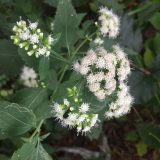
ConeflowersThe other day I watched gold finches fight each other for a chance to sit on the ripe seeds heads of my cone flowers (Echinacea). Once they get a foothold, they perch precariously on the spiky seed heads and feast.

With most of my perennials, I am constantly deadheading to encourage more bloom. Echinacea, because of its ability to attract the birds is an exception. The magenta flowers always bring a smile to my face. One of my favorite cone flowers is a cultivar called ‘Rubinstern’, sometimes touted as ‘Ruby Star’. It possesses a vibrant shade of magenta that flowers dependably and continuously from late summer into early autumn in my garden.

My favorite fragrant coneflower is a pure white cultivar called ‘Fragrant Angel’. On a sunny day the fragrance is delicious. Recently, I was swept off my feet by a successful looking orange flower cultivar named ‘Sundown’ or ‘Evan Saul’. I was impressed by its sturdy stems and a beautiful flower – a brilliant rust colored cone and iridescent flowers of orange streaked with yellow.

Regardless of your predilection, a good coneflower is not hard to find and it will certainly please the birds if you leave the seed heads on to ripen. Just tug off the ray flowers once they fade and start to turn brown and leave the cone intact.

Fall Brings an Array of Migrants

Debbie Becker leads a free bird walk at the Garden every Saturday from 11 a.m. to 12:30 p.m., beginning at the Reflecting Pool in the Leon Levy Visitor Center.

Red Tailed HawkAutumn is that miraculous time of year when the leaves on the trees turn glorious colors. It is also time for the great fall migration. From August through November, thousands of birds leave their northern breeding grounds and return to their southern homes. As they pass through NYBG they stop and eat the luscious crab apples, berries, and nuts emerging from trees, bushes, and shrubs. It is a unique time of year to see tanagers, orioles, grosbeaks, and warblers in different stages of maturity as they move through the area.

Also migrating are raptors. Red-tailed hawks, red-shouldered hawks, kestrels, Cooper’s hawks, and sharp-shinned hawks are just some of the accipiters and buteos that glide on the thermals over Daffodil Hill. More than 5,000 broad-winged hawks have been spotted in one afternoon at NYBG. Bald eagles and golden eagles fly lazily over the Bronx River searching for a meal. Osprey circle above as they, too, fish the Bronx River.

White-throated SparrowOn Twin Lakes, the wood ducks and mallards emerge from their state of eclipse and reclaim the lakes in full-colored feathers again. Joining them are autumn migrants: gadwalls, green-winged and blue-winged teals, northern shovelers, hooded and common mergansers, buffleheads grebes, coots, and many surprise visitors.

During October, the Garden plays host to a wide variety of sparrows: tree, field, savannah, song, swamp, fox, chipping, white-crowned, white-throated, and more. November brings the grackles and the blackbirds migrating in the thousands. Large flocks will sweep over NYBG and literally turn the trees black when they perch, all the while cackling loudly.

As autumn comes to an end during the middle of December, our great-horned owls begin to stir. Their breeding season will be just beginning as they emerge from the forest ready to entertain us with mating calls and rituals.

Autumn at NYBG is an exciting season. Come join us on a fall bird walk. You never know what or “hooo” you will see.

Karen Daubmann is Director of Exhibitions and Seasonal Displays.

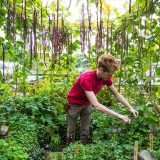
Kawana Sculpture DesignLast year, as one of my first projects as an employee of the Garden, I had the pleasure of working with artist Tetsunori Kawana as he and a crew of staff and volunteers (see photo below) assembled a bamboo sculpture for Kiku: The Art of the Japanese Chrysanthemum. The exhibition focuses on luscious displays of chrysanthemums but uses bamboo, maples, and other Japanese plants to showcase how important plants are to the Japanese, especially in autumn.

The towering sculpture provided a magnificent accent to last year’s Kiku display in the Enid A. Haupt Conservatory Courtyards. If you saw the sculpture, I’m sure you’ll agree with me that it was very cool and like nothing you’d seen before. Though it was untitled, I’d compare it to a bamboo volcano, a wide base narrowing at the top but giving way to an explosion of bamboo strands that danced through the air, rugged and powerful but graceful at the same time.
This year, Kawana-san is back with a bigger and even cooler project. He has designed what he calls a “cloud forest,” which visitors can walk through to experience it from within, immersing themselves in his work.
Bamboo Sculpture InstallationOn Monday, 350 pieces of 30-foot timber bamboo (Phyllostachys bambusoides) arrived here from Georgia. As the truck was unloaded, the excitement for the project began to build. The bamboo will be used in many ways—cut into sections to form triangles of support, split into segments and woven to create “clouds,” and used full length to create the “forest.”

Unless you’re a volunteer working on this project, you’ll have to wait until the show opens for the sculpture’s unveiling. However, if you’re willing to spend some time sawing, splitting, and wiring bamboo together and you are available October 2–11, please contact the volunteer office at volunteer@nybg.org or 718-817-8564.

Believe me, it is a treat to work alongside Tetsunori Kawana.

Rustin Dwyer is Visual Media Production Specialist at The New York Botanical Garden.


Apple Tasting at the Farmers Market from The New York Botanical Garden on Vimeo.

Chef Paul Yeaple, the Community Markets site manager for the Farmers Market held at The New York Botanical Garden, talks about some of the differences between the locally grown apples available for purchase.

Nick Leshi is Associate Director of Public Relations and Electronic Media.

Imagine my surprise this summer when I received a handwritten postcard from Academy Award-winning actress Joan Fontaine.

The story began in June when I received a phone call from a visitor to The New York Botanical Garden who was delighted to discover in the Peggy Rockefeller Rose Garden a white modern rose named after a friend. That friend happened to be Joan Fontaine, best known for her roles in the Alfred Hitchcock thrillers Rebecca (1940) and Suspicion (1941), for which she won an Oscar. Ms. Fontaine also appeared in many other film classics from Hollywood’s golden age, including Gunga Din (1939), The Women (1939), Jane Eyre (1944), and Ivanhoe (1952).

I sent an image of the Joan Fontaine rose to the caller and was delighted to learn that she forwarded the photo to the legendary actress. Needless to say, Ms. Fontaine’s resulting note of appreciation made my day.

The episode inspired me to think of other roses named after celebrities. To paraphrase Peter Kukielski, Curator of the Peggy Rockefeller Rose Garden, walking through the Beatrix Farrand-designed beds is like stumbling upon a tea party of the famous. The soft apricot flowers of the ‘Marilyn Monroe‘ rose are near the deep pink blooms of another hybrid tea named after Elizabeth Taylor. Also nearby is the ‘Julia Child’ floribunda, the 2006 All-America Rose Selections winner, with its buttergold petals and licorice candy fragrance. Watching over them all with its double pink flowers is the hardy grandiflora ‘Queen Elizabeth.’

Other roses are named after artists such as ‘Rembrandt‘ Portland or the floribunda ‘Henri Matisse‘ or the standard rose ‘Auguste Renoir‘ or the ‘Audubon‘ shrub. Wolfgang Amadeus Mozart has at least two roses with his moniker, the Hybrid Musk ‘Mozart‘ and the climber ‘Amadeus.’ Famed scientists also have their rose doppelgangers, including Charles Darwin and Madame Marie Curie. And still other roses honor Amelia Earhart, George Burns, and Johann Strauss. Famous names pop out from the world of fiction as well, such as ‘Othello,’ ‘Falstaff,’ and ‘Betty Boop.’

The Peggy Rockefeller Rose Garden is a delightful destination full of surprises, with wonderful color and fragrance right up until the first frost of the season.


Autumn in the Peggy Rockefeller Rose Garden from The New York Botanical Garden on Vimeo.

Divide and Conquer
Sonia Uyterhoeven is Gardener for Public Education at The New York Botanical Garden.
New England AsterFrom time to time, some of your perennials will start to languish. It’s not the heat or a lack of moisture that is the cause. Sometimes they just outgrow their space, start to sprawl all over the place, and slowly die out in the middle. When this happens, it is time to divide your perennials.

The general rule of thumb is to divide spring flowering perennials either immediately after flowering or in the fall, and to divide fall flowering perennials in the spring.

When you dig up the perennial be generous with the size of the root ball so that you get a good amount of roots. Garden forks often work better than spades since they do not slice through the roots.

If you are dividing in the fall, cut back the foliage to six inches—this will make it easier to see what you are doing and will help redirect the energy of the plant back into root growth. Water the perennial a day or two before you divide it to make digging easier and to make sure the plant won’t be stressed. Make your divisions large enough: A minimum of a quart-size pot is a good standard size.

Divide clumping plants such as astilbe (Astilbe), hosta (Hosta), ornamental grasses, or daylilies (Hemerocallis), with the double fork method or by slicing through them with a spade. For spreading plants such as lamb’s ears (Stachys), asters (Aster), and bee balm (Monarda), pull them apart by hand or sever with a knife or spade.

Indian Summer at the Howell Family Garden
Annie Novak is coordinator of the Children’s Gardening Program.
WigwamTwo years ago, two men named Eric built a second home. It wasn’t a vacation spot nor was it particularly accommodating for men of their height. At first, the only inhabitants were chipmunks, squirrels, and the occasional investigatory rabbit.

Soon, however, the house was full of noise. Children busily explored the low dome of the interior and peered out the window into the neighboring garden. So it was that in 2006, the wigwam that Eric Wright and Eric Sanderson built became the latest structural addition to the Ruth Rea Howell Family Garden.

Although it’s the first wigwam in The New York Botanical Garden, it is by no means the first to grace the cliffs along the Bronx River’s shore. As Sanderson is quick to explain, for the 5,000 years before New York City’s skyline dominated the Hudson, Native Americans lived along the river system. Known as the Lenape, they inhabited the large area they called Leanapehoking all throughout New York and New Jersey, as far as the Delaware Water Gap.

Learn more about the wigwam in the Family Garden after the jump.

Check out Saturday’s programming

Check out Sunday’s programming

Continue Reading »

Rustin Dwyer is Visual Media Production Specialist at The New York Botanical Garden.


Enid A. Haupt Conservatory Whitewash Removal from The New York Botanical Garden on Vimeo.

John Suskewich is Book Manager for Shop in the Garden.
The Heirloom TomatoNYBG’s Farmers Market, which rolls in here every Wednesday through summer and fall, is a feast and a fanfare of fresh fruits and veggies. As beautiful as jewelry but full of thiamin and riboflavin, the produce glistens when the tents are first unfurled, and this year the tomatoes—Black Cherry, Sungold, Brandywine, Bicolor—seemed to glimmer like a Tiffany’s window of semiprecious stones.

Ah the tomato! This, the cynosure of the Solanaceae, is sweetly celebrated in an excellent new publication, The Heirloom Tomato, by our board member and chair of Seed Savers Exchange, Amy Goldman. The book is all about selecting, growing, and eating tomatoes, but the heart of the volume is a 150-page gallery of the fruit, a museum of Lycopersicon, with photographs by Victor Schrager, who turns even homely “Radiator Charlie’s Mortgage Lifter” into a Vermeer. The descriptions by Dr. Goldman include specs for each variety on size, weight, shape, color, and texture, and her interpretative material includes archival research and nuggets of oral history that illuminate our lost rural history as evocatively as a tintype.

The Heirloom Tomato is a book for anyone who loves gardening, plants, food, tomatoes, art and/or language. It is the third volume in the Goldman/Schrager collaboration. They created a template with two works on cucurbits: Melons for the Passionate Grower and The Compleat Squash, and they have now brought it to such a state of perfection I wouldn’t be surprised if they next turned their attention to okra, or maybe kohlrabi.

A selection of images from the book is on display in the Botanical Garden’s Arthur and Janet Ross Gallery in The Heirloom Tomato: An Exhibition of Photographs by Victor Schrager—Portraits of Historic Tomato Varieties from the Gardens of Amy Goldman.

Written by Kate Murphy, a junior at Fordham University, with additional reporting by Genna Federico, a senior at St. John’s University. Both interned in the Communications Dept. this summer.

Mark and Jac in New OrleansThe recent devastation caused by hurricanes Gustav and Ike brought back memories of the catastrophe wrought by Katrina. But that hurricane, which hit Louisiana in 2005, was already on the mind of Mark Cupkovic, Associate VP for Operations at NYBG, who spent his summer vacation working with Habitat for Humanity helping to rebuild homes in New Orleans.

Mark learned about the opportunity through an international humanitarian organization, International Orthodox Christian Charities, which has been working with Habitat for Humanity on a 23-week program in New Orleans. Mark, trained as a carpenter, jumped at the chance to participate in this effort along with his son, Jac.

Mark and Jac met the rest of their team and team leader at the airport. After a good night’s rest, they spent their first full day of the trip getting acquainted with New Orleans and seeing where the city stands today, three years after the disaster.

The team first visited the areas that were hardest hit, such as the northeast section of the city and the lower ninth ward. They also viewed the levees, most of which broke during the hurricane, causing the flooding. Musicians’ Village, an area reconstructed by Habitat for Humanity in hopes of bringing musicians back to the area, served as a positive example of reconstruction and rebuilding.

Mark and Jac spent the next five days working in an area with six houses under construction, all in different stages of completion. They also encountered temperatures in the 90s every day, with about 97 percent humidity on top of that! Everyone received a tool belt and went to work. Mark, with 25 years of experience, took a leadership role, looking at the house plans and organizing work flow. People of all different experience levels volunteered, each finding a way to contribute. They even were fortunate to work alongside the family that will be living in one of the houses. Mark said the family was extremely thankful for all of the volunteers’ help.

Mark stressed that the sum total of the group is much greater than anything someone could do alone. Slowly but surely, the group saw their progress grow before their eyes—the house was being built. And while Mark says the experience left an impact on him, he says the change in Jac is incredible. They both hope to return to New Orleans someday.

Older Posts »